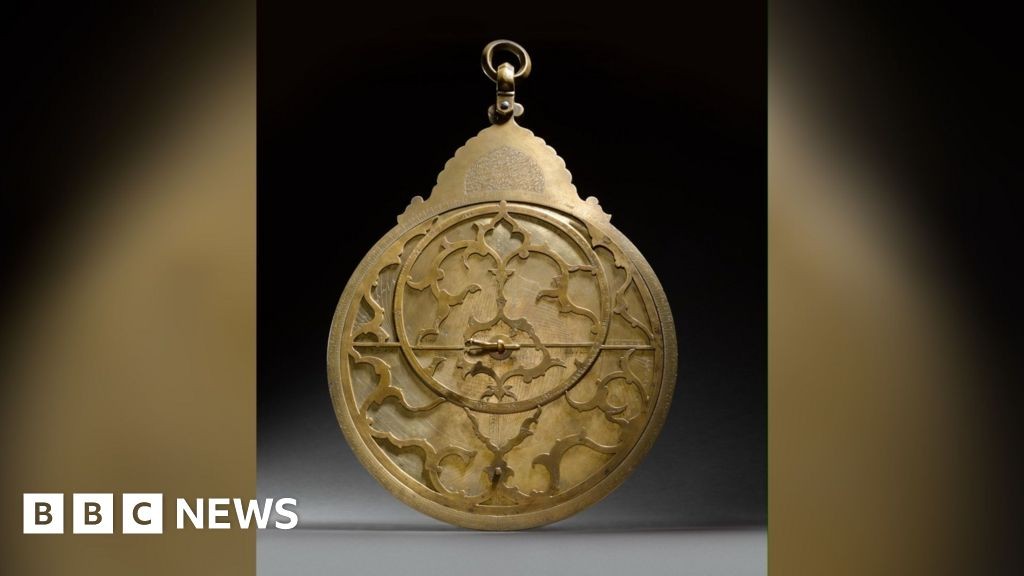
A rare and monumental piece of scientific history is set to enter the public market. Sotheby’s London has announced that a massive, 17th-century brass astrolabe—once a prized possession of the Jaipur royal family—will be auctioned on April 29.
Estimated to fetch between £1.5 million and £2.5 million, this instrument is not merely a relic; it is a masterpiece of precision engineering that served as the “high-tech” device of its era.
The 17th-Century “Smartphone”
To a modern observer, an astrolabe may look like a simple decorative disk. However, in the 17th century, it functioned much like a modern smartphone. By using its multi-layered, interlocking components, users could perform a vast array of complex calculations.
According to Dr. Federica Gigante of the Oxford Centre for History of Science, Medicine and Technology, these devices allowed users to:
– Determine the time of sunrise and sunset.
– Calculate the height of buildings or the depth of wells.
– Measure distances.
– Map the stars and determine the direction of Mecca.
– Predict celestial movements and even cast horoscopes when used alongside an almanac.
Essentially, the astrolabe acted as a two-dimensional projection of a three-dimensional universe, condensing vast astronomical data into a portable, handheld tool.
A Masterpiece of the “Lahore School”
This specific instrument is extraordinary due to its scale and origin. Crafted in the early 17th century in Lahore (modern-day Pakistan), it was produced by the renowned brothers Qa’im Muhammad and Muhammad Muqim. They were leading figures of the “Lahore School,” a prestigious center of craftsmanship where technical precision and artistic elegance were seamlessly integrated.
While most astrolabes of this period were functional tools, this piece represents the pinnacle of Mughal-era science and art:
– Unprecedented Scale: Weighing 8.2kg and standing 46cm tall, it is nearly four times the size of a typical Indian astrolabe from this period.
– Extreme Precision: The device features degree divisions subdivided down to a third of a degree, allowing for incredibly accurate celestial measurements.
– Intricate Detail: The brass disk is inscribed with 94 cities, each marked with precise longitude and latitude, and features 38 star pointers decorated with delicate floral patterns.
Royal Provenance and Historical Context
The instrument’s journey through history adds to its allure. It was originally commissioned by Aqa Afzal, a high-ranking Mughal nobleman of Persian origin. Later, it became part of the royal collection of Maharaja Sawai Man Singh II of Jaipur. Following the Maharaja’s death, it passed to his wife, the iconic Maharani Gayatri Devi, before eventually moving into a private collection.
The existence of such an opulent and accurate device highlights the sophisticated scientific culture of the Mughal courts, where rulers actively patronized advancements in astronomy and astrology to better understand the heavens.
“It is not only big, beautiful and heavy, it is so incredibly accurate that it will give you the exact degree of altitude [of a celestial body],” notes Dr. Gigante.
Conclusion
This auction represents a rare opportunity to acquire a primary artifact of the history of science. Given its pristine condition, immense scale, and connection to the Jaipur royalty, the astrolabe is expected to be a centerpiece for major museums and elite collectors alike.