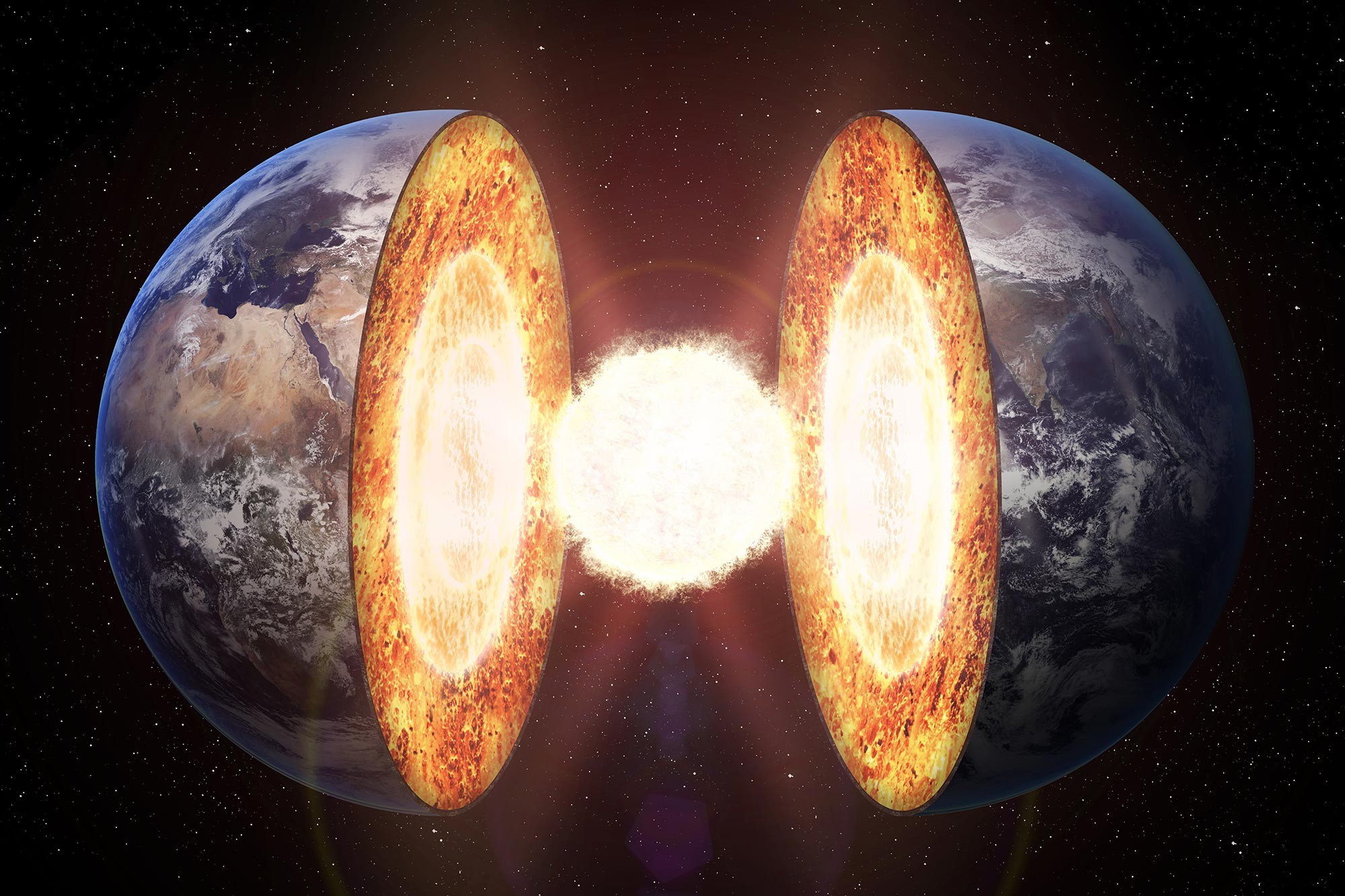
For decades, the standard model of our planet has been simple: a crust, a mantle, a liquid outer core, and a solid inner core. However, new seismic evidence suggests this model is incomplete. Researchers are uncovering signs of a hidden, distinct layer buried deep within the Earth’s center—a region being called the “innermost inner core.”
This discovery challenges our fundamental understanding of planetary evolution and suggests that the Earth’s heart is far more complex than a single, uniform sphere of iron and nickel.
Probing the Unreachable
Because the Earth’s core is located hundreds of kilometers beneath the surface, it is impossible to reach via drilling. Instead, scientists act as planetary detectives, using seismic waves generated by earthquakes to “scan” the interior.
These waves act like an ultrasound for the planet; they change speed and direction depending on the density and structure of the material they pass through. By analyzing these shifts, scientists can map out what lies beneath.
The Evidence: Changing Wave Patterns
The breakthrough came from a more sophisticated way of reading these seismic signals. Rather than using broad averages, researchers from The Australian National University (ANU) used advanced algorithms to look for subtle irregularities in how waves move.
They identified a significant change in behavior approximately 650 kilometers (400 miles) from the center of the Earth. The key evidence lies in a phenomenon known as anisotropy :
- Directional Speed: In the outer part of the inner core, seismic waves typically travel faster along Earth’s rotational axis than they do along the equator.
- The Central Shift: In this newly identified central zone, that pattern breaks. The slowest wave speeds occur at a specific angle (about 54 degrees) relative to the rotation axis.
- Crystal Alignment: This shift suggests that the iron crystals in this deep zone are aligned differently than those in the rest of the inner core.
A Window into Earth’s Violent Past
Why does a small, hidden layer matter? The structural difference suggests that the Earth’s core did not form or cool in one continuous, smooth process.
According to lead researcher Joanne Stephenson, these distinct zones may be “geological scars” from major historical events. The existence of a separate innermost layer could indicate:
1. Two separate cooling events: The core may have undergone distinct phases of solidification.
2. Dramatic planetary shifts: An unknown, massive event in Earth’s early history may have fundamentally altered the core’s composition or structure.
In 2023, independent research published in Nature Communications bolstered these findings. By studying rare seismic signals that bounce through the core multiple times, scientists confirmed the presence of this central region, providing a second, independent layer of proof.
Challenges and the Path Ahead
While the evidence is compelling, the map of Earth’s interior remains imperfect. The primary obstacle is data distribution. Earthquakes and seismic sensors are not evenly spread across the globe—particularly at the polar regions—leaving “blind spots” in our planetary scans.
As researchers work to fill these gaps, the discovery of the innermost inner core forces a reconsideration of how planets form and evolve.
“It’s very exciting—and might mean we have to re-write the textbooks!” — Joanne Stephenson, ANU Researcher
Conclusion: The discovery of a distinct innermost core suggests that Earth’s center is not a static relic, but a complex archive of the planet’s most violent and transformative historical eras.