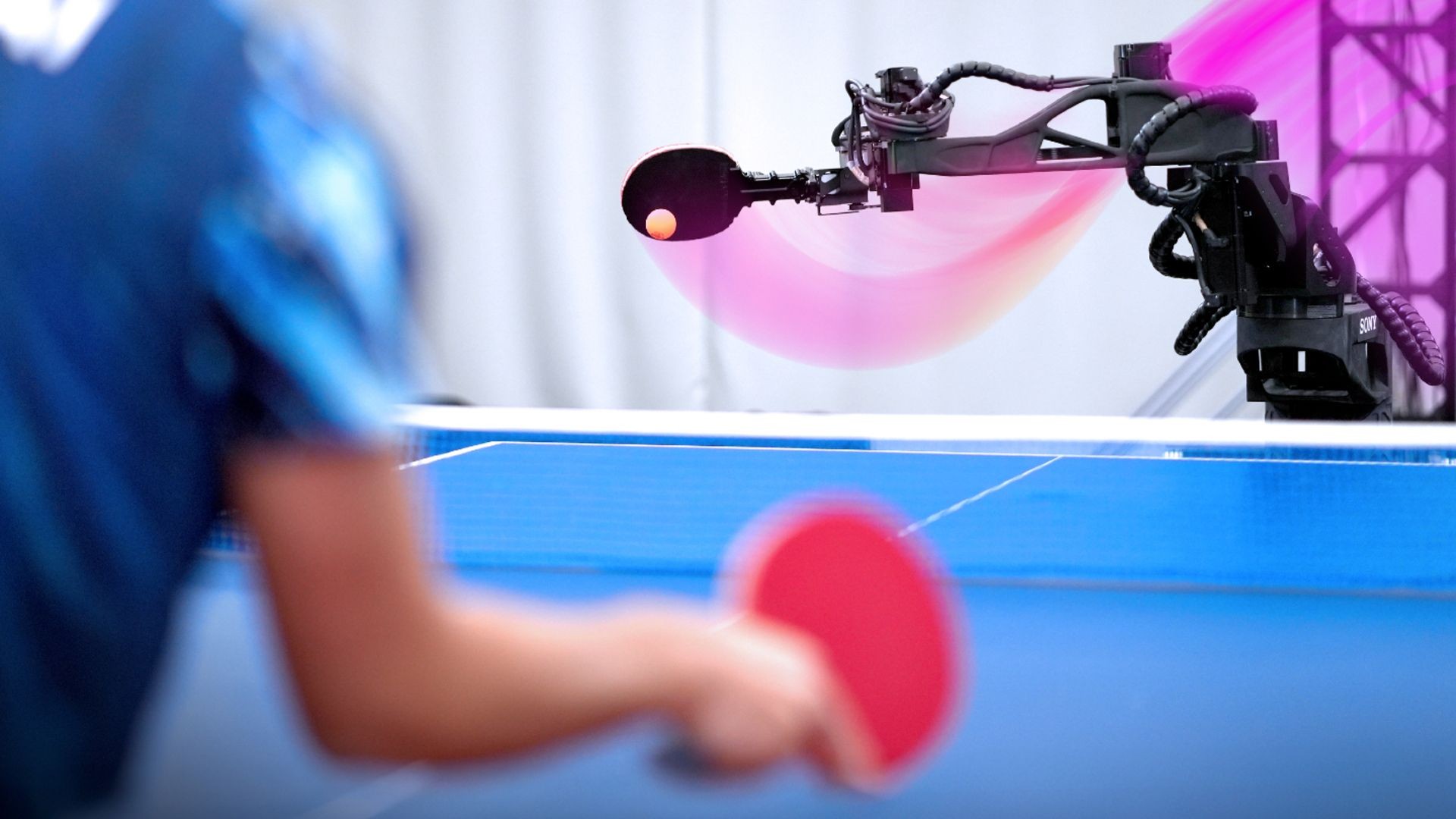
Sony AI has unveiled Ace, an autonomous robot capable of competing at an expert level in table tennis. While the feat is impressive for sports enthusiasts, the underlying technology represents a much larger milestone: the ability for artificial intelligence to move beyond digital screens and master the unpredictable, high-speed complexities of the physical world.
The Challenge of “Physical AI”
For years, AI has dominated strategic games like Chess and Go. However, there is a massive technical gap between winning a board game and moving a robotic limb in real-time. In digital environments, AI operates in a controlled space; in the physical world, it must contend with gravity, friction, and millisecond-level delays.
Table tennis is a uniquely difficult test for this technology because it requires:
– Extreme Precision: Tracking a small, fast-moving object in 3D space.
– Rapid Reflexes: Making split-second decisions based on visual input.
– Hardware-Software Synergy: Ensuring the robotic arm moves exactly as the “brain” dictates without lag.
How Ace Operates: Perception and Learning
The secret to Ace’s performance lies in its sophisticated sensory array and a unique approach to machine learning. Unlike traditional systems that rely on pre-programmed rules, Ace uses model-free reinforcement learning. This allows the robot to learn through direct interaction with its environment, adapting its behavior based on success and failure rather than following a rigid script.
To “see” the game, Ace utilizes a complex suite of hardware:
– Nine active pixel sensor cameras: These track the ball’s exact position in 3D space.
– Three gaze systems: Utilizing mirrors and event-based vision cameras, these systems measure the ball’s spin and angular velocity —critical data points for predicting where a ball will land.
– Proprietary robotic hardware: A specialized swiveling arm designed to translate AI decisions into high-speed physical movement.
From Learning to Winning: The Performance Gap Closes
The evolution of Ace’s skill level highlights the rapid pace of progress in robotics. Recent testing sessions demonstrate a clear upward trajectory in the robot’s capabilities:
Phase 1: Testing Against Elite Players
In early 2025, Ace faced five “elite” players (highly skilled amateurs with extensive training) and two professionals.
– Results: Ace won three out of five matches against the elite players and maintained a 75% serve return rate.
– Limitation: It lost both matches against the professional athletes.
Phase 2: Achieving Professional-Level Play
By December 2025, following further refinement, Ace showed significant tactical improvements. The robot began moving closer to the table, increasing its shot speed and engaging in faster-paced volleys.
– Results: In a series of matches, Ace defeated both elite players and one of the two professional players.
This rapid improvement is particularly notable when compared to previous industry benchmarks; for instance, Google DeepMind’s robotic table tennis project was defeated by elite players just two years prior.
Why This Matters
The success of Ace is not just about sports; it is a proof of concept for “Physical AI.” When an AI can perceive, reason, and act in a high-speed, chaotic environment like a table tennis match, it proves that robots can eventually handle much more complex real-world tasks.
“This breakthrough is much bigger than table tennis,” says Peter Stone, Chief Scientist at Sony AI. “It represents a landmark moment… showing that an AI system can perceive, reason, and act effectively in complex, rapidly changing real-world environments.”
As these systems move from the playing field to the real world, they pave the way for advancements in precision manufacturing, automated emergency response, and highly interactive human-robot collaborations.
Conclusion: Sony’s Ace demonstrates that AI is successfully transitioning from digital logic to physical mastery, signaling a new era where robots can navigate and react to the complexities of human environments with professional-grade precision.