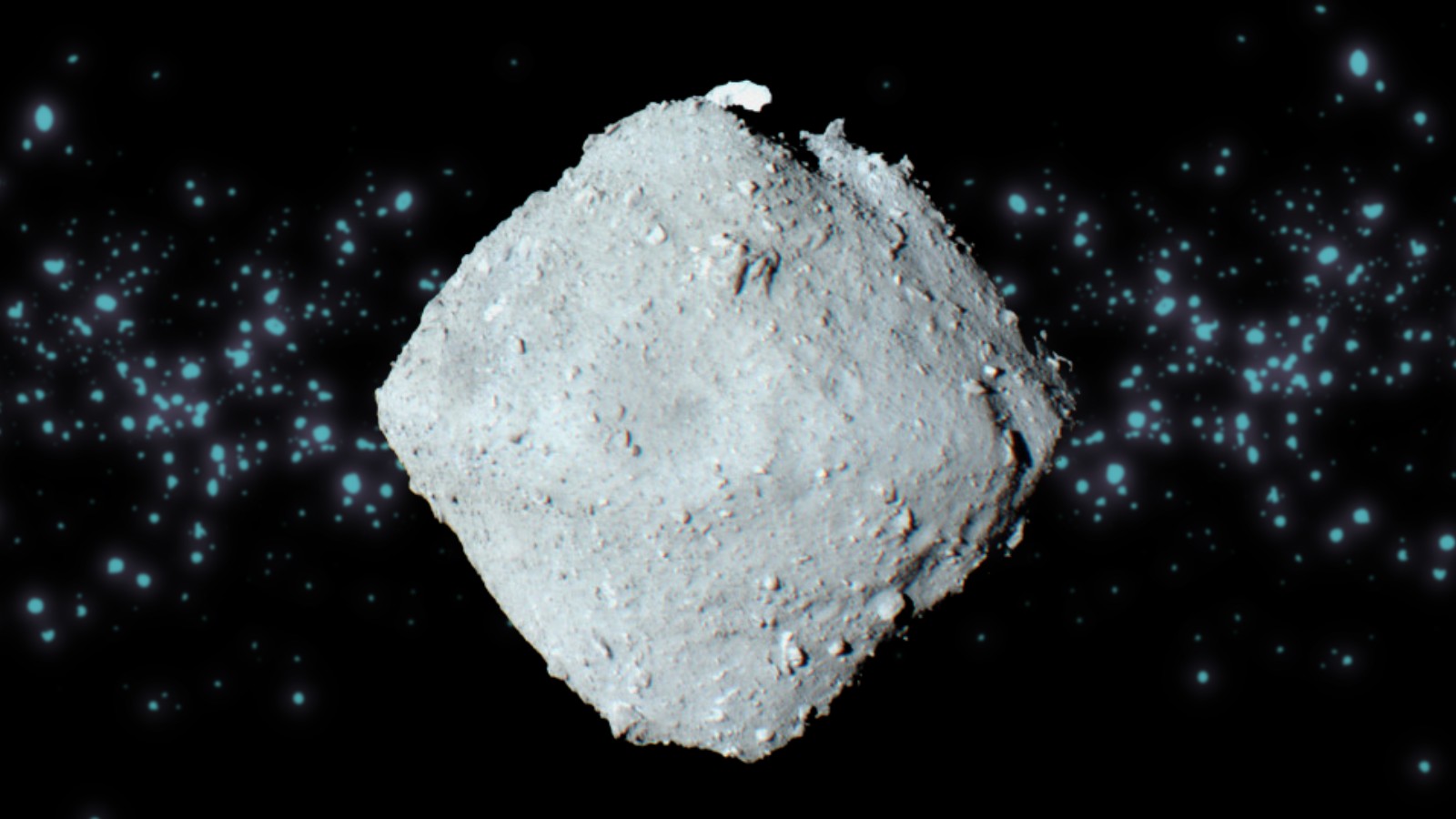
New analysis of samples returned by Japan’s Hayabusa2 mission has revealed that the asteroid Ryugu underwent a significant surface transformation much more recently than its 4.6-billion-year age would suggest. Researchers have discovered evidence that the asteroid was bombarded by a dense swarm of micrometeorites approximately 1,000 years ago.
The Sodium Mystery
The breakthrough came from examining the chemical composition of Ryugu’s surface fragments. Scientists detected a microscopic layer of sodium —only 10 nanometers thick—coating the particles.
Under normal circumstances, finding sodium on an asteroid’s surface is a scientific anomaly. Sodium is a “volatile” element, meaning it is easily lost to the vacuum of space. Typically, solar winds strip these elements away, leaving the surface depleted. The presence of this sodium layer acted as a chemical “timer” for researchers.
“Based on these data, we considered a maximum time window of a thousand years, beyond which the sodium should have been completely released, making it impossible to observe any accumulation,” explained lead researcher Ernesto Palomba of the Italian National Institute for Astrophysics (INAF).
Evidence of Impact
To confirm the theory of a recent bombardment, the research team looked beyond just chemical traces. They identified physical “scars” on the asteroid fragments, including:
– Glassy formations: Small areas of melted material caused by high-velocity impacts.
– Micro-craters: Tiny impact sites left by micrometeorites.
– Lattice-like microstructures: Patterns created by the continuous interaction between the asteroid and solar winds.
The team also noted an enrichment of iron on the surface. This suggests that while the material protected deep underground remains relatively unchanged, the surface layer has been aggressively altered by constant micro-impacts and solar radiation.
Why This Matters: Space Weather and Planetary Evolution
This discovery provides a rare window into the “weather” of deep space. While we often think of asteroids as static, ancient rocks, they are actually dynamic objects constantly being reshaped by their environment.
This phenomenon highlights a fundamental difference between Earth and airless celestial bodies:
– On Earth: Our atmosphere acts as a shield, burning up micrometeoroids and creating meteor showers like the Perseids.
– On Asteroids: Without an atmosphere, these tiny impacts strike the surface directly, fundamentally changing the chemical and physical makeup of the object.
Understanding these processes is crucial for scientists studying the evolution of the solar system and the composition of near-Earth objects that could potentially pose risks to our planet.
Looking Ahead
The INAF research team now intends to conduct laboratory experiments to replicate these chemical changes. By attempting to recreate the specific surface chemistry observed in the Ryugu samples, they hope to better understand how cosmic dust and solar winds reshape the surfaces of worlds across our solar system.
Conclusion
The discovery proves that even ancient asteroids are subject to sudden, transformative events. By analyzing microscopic chemical traces, scientists can now reconstruct the recent history of celestial bodies, revealing a much more active and violent space environment than previously understood.