It looks weird.
Maybe too weird.
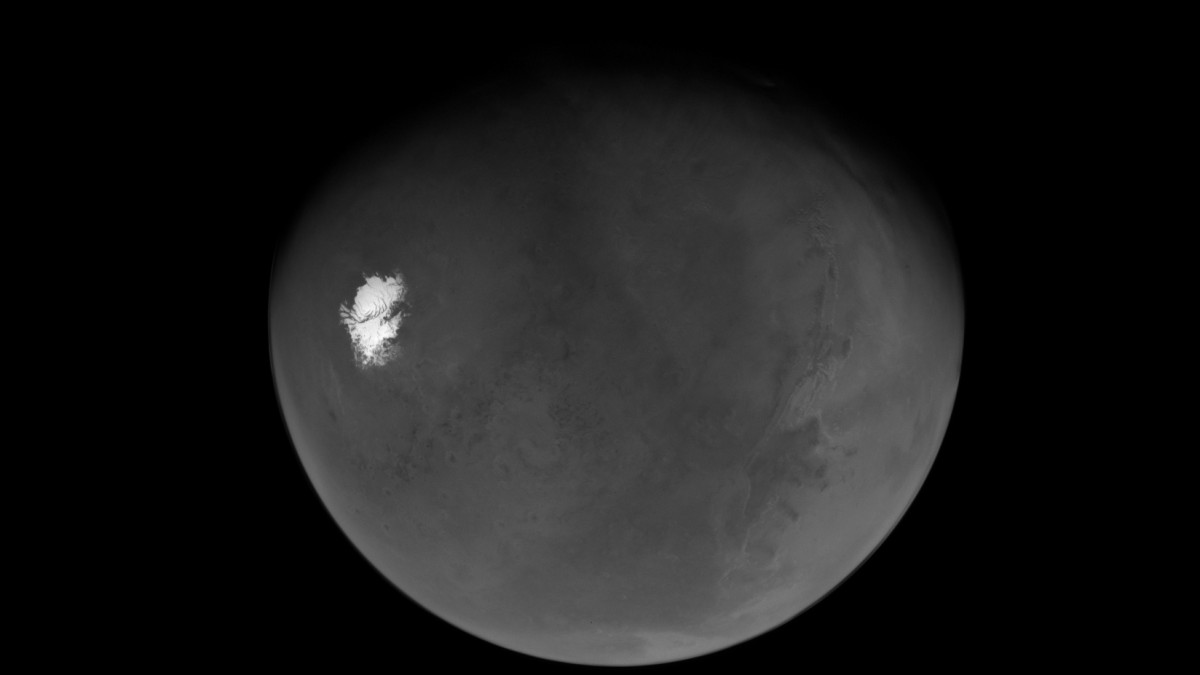
If you look at the new shots from NASA’s Psyche mission, you might think Mars is growing an extra eye. Or a cloud stuck sideways to its face. That bright white patch? It’s not a storm. It’s the south pole. Just sitting there off-center, because the spacecraft arrived at an awkward angle.
On May 15, Psyche swung close to the Red Planet for a gravity assist. It needed a push. The maneuver added about 1,000 miles per hour to its speed. Changed its course, too. Heading for an asteroid. But it left us with something unexpected.
The clearest picture we’ve ever had of the southern polar cap.
The ice stretches 430 miles. The resolution? Better than a half-mile per pixel.
“This new data won’t settle the decade-old debate,” Gareth Morgan said recently, “but it makes it very hard to support a liquid lake.”
Ah. The lake thing.
In 2018, everyone got excited. ESA’s Mars Express orbiter suggested liquid water lurked under a mile of ice. Liquid water equals life. Or at least, it equals hope. The headlines exploded. But then the data got messy.
Newer radar from NASA’s Reconnaissance Orbiter showed weaker signals. The “liquid” might just be wet mud. Or smooth rock. Maybe ancient lava.
Doesn’t matter who was right yesterday.
The new Psyche images just complicate things. The south pole isn’t just ice. It’s layers. Frozen carbon dioxide. Dust. A geological archive stacked up over billions of years like a history book written in frost.
Psyche didn’t come for Mars. Not really.
The spacecraft flew within 2,800 miles of the surface mostly to calibrate its cameras. A test run for the asteroid named after itself.
That asteroid—Psyche—is weird. Think metal. Exposed core of a dead planet. It sits between Mars and Jupiter. Robotic visitors are rare there.
So we look back.
The engineers will keep taking pictures for a while longer as Mars fades in the distance.
Why rush?
The real target is still three years away.