Climate change is messing with the conveyor belt that regulates global weather. And now, it’s turning up the pressure on the California coast.
Scientists say a major Atlantic ocean current, known as the AMOC (Atlantic Meridional Overturning Circination), is on the brink of collapse. When that system slows down or shuts off entirely, the fallout isn’t limited to Europe. The ripples reach across the Pacific, threatening extreme storms and volatile water supplies in the US.
The Stalling Conveyor Belt
The AMOC moves warm surface water north toward Europe. There, the water cools, becomes dense, and sinks, flowing back south along the deep seafloor. It’s a planetary engine. But human-induced climate change is overheating the atmosphere and melting polar ice, adding freshwater to the mix. This fresh water is less dense, acting like a cork in the sink and preventing the deepwater from sinking. The result is a slowing current.
“It turns out a weakening AMOC will… along the California coast in particular,” lead researcher Mohima Mimi says, “strengthen storms… while reducing them over Greenland.”
A team of researchers, led by Mimi from the University of California, Riverside (UCR), published new findings in Nature Communications that quantify exactly what that stalling means for atmospheric moisture and storm patterns far from the Atlantic. They didn’t just guess. They used decades of NASA atmospheric data combined with climate simulations to project the AMOC’s evolution through the end of the century.
Why Atmospheric Rivers Matter More
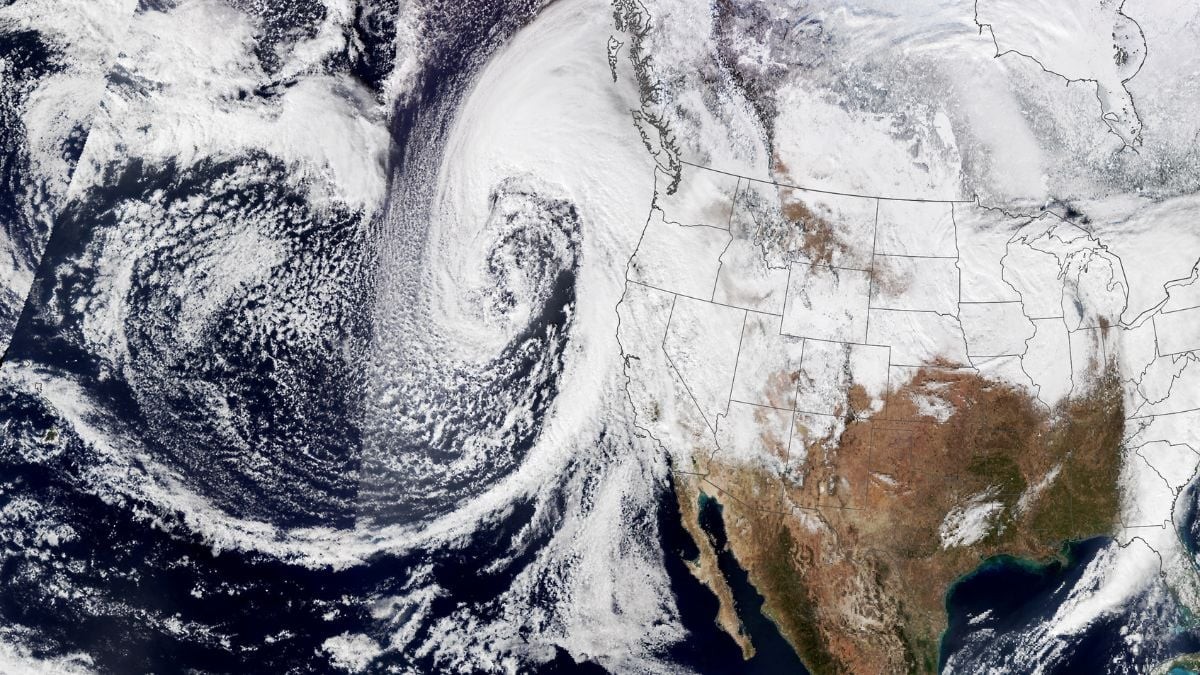
To understand the danger to California, you have to look at atmospheric rivers (ARs).
These are long, narrow corridors in the sky packed with concentrated water vapor. They are not gentle rain clouds. One strong AR can carry 15 times more water than flows out of the Mississippi River.
For years, ARs have been seen as both saviors and destroyers in California.
- The Life-Giver: ARs deliver up to 50% of the annual rainfall in the western U.S. They are the primary engine of the state’s water supply, recharging reservoirs and snowpack.
- The Destroyer: When those same rivers of moisture become too intense, they cause catastrophic flooding. They hit during droughts too, washing out soil and contaminating water systems. They destroy homes, damage infrastructure, and threaten lives.
Mimi explains the paradox: ARs supply the water California desperately needs but possess the destructive power to wipe it all away.
The Shifting Belt of Rain
So, how does a slow Atlantic ocean current change the weather in San Diego?
As the AMOC weakens, it alters global ocean temperatures and shifts moisture distribution. The Northern Hemisphere generally loses atmospheric moisture, while the Southern Hemisphere gains it. But the effect is highly regional.
The study predicts the greatest increases in AR frequency along North America’s west coast. That stretch, running from Baja California to Alaska, faces more intense, more frequent deluges. Conversely, regions like the Arctic, Greenland, northern Asia, northern Australia, and the South Pacific will see fewer of these moisture highways.
Globally, the average frequency of ARs may jump by 50%.
But location dictates whether that increase is welcome or deadly. For the rest of the planet, the changes are just as distinct:
- West Coast U.S.: Increased ARs mean bigger floods but potentially more capture opportunity if infrastructure adapts.
- South America: ARs increase along the east coast.
- Western Europe & Southern Asia: More frequent moisture transport.
- Antarctica: ARs drive 40–80% of summer meltwater on West Antarctic ice shelves. More ARs means faster ice loss and accelerated global sea-level rise.
- Northern Hemisphere Poles: Interestingly, the study notes a reduction in ARs over Greenland and parts of the Arctic, leading to cooler surface air temps.
The Industrial Reality
Is this destiny?
Not yet. It depends on industrial inertia. Every ton of CO2 trapped by burning fossil fuels pushes the AMOC further toward instability. The carbon we release locks deep earth resources from millions of years ago into the atmosphere right now.
If emissions plateau, the trajectory shifts. But we are not off the hook. Recent reports suggest we might avoid the worst case scenarios, but that does not mean a comfortable one.
Preparation Over Panic
The study serves as a grim reminder: our planet is one tangled system. A change in Atlantic currents drives storms in California and intensifies Amazonian rains.
Mimi’s conclusion underscores the pragmatic need for adaptation.
“This research shows that the effects of the effects of the AMOC exted far beyond the Atlantic,” Mimi says.
Understanding these links helps us prepare. Can California capture more of these intense bursts by restoring wetlands and natural landscapes to buffer the blow? Probably. Does the window for doing so without catastrophic impact close every year we delay? Absolutely.
The ocean current is slowing. The rivers in the sky are gathering. And for coastal cities built on a rhythm of predictable drought and flood, that rhythm is breaking.
We know how the storm comes. We just haven’t agreed on how hard it will hit.