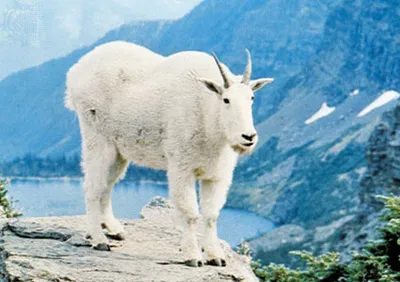
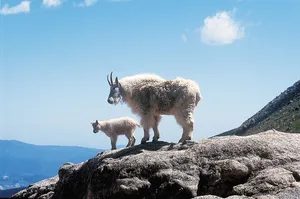
They look like they should fall. Stocky bodies, short legs, and a coat that looks too thick for the freezing air. But the mountain goat, scientifically known as Oreamnos americanus, belongs to the Bovidae family and thrives where nothing else wants to go. These North American ruminants cling to vertical faces, moving from ocean-side bluffs to the highest glaciated peaks.
Their survival strategy is simple: go where predators cannot follow. While wolves or bears might hunt on the ground, they hesitate at the edge of an icy precipice. The goats do not. They are agile, methodical climbers. Their hooves are adapted for insecure footing on snow and ice. When a predator gets too close, or if a human intrudes on their territory, the goat turns. It stands its ground.
They readily turn on their pursuers, including humans.
This is not a gentle herbivore. It is a specialist.
Where mountain goats actually live
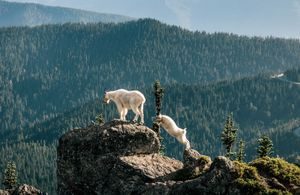
Mountain goats are part of the Rupicaprini tribe, a specific group within the bovid family. They look nothing like domestic goats, but genetically, they are close cousins to sheep and true goats. Their range stretches from the Yukon and Alaska down to Utah. The bulk of the population hangs out in British Columbia.
Reintroduction efforts have worked in some places. Populations have bounced back to former levels in certain areas. They were also moved to spots where they never evolved, including:
- Kodiak Island
- The Olympic Peninsula in Washington
- The Rocky Mountains in Colorado
- The Black Hills in South Dakota
It did not work everywhere. Mountain goats roamed Vancouver Island in the early postglacial period. They went extinct there. Modern attempts to bring them back failed.
Why monitoring mountain goat populations matters
These animals are sensitive to human activity. Their numbers fluctuate based on environmental stress. This makes them a target for constant observation. Conservationists watch closely to catch problems early. They need to apply corrective management before populations crash.
Ignoring them is not an option. The balance is delicate. Small changes in habitat or human presence can tip the scale.
Physical traits and combat tactics
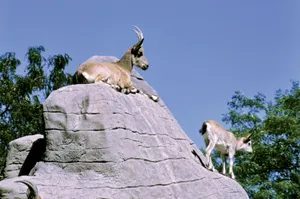
These animals look tough. Stocky bodies, muscular legs, broad hooves. Standing about 1 metre (39 inches) at the shoulder, large males tip the scale at over 120 kg (260 pounds). Females are lighter, usually 60-90 kg (130-200 pounds). The coat is coarse, white, and shaggy, hiding a thick woolly underfur. A beard frames the slender muzzle. Males and females look nearly identical, both sporting sharp, black horns that curve slightly backward. These horns range from 5 to 25 cm (2-10 inches).
They do not butt heads. Unlike true goats, mountain goats stab each other with their horns. This makes fighting dangerous. Severe injuries are common. As a result, these animals are highly reluctant to fight. Males develop very thick skin on their bodies. It acts as armour against rivals or aggressive females.
Horns are weapons, not rams. The threat of stabbing keeps most conflicts from escalating into brutal, frequent brawls.
Diet and mineral supplementation
Living on narrow cliffs limits food sources. Mountain goats compensate by eating a wide variety of plants. Grasses, herbs, foliage, twigs, and lichens are all on the menu. Alpine firs and other conifers are particularly important. At the timberline, they may dig through deep snow to reach these plants.
Summer brings specific nutritional needs. Lactating females and those growing new coats need extra nutrients. They reluctantly leave their cliff security to visit mineral licks. Inorganic sulfur is key here. The goat’s rumen flora uses this mineral to synthesize cysteine and methionine. These are rare amino acids. They are essential for hair growth during this period.
Social hierarchy and reproduction
The social structure is unusual. Males readily defer to females. Females live in small bands. In severe winters, they may become territorial. Adult males, by contrast, are solitary.
Courting behavior is distinct. Males crawl toward females. They make sounds similar to baby goats. Mating occurs in late November and December. After the mating season, females often drive males off their wintering ranges.
Reproduction follows a strict timeline. A single kid, rarely two, is born in late spring. Gestation lasts about 180 days. Within a week of birth, the kid joins a nursery group. Mothers are highly protective. In winter, females with young claim favourable cliff habitat. They chase other goats from these territories. They attack hesitating males without hesitation. Females are actually more likely to fight than males.