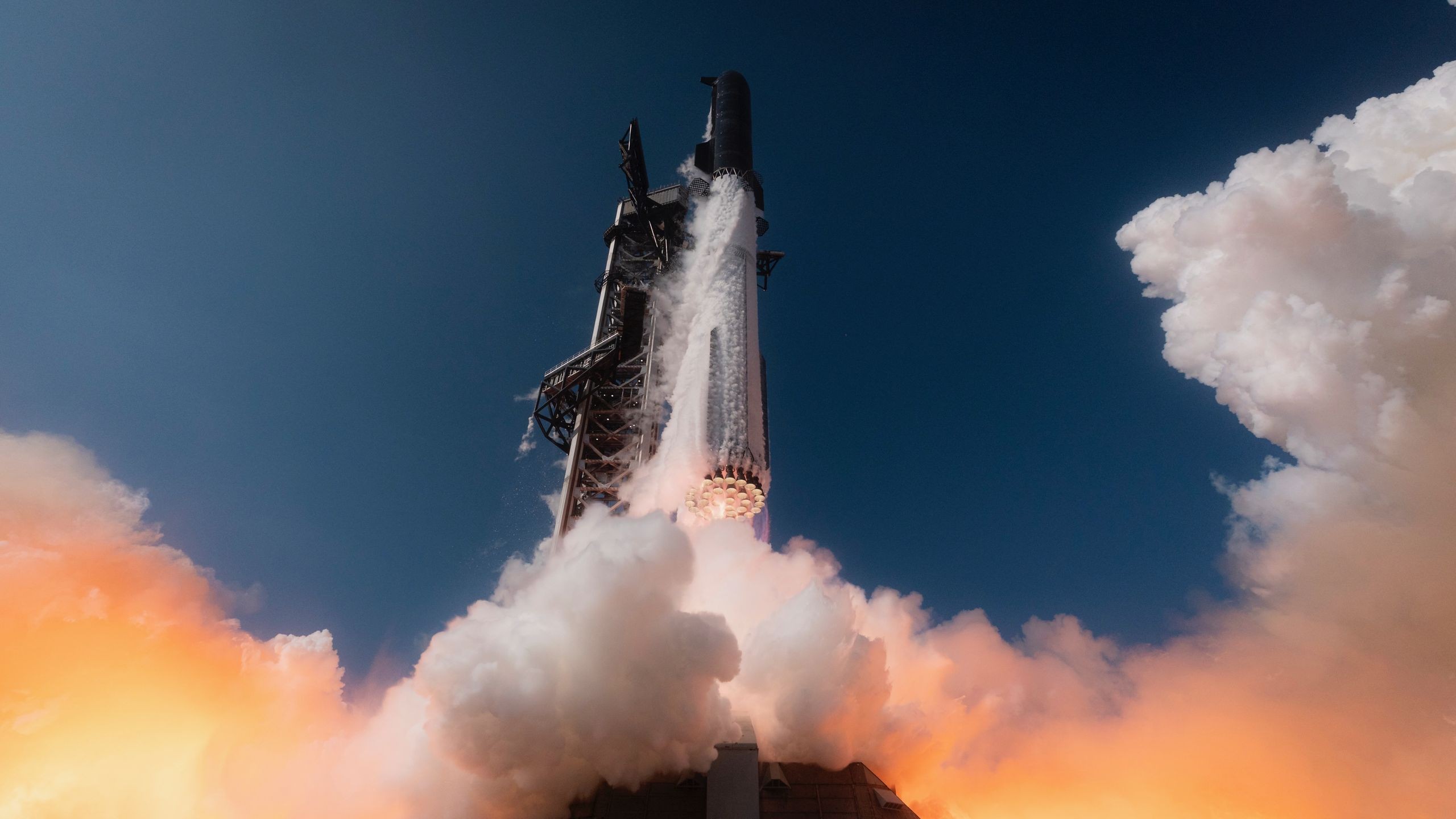
SpaceX is launching Starship again.
Today.
It’s Flight 13. The thirteenth time this thing tries to prove itself to gravity and the world. July 16.
A convenient date? Sure. The 57th anniversary of Apollo 11 lifting off for the Moon. But history isn’t the point today. The hardware is.
The Setup
Launch window opens at 6:45 p.m. EDT. Or 22:45 GMT. Or 5:45 p.m. if you are in South Texas, watching from Starbase.
The vehicle is monstrous. 400 feet of stainless steel. It stands there. Waiting.
Super Heavy sits below. Starship—often called Ship to avoid confusion with the rocket name itself—sits on top. Both are made of the same rough, unpainted steel. Both are built to fly more than once.
The goal is full reusability. Not partial. Not eventually. Fully and rapidly.
It debuted in 2023. Eleven suborbital flights have passed since then. The most recent was May 22. Flight 12.
Flight 12 introduced Version 3. Or V3.
V3 is the mature iteration. Months in the making. The previous version, V2, wrapped up its run in October 2025 with Flight 11.
Where Flight 13 Breaks New Ground
V3 is supposed to be operational. Eventually. NASA’s Artemis III mission in 2027 plans to use it. Artemis IV astronauts will walk on the Moon thanks to it a year later. If things go well.
Flight 12 was a strong test. Ship deployed 22 objects. A “PEZ dispenser” slit in its body spat them out. Twenty were dummies. Two were real Starlink satellites with cameras. Ship came back whole. It splashed down in the Indian Ocean near Western Australia.
Super Heavy failed to return. Engine issues. It crashed in the Gulf.
Flight 13 changes the payload mix.
Twenty Starlink V3 satellites.
These are heavy. Roughly 4,400 lbs each. Heavier than the old ones. They extend solar arrays. They attempt to link to the constellation using high-capacity lasers. They do this for about twenty minutes.
Then they burn up on reentry.
Why bother launching something destined to die?
Data.
Six of these twenty sats carry cameras. They film Ship. Specifically, they film the heat shield tiles while the ship blasts back through the atmosphere. SpaceX wants to see how the tiles hold up.
They also put sensors inside the shield. Load-sensing tiles. They measure stress during ascent. The flight profile is pushing harder against dynamic pressure this time. More payload means more stress. It’s a trade-off. Risk for capability.
The Launch Plan
SpaceX hasn’t caught Ship with chopsticks yet. Never have.
Not on this flight.
Super Heavy will try a splashdown. Controlled. In the Gulf of Mexico. Or the Gulf of America, as it’s currently known. That is the primary test. Separation. Boostback burn. Landing burn. Offshore.
The hardware and software got tweaks. Fixes for the problems seen on Flight 12.
Ship heads to Australia again. About 65 minutes in.
This isn’t a quick test. It’s a step toward the big vision.
SpaceX wants 100,00 Starlinks. V3 class. The current network has about 10,000. You can’t do that with Falcon 9. You can’t do it with anything else. Only Starship.
So they are breaking the tiles to see how strong they are.
Catch the launch. The window opens soon. Just watch it lift off. Watch it disappear.