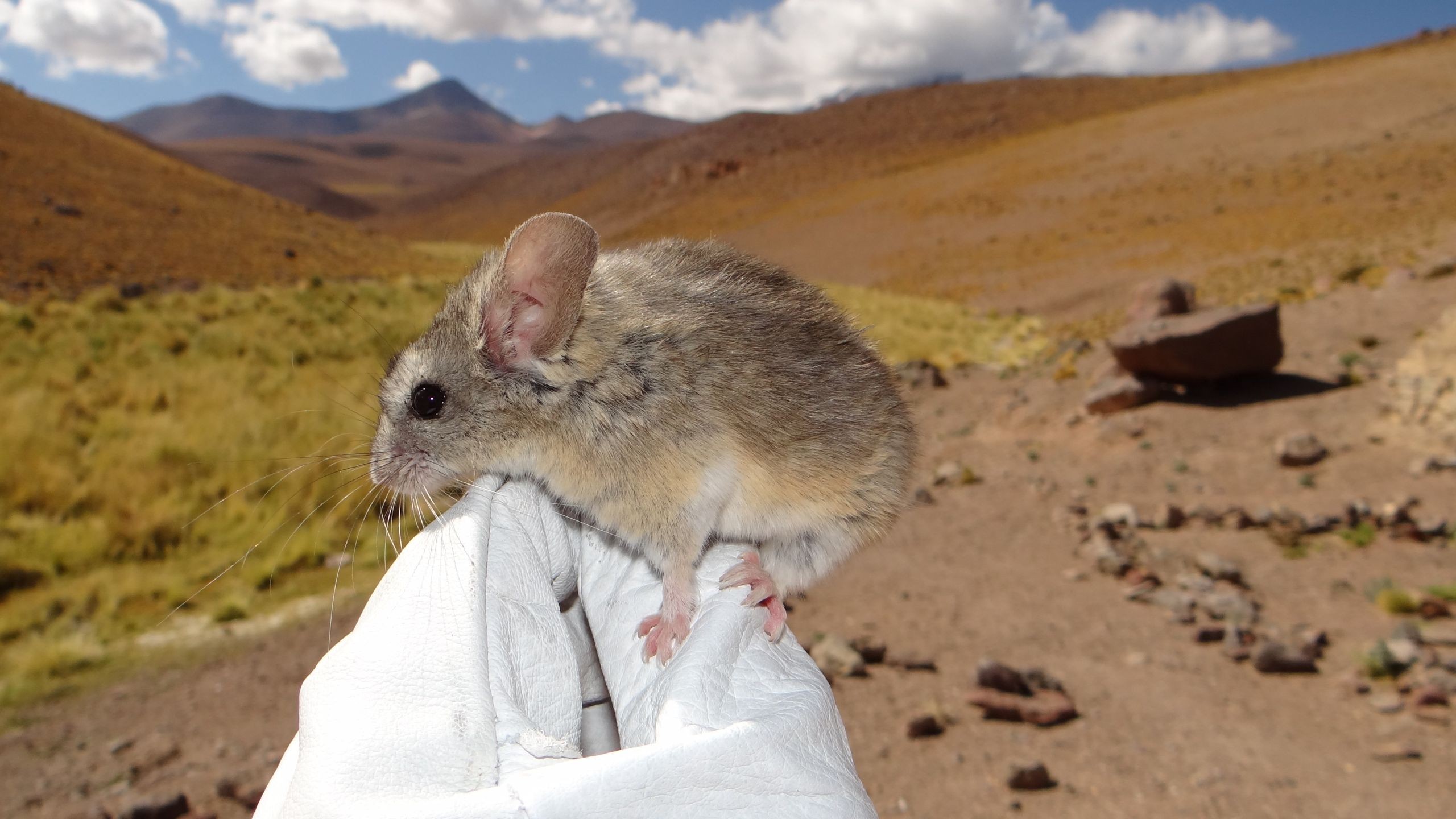
The air is so thin up there you can’t remember your own name. The cold bites through your suit, even if you’re layered in fleece. You’re standing on a dead volcano in the Andes, above the clouds, where water doesn’t exist and vegetation is a myth. It’s not remotely compatible with long-term human survival. You know this. Your body knows this. It’s screaming for you to go back down.
But down there, miles below, something else is happening. Something that shouldn’t work.
Jay Storz, a professor at the University of Nebraska–Lincoln and an amateur mountaineer, put it best. He calls these peaks “godforsaken.” Yet, there are mice living on the summits of dormant volcanoes more than a mile above the highest human settlements. They aren’t just surviving. They’re thriving. And they’re eating things that would kill a horse.
Shattering the mammal record
Before 2020, science drew a hard line. Researchers assumed mammals hit a ceiling around 18,000 feet above sea level. Go higher, and biology stops working. The heart gives out. The blood thins. You die.
Then came the Andean leaf-eared mice (Phyllotis vaccarum ).
In 2020, a team led by Storz climbed Llullaillaco. It’s a dormant volcano on the Argentina-Chile border, the highest historically active peak in the world. At 22,110 feet—roughly 6,739 meters—they found them. Records were broken. The assumption was smashed.
What makes this species bizarre is its range. Some live at sea level in the deserts of northern Chile. Others live where the air pressure is less than a third of what we breathe at home. The same animal. Same genome, mostly. But different solutions to the same lethal problem.
Eating poison to stay alive
Here’s the twist. The high-altitude environment isn’t just cold and low-oxygen. It’s barren. Plants are scarce. The ones that do grow up there? They’re often toxic. Most mammals would eat them and suffer.
These mice have evolved a digestive cheat code.
Genomic sequencing revealed that high-elevation mice have adapted genes allowing them to detoxify these plants. It’s a specific adaptation. While low-altitude mice lack this efficiency, the mountain dwellers can digest food that would otherwise be harmful. They’ve turned a poisonous landscape into a pantry.
But adaptation isn’t free. It comes with trade-offs. High-altitude mice are better at retaining body heat and maintaining oxygen levels in their blood. They’re built differently. Metabolically. Physiologically.
The human cost of discovery
Studying these mice isn’t like hiking in the park. It’s dangerous work. Storz’s team spent years (2020–2023) ascending these slopes, setting traps, and recording data in conditions that push human physiology to the limit.
One colleague was evacuated from a separate expedition in Peru. High-altitude pulmonary edema. Fluid building up in the lungs. Life-threatening. It’s a stark reminder that these conditions are lethal to humans. Even well-acclimatized climbers last only a short time up here.
To get the answers, the researchers had to euthanize specimens. They needed to study the tissues. They collected 167 “voucher” specimens, preserving them in museums. Storz argues this is vital for future science. These archives allow researchers to return to the biology of a specific moment in time. The populations weren’t impacted. The deaths were humane. The trade-off for knowledge? Accepted by science, though it never sits lightly.
King of the mountains
Graham Scott, a co-author from McMaster University, sees this as a story of evolutionary complexity. Life doesn’t just endure the extreme; it finds a way through it.
Why go so high? Probably competition. Down low, everywhere is crowded. Up here? It’s quiet. The air is thin for everyone. If you can handle the cold and the hunger, you have the mountains to yourself. Less predator pressure. Less competition.
But are they the highest?
Scott points out that birds are hard to pin down. They fly. They have records of soaring at higher elevations. But for land animals? For mammals specifically? These mice are likely the undisputed champions.
“It just shows the complex ways that evolution has made Phyllotis vaccarum the king of the mountains,” Scott said.
They are active during the day up high. Warmer then. Fewer predators. A different rhythm from their low-altitude cousins who might scurry at dusk or dawn to avoid heat or hawks.
Yet, despite the extreme adaptations, the mice remain genetically similar across the entire elevational range. They aren’t isolated species. They’re one population, stretching from the coast to the stratosphere, connected, overlapping.
We look at those icy peaks and see death. The mice see a home. A place to eat poison. A place to hide. A place to survive the unthinkable.