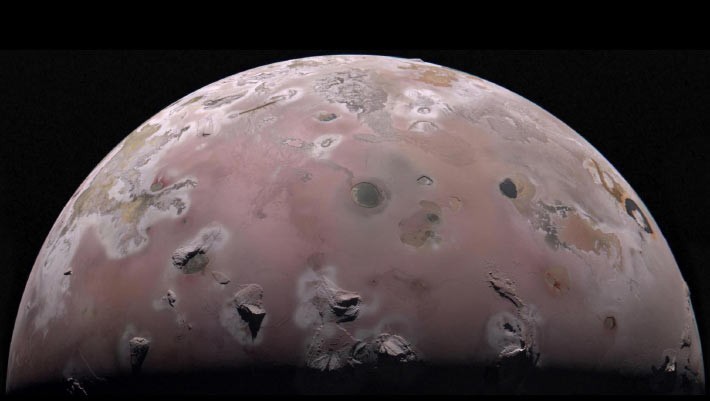
Jupiter’s moon Io isn’t just hot. It’s intensely, violently hot.
Until now, we’ve been looking at its temperature like a skin-deep diagnosis. Infrared cameras see only the surface—the thin layer of heat escaping into the void. We knew it was volcanic. We knew it was active. But the subsurface? That was a mystery wrapped in magma.
Now, NASA’s Juno spacecraft has changed the game.
Using its Microwave Radiometer (MWR), the probe didn’t just measure heat. It tuned into it. The new data reveals something startling: temperatures spike by more than 20 degrees Celsius within just a few meters of Io’s crust.
This is the first time humanity has seen beneath the surface of the solar system’s most volcanic body.
Why This Measurement Matters for Tidal Heating
Io sits in Jupiter’s gravitational deep well. The giant planet’s pull stretches and squeezes the moon relentlessly. Friction. Stress. Heat. Massive amounts of internal energy generated by tidal forces.
This process isn’t just about volcanoes. It’s a fundamental cosmic engine.
“Io provides a unique window into learning how tidal heating works throughout the cosmos,” says Dr. Scott Bolton, Juno’s principal investigator.
Bolton points out that this same mechanism fuels the subsurface oceans of Europa and Ganymede. Worlds that might harbor life. Worlds that have been icy and distant. Without understanding the heat transfer mechanism inside Io, we’re missing a key piece of the planetary physics puzzle.
“Up until this point we could only observe how the heat escapes from the interior toward the surface through eruptions,” Bolton notes. “Now we can characterize the movement.”
Reading the Microwave Signals
The MWR instrument doesn’t see light. It sees radio waves. Long-wavelength microwaves can penetrate the surface layer of solid bodies. They bounce back different signals depending on what lies beneath.
When Juno looked at Io, the signals were unexpected.
At long wavelengths, the surface appeared smooth. But the density? Low.
The upper layer of Io’s crust isn’t solid rock. It resembles volcanic ash or pumice. Loose, porous, and insulating.
This low-density layer is why the heat gets trapped just below. The temperature jump—over 20°C in a few meters—suggests strong endogenic heating trapped within the top tens of meters of the crust.
Two scenarios fit the data.
First, heat rising steadily through a conductive crust. The rock itself carries the warmth upward, creating a gradient.
Second, scattered patches of thin crust overlying lava or hot vents. These patches might cover about 10% of the surface, acting as focused heat pipes. The rest? Just insulating dust.
“The surprising discovery that we could see below a Rocky moon’s surface has important implications.”
Implications for Earthly Volcanoes
Why care about a moon 400 million miles away?
Because volcanoes on Earth work on similar principles. Magma moves. Heat transfers. Pressure builds.
Bolton suggests that if we point an MWR-type instrument at an active volcano on Earth—say, in Hawaii or Iceland—we might see the same subsurface temperature signature. A spike just beneath the loose rock and ash.
This could provide new, non-invasive data on how terrestrial volcanoes operate. How deep does the heat extend? Is the crust thick or thin in specific zones? Could these readings warn of an impending eruption before we see smoke?
It’s not science fiction. It’s applied planetary physics.
The Data in Context
The research, led by Shannon Brown and published in the Journal of Geophysical Research: Planets, marks a shift in how we study planetary bodies.
We used to think we needed landers. Rovers. Drills. To understand what’s underground.
Now, a spacecraft orbiting a gas giant can peek under the skin of its neighbor. The microwave radiometer acts like an x-ray. It doesn’t need to touch the ground to tell you what’s happening beneath it.
The crust of Io is porous. The heat is trapped. And the surface? It’s just the tip of the iceberg. Or rather, the tip of the volcano.
What happens when that thin crust gives way? We’ll see. But for the first time, we’re not guessing in the dark. We’re seeing the gradient. We’re seeing the flow. And it’s hotter than we thought.