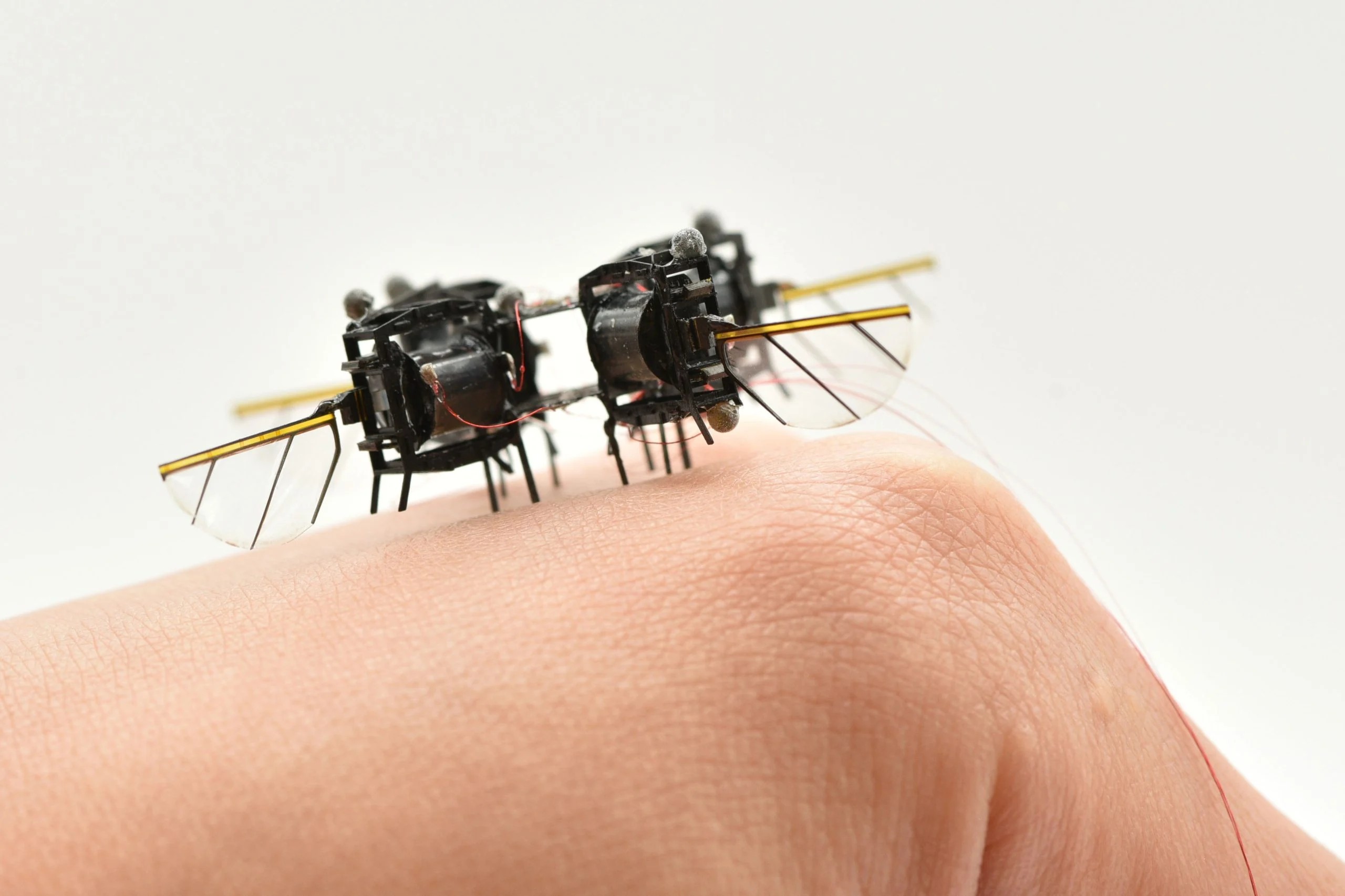
MIT’s latest insect-scale flying robot has cracked the code on rapid, agile flight. It’s small enough to slip into collapsed buildings after an earthquake. It’s fast enough to outpace debris falling from unstable structures. For years, microrobots were sluggish. They drifted along smooth, predictable paths. Now, thanks to a new AI control system, they mimic the erratic, high-performance maneuvers of real insects.
The implications are immediate: better search-and-rescue capabilities. But the leap in performance is also a victory for robotics engineering itself.
Why Traditional Microrobots Fall Short
Historically, aerial microrobots faced two hard constraints. Hardware was fragile. Control software was rigid. Researchers could build lighter frames and faster wing actuators. But without a brain capable of processing complex aerodynamics in real time, those hardware gains went unused.
Humans tuned the controllers by hand. It was slow. It was imprecise. The robot couldn’t exploit its own potential.
Kevin Chen, associate professor in MIT’s Department of Electrical Engineering and Computer Science, led the charge to change that. His team didn’t just tweak the hardware. They rebuilt the “brain” of the robot. The result? A system that matches the speed and agility of living insects.
How the AI Controller Works
The solution isn’t a single algorithm. It’s a two-part system.
First, an expert planner uses a mathematical model of the robot’s motion. It predicts behavior. It selects optimal actions for complex routes. It handles sharp turns, steep tilts, and consecutive somersaults. This planner is computationally heavy. It requires massive power. It cannot run in real time on a microchip.
So, the researchers used this powerful planner as a teacher.
Through imitation learning, they trained a deep-learning model to mimic the planner’s decisions. This policy engine serves as the robot’s real-time decision maker. It’s lightweight. It’s fast. It captures the robustness of the complex planner without the computing overhead.
“If small errors creep in, and you try that flip 10 times, the robot will crash. We need robust flight control.”
Performance Metrics: Faster and More Agitable
The results are quantifiable. Drastically so.
Compared to earlier demonstrations by the research team:
- Speed increased by 447%
- Acceleration improved by 255%
In tests, the robot completed 10 consecutive body flips (somersaults) in just 11 seconds. It stayed within 4 to 5 centimeters of its target path despite wind disturbances. That level of precision at insect scales is unprecedented.
The robot also replicated a saccade. Insects tilt sharply, accelerate, then pitch backward to stop. This helps them maintain clear vision during rapid movement. The microrobot can do it too. This capability could eventually allow these robots to carry onboard cameras and sensors for independent navigation.
The Hardware Behind the Software
You can’t have high-speed flight with weak wings. The latest model features larger flapping wings driven by soft artificial muscles. These muscles move back and forth at extreme speeds. The frame is more durable than previous versions. It’s no bigger than a microcassette. It weighs less than a paperclip.
But hardware alone wasn’t enough. Jonathan P. How, co-senior author and professor in Aeronautics and Astronauts, notes the synergy.
“As Kevin’s team demonstrates new capabilities, we show that we can utilize them. The hardware pushed the controller. The controller pushed the hardware.”
Search and Rescue: A New Paradigm?
Why does this matter outside the lab?
After an earthquake, survivors may be trapped under rubble. Quadcopters are too big to enter narrow gaps. They crash easily. Insects, however, navigate debris fields with ease. They dodge obstacles. They adjust to wind. They land on unstable surfaces.
This new microrobot aims to bridge that gap. It combines the size of an insect with the computational power to execute insect-like maneuvers.
“We want to use these robots in scenarios traditional quadcopters can’t fly into,” Chen says.
The next steps involve adding independent sensors. Currently, the robots rely on external motion capture systems for navigation. Adding onboard cameras would allow outdoor, unsupervised flight. Researchers are also exploring swarm coordination. Could multiple microrobots work together to avoid collisions while scanning a disaster zone?
What’s Next
The paper, published in Science Advances, marks a shift in control architecture. It proves that high performance and efficiency can coexist.
But the work isn’t done. Sensors are the next hurdle. Real-world deployment is still ahead. For now, we have a robot that can somersault ten times in eleven seconds. It flies faster than ever before. It sees less like a machine and more like a bug.
Is this the dawn of autonomous microrobot swarms? Maybe. Or maybe it’s just the first step toward getting closer to what nature has perfected over millions of years.