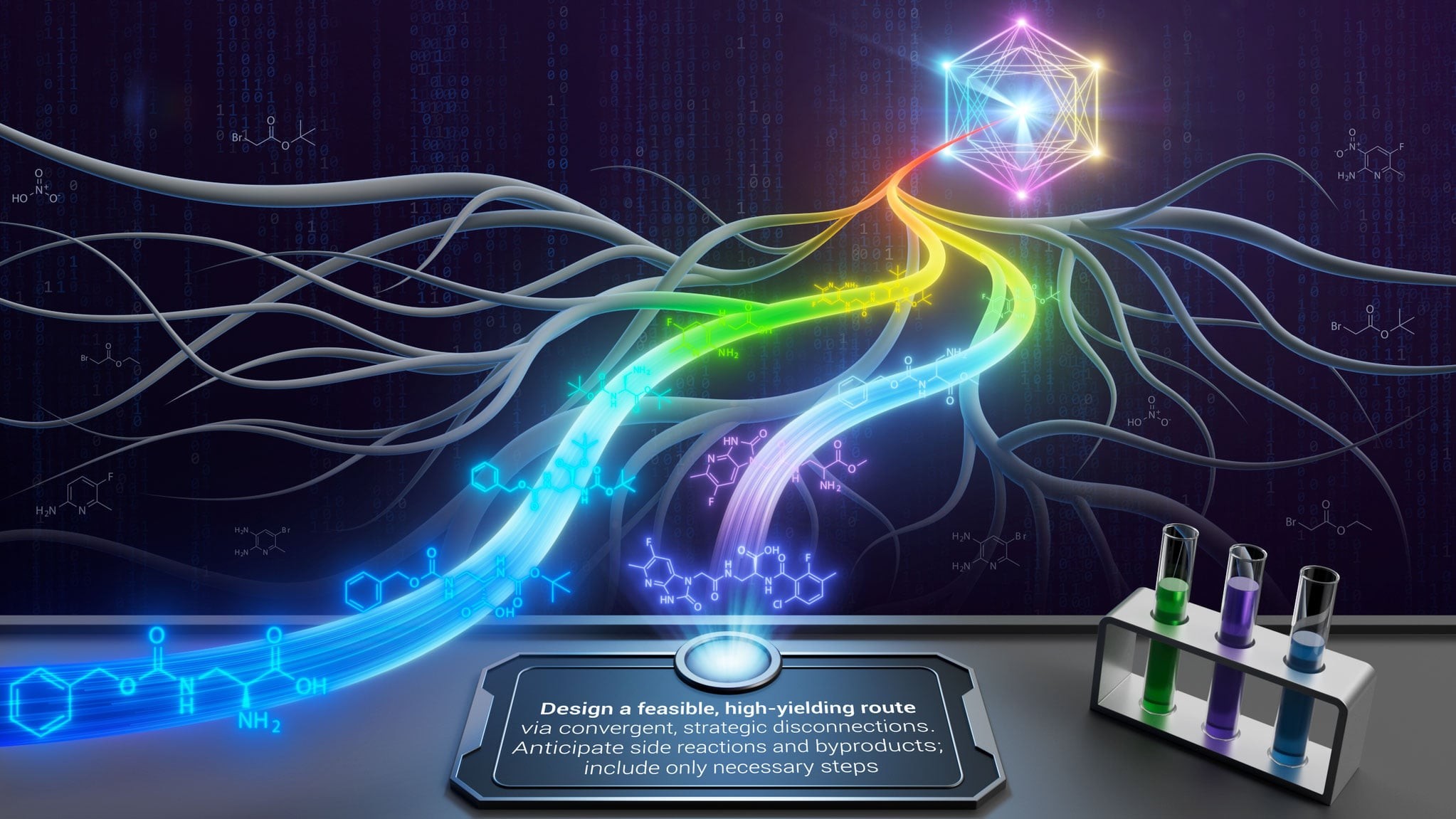
Designing a new molecule is much more than a simple math problem; it is a complex strategic game. Whether a scientist is trying to engineer a life-saving drug or a high-performance material, they must plot a precise sequence of chemical reactions to reach their goal. This process requires years of human expertise to master.
However, a new research breakthrough suggests that artificial intelligence may soon be able to replicate this high-level strategic reasoning, not by mimicking chemical structures, but by understanding the language of chemistry.
The Strategic Bottleneck in Modern Chemistry
To understand why this development matters, one must look at the two primary hurdles facing modern synthetic chemistry:
- Retrosynthesis (The “Backward” Problem): Chemists start with a final target molecule and work backward to find simpler starting materials. While computers can scan millions of possible routes, they often lack the “intuition” to make strategic decisions—such as deciding when to form a molecular ring or how to protect sensitive parts of a molecule from unwanted reactions.
- Reaction Mechanisms (The “How” Problem): This involves understanding the step-by-step movement of electrons that makes a reaction happen. Predicting these mechanisms is vital for efficiency, but current computational tools often struggle to distinguish between a theoretically possible pathway and one that is actually realistic in a laboratory setting.
Historically, AI has struggled here because it was often tasked with generating structures from scratch, which frequently resulted in chemically impossible or impractical suggestions.
Synthegy: Using Language as a Reasoning Tool
A research team led by Philippe Schwaller at EPFL has introduced a paradigm shift with a new framework called Synthegy.
Rather than asking an AI to “invent” chemistry, the researchers are using Large Language Models (LLMs) as evaluators and guides. Synthegy works by treating chemical strategy as a form of natural language. This allows the AI to act as a bridge between complex computational algorithms and the human chemist.
How the system operates:
- Natural Language Input: A chemist can give the system plain-English instructions, such as “Avoid using protecting groups” or “Form the ring structure as early as possible.”
- Algorithmic Search: Standard software generates a wide array of potential reaction routes.
- AI Evaluation: The LLM reviews these routes, converts the chemical data into text-based reasoning, and scores each pathway based on how well it follows the user’s specific strategic goals.
“With Synthegy, we’re giving chemists the power to just talk, allowing them to iterate much faster and navigate more complex synthetic ideas.” — Andres M. Bran, lead author.
Proving the Concept: Accuracy and Efficiency
The effectiveness of this approach was tested through a rigorous double-blind study involving 36 professional chemists. The results were compelling: the AI’s evaluations aligned with human expert judgment 71.2% of the time.
Beyond simple planning, Synthegy also applies this logic to reaction mechanisms. By breaking down electron movements and evaluating them through a linguistic lens, the AI can steer the search toward more plausible chemical pathways. This creates a unified interface where a scientist can describe a goal and receive a strategy that is both chemically sound and strategically optimized.
Why This Matters for the Future of Science
The ability to bridge the gap between high-level synthesis planning and granular reaction mechanisms is a significant milestone. By using LLMs as “reasoning engines” rather than mere “generators,” researchers have found a way to make AI a true collaborator in the lab.
This evolution in AI-assisted discovery has the potential to:
– Accelerate drug discovery by drastically reducing trial-and-error in the lab.
– Lower costs by identifying more efficient and less wasteful reaction routes.
– Democratize complex chemistry, allowing researchers to navigate vast chemical spaces using intuitive, conversational commands.
Conclusion
By treating chemical strategy as a language, Synthegy moves AI away from blind pattern matching and toward genuine reasoning, providing chemists with a powerful, conversational partner for molecular design.