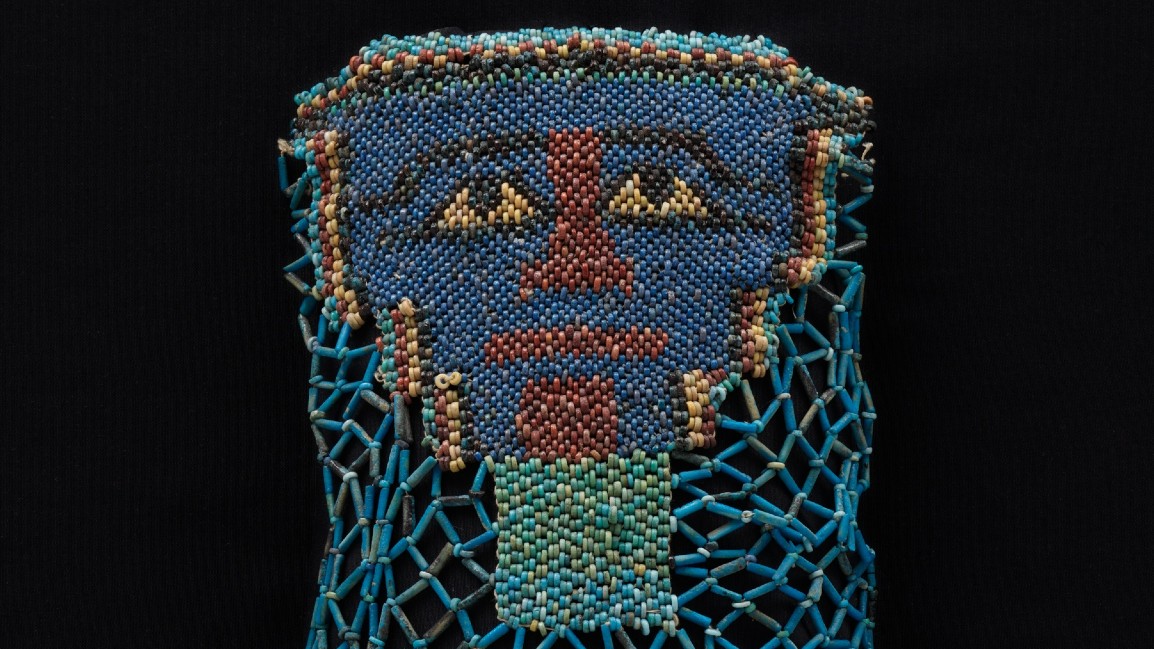
They didn’t just wrap the dead. They dressed them for glory.
2,500 years. That’s how old these beaded veils are. From Egypt. Not cloth. Beads. Intricate nets of color draped over mummies already bound in linen.
Why? To turn a person into Osiris. The god of fertility. Sovereign of the dead. It wasn’t enough to rest in a jar or a box. You wanted to become the ruler of the underworld.
The Art Institute of Chicago has one. It came in via the back door of the 19th-century art trade—purchased from Rev. Chauncey Mouch. He ran the American Presbyterian Mission in Luxor. He was a collector. Maybe too enthusiastic about taking home pieces of antiquity. But here the shroud is. Small, actually. 18 by 15.8 inches. It could cover your head. Maybe your collarbone if you were short.
What’s on it matters more than the size.
Egyptologist Emily Teeter broke it down for the museum. Three parts. First: the face. Mostly dark blue. Black, red, and yellow dots form the eyes. The makeup is abstract but sharp. A beard, too. Teal beads. It looks like Tut’s mask, if Tut was made of mosaic glass. The blue? Likely Nut, the sky goddess. Her body was the night sky. Full of stars. Or beads, in this case.
Then comes the scarab.
Wings out. Multicolored. Sitting right under the chin. This is Khepri. Sun god. Scarab face. Creator. Renewal. Usually, you find these as amulets tucked into linen folds during mummification. This one is woven. It’s not hidden. It’s displayed. A badge of regeneration sewn directly into the afterlife suit.
Below that? A collar.
Lotus flowers. Red pendants. Blue, black, yellow. A floral explosion.
“Just as the arms of Nut enclosed the deceased, the bead net encompassed the mummy,” Teeter noted.
Think about that. The net is a hug from a goddess. It’s also armor. It was tied behind the back, over red linen. Red. A protective color. Together, the fabric and the beads mimicked the wrappings of Osirish. You didn’t just die. You were reconstructed. Pixel by pixel. Bead by bead.
Does it feel heavy to wear? Probably. But did they care about comfort?
Not really. They cared about identity. About transformation.
The net holds. The image stays.
And the rest of history? Still waiting.