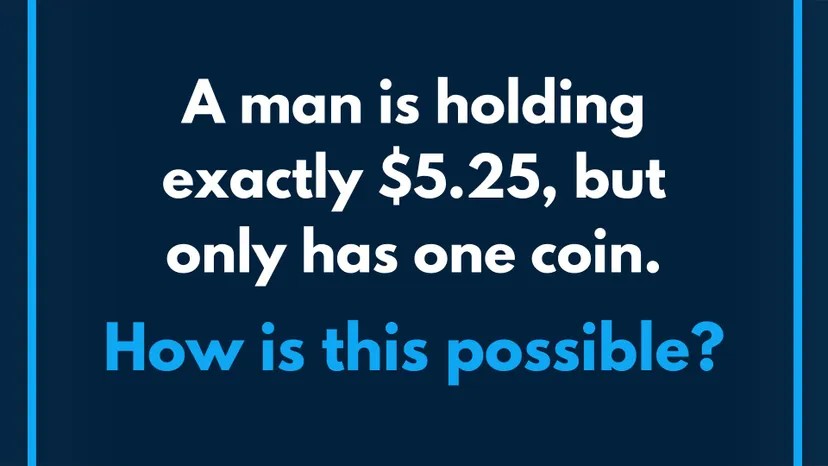
It is a classic trap. You see the words “quarter” and “five dollars” and your brain instantly wants to sum them. Seven twenty-five. Easy. But riddles rarely care about basic arithmetic. They care about wordplay. And in this specific case, the answer hinges on a single preposition.
“He has a quarter and a $5 bill.”
The riddle doesn’t ask how much money he has in total. It asks for the specific combination of items he is holding. He has one coin. And one bill. That is it.
If the riddle were phrased “How much money does he have?” you would be stuck doing mental math. But most variations of this trick question rely on the listener assuming a total sum when the prompt only lists inventory. It is a test of attention, not calculation.
Think of it like a menu. A burger and a fry are two items. They are not one item. They just happen to be related. The “quarter” is a specific denomination. The “$5 bill” is another. They exist side by side. They do not merge.
Some people argue that “quarter” can mean a fraction of time or space. But in the context of money riddles, it is always a coin. 25 cents. The $5 bill is distinct. No overlap. No hidden variables. Just two separate pieces of currency.
Why do we fall for this? Because we are conditioned to find totals. We see numbers and we want a final figure. It feels unsatisfying to just list the objects. We want the sum. We want the answer to be a single number. But riddles often reward the literal interpretation over the assumed one.
He has two things. A quarter. And a five. The rest is noise.