Natural gas is simple on paper but complex in practice. It is a colourless, highly flammable gaseous hydrocarbon. The mix consists primarily of methane and ethane. It falls under the broad umbrella of petroleum. You will often find it sitting alongside crude oil. This fossil fuel powers everything from home heaters to heavy industrial plants. It generates electricity. It cooks food. It even fuels certain vehicles. Beyond energy, it serves as a vital chemical feedstock. Manufacturers use it to create plastics. Fertilizer production depends on it. So do dyes.
Finding this resource is not always straightforward. Natural gas often dissolves in oil within underground reservoirs. The pressure there is immense. Sometimes it forms a gas cap floating above the oil layer. That pressure acts as a driver. It forces the oil up to the surface. This type is known as associated gas. It is essentially the gaseous phase of crude oil. It usually carries light liquids like propane and butane. People call this “wet gas.”
Not all gas comes with oil. Some reservoirs contain only gas. This is nonassociated gas. Because there is no liquid petroleum source nearby, it is termed “dry gas.”
Where Did Humans First Use Natural Gas?
The story begins long before modern pipelines. Early humans noticed natural gas seeps. These occurred in Iran between 6000 and 2000 bce. Ancient writers documented these petroleum seeps across the Middle East. The Baku region, now part of Azerbaijan, was a hotspot. Lightning likely struck these seeps first. The resulting flames fueled the “eternal fires” of ancient Persian fire-worshipping religions.
China entered the picture around 900 bce. The Chinese were practical innovators. They drilled the first known well for natural gas in 211 bce. The depth reached about 150 metres. Bamboo poles and primitive percussion bits did the work. The target was limestone from the Late Triassic Epoch. This rock layer, dating back roughly 237 million years, lay in an anticline west of modern Chongqing.
Why drill deep? To dry rock salt. The salt was interbedded in the limestone. Burning the gas provided the heat. Wells eventually dug deeper. Some approached 1,000 metres. By 1900, over 1,100 wells dotted that anticline.
Europe knew nothing of natural gas for millennia. The continent only discovered it in England in 1659. Even then, it failed to catch on. Town gas took the lead. This fuel came from carbonized coal. It lit streets and homes across Europe starting in 1790.
North America took a different path. The first commercial use of a petroleum product happened there. A shallow well in Fredonia, New York, produced natural gas in 1821. Small-bore lead pipes carried the gas. Consumers used it for lighting and cooking.
The Pipeline Problem
For most of the 19th century, natural gas use stayed local. The technology to move large quantities over long distances simply did not exist. Coal and oil drove industrial development. Natural gas sat on the sidelines.
A breakthrough arrived in 1890. The invention of the leakproof pipeline coupling changed the game. It allowed for better transport. But the materials and construction techniques remained cumbersome. Gas could not travel more than 160 km from its source.
The economics were brutal. Associated gas was mostly flared. That means it was burned off at the wellhead. Nonassociated gas was often left in the ground. Cities relied on manufactured town gas instead. The infrastructure lagged behind the resource.
The Rise of High-Pressure Pipeline Networks
Long-distance gas transmission only became viable in the late 1920s. That was when pipeline technology finally caught up to ambition. Between 1927 and 1931, the United States built over ten major transmission systems. They were massive undertakings. Each system used pipes roughly 50 cm (20 inches) wide. They stretched more than 320 km (200 miles).
After World War II, the scale exploded. Engineers built even longer pipelines with increasing diameters. Fabrication techniques allowed for pipes up to 150 cm (60 inches) wide. Since the early 1970s, the longest of these arteries have originated in Russia.
Consider the Northern Lights pipeline. Built in the 1960s and ’70s, it spans 5,470 km (3,400 miles). It crosses the Ural Mountains and more than 700 rivers and streams. It links eastern Europe with the West Siberian gas fields on the Arctic Circle. The result is that gas from Urengoy, the world’s largest field, flows into eastern Europe and then on to western Europe for consumption.
Then there is the Trans-Mediterranean Pipeline. It is shorter but an engineering nightmare. This 50-cm (20-inch) line runs between Algeria and Sicily. It traverses waters where the sea is more than 600 metres (2,000 feet) deep.
Why Natural Gas Became a Premium Fuel
Natural gas wasn’t always valuable. As recently as 1960, associated gas was a nuisance. It was a by-product of oil production. Engineers separated it from crude oil and eliminated it as cheaply as possible. Often, they just flared it. Burning it off was the easiest solution.
Things changed after the oil crises of the late 1960s and early ’70s. Natural gas became a critical world energy source.
Even in the United States, the home-heating market was limited until the 1930s. Town gas was common then. It was synthetic. It had half the heating value of natural gas. When abundant, cheap natural gas arrived, it replaced town gas.
Natural gas burns completely, forming mostly carbon dioxide and water. It is relatively free of soot, carbon monoxide, and nitrogen oxides.
This cleanliness matters. Sulfur dioxide emissions are almost nonexistent. As a result, many countries prefer natural gas for environmental reasons. It has supplanted coal in electric power plants across the world.
But there is a catch. Methane is a potent greenhouse gas. It traps heat about 25 times more effectively than carbon dioxide. Despite its reputation as a clean fuel, methane leaks from storage facilities, pipelines, and transport contribute significantly to global warming. This remains a major concern.
What Is Inside the Pipe?
Natural gas is a hydrocarbon mixture. It consists primarily of saturated light paraffins. Methane and ethane are the main components. They are gaseous under atmospheric conditions.
The mixture may also contain propane, butane, pentane, and hexane. In reservoirs, high pressure keeps even these heavier hydrocarbons in gaseous form. Once brought to the surface and atmospheric pressure, they liquefy. These are produced separately as natural gas liquids (NGLs).
This happens in field separators or gas processing plants. The NGLs are then separated into fractions. You get everything from heavy condensates (hexanes, pentanes, butanes) to liquefied petroleum gas (LPG) and ethane. In the United States, this is a huge industry. Natural gas processing provides much of the ethane feedstock for olefin manufacture. The LPG is used for heating and commercial purposes.
Nonhydrocarbon Contaminants
Natural gas often contains nonhydrocarbon gases. Nitrogen, carbon dioxide, hydrogen, helium, and argon are common.
Nitrogen and carbon dioxide are noncombustible. They can appear in substantial proportions. Nitrogen is inert. However, if present in large amounts, it dilutes the heating value. It must be removed before the gas hits the commercial market. Carbon dioxide is removed to raise heating value, reduce volume, and ensure steady combustion.
Then there is sulfur. Natural gas often contains hydrogen sulfide or other organic sulfur compounds. This is known as “sour gas.”
Sulfur is toxic when breathed. It corrodes plant and pipeline facilities. If burned, it creates serious pollutants. So, it is removed during processing. But here is the twist: after sulfur removal, a minute quantity of a noxious mercaptan odorant is added. Why? To detect leaks. Methane is odorless. You need a smell to know if something has gone wrong during transport or use.
Gas and formation water live together in the reservoir. So, gas recovered from a well contains water vapor. This vapor partially condenses during transmission to the processing plant.
Thermal and Physical Properties
Commercial natural gas is stripped of NGLs. It is sold for heating. It usually contains 85 to 90 percent methane. The remainder is mainly nitrogen and ethane.
Its heating value is high. It typically provides approximately 38 megajoules (MJ) per cubic metre. That is about 1,050 British thermal units (BTUs) per cubic foot.
Methane itself is colorless and odorless. It is highly flammable. But as noted, associated gases like hydrogen sulfide have a distinct, penetrating odor. Just a few parts per million are enough to give natural gas a decided smell. That smell is a safety feature.
Gas doesn’t stay the same once it leaves the ground. It expands. It cools. It changes state. Understanding how we measure and move this invisible fuel is half the story of the energy industry. The other half is keeping it from freezing up in the pipes.
Standard volumes and market values
We measure gas by volume, but only under strict conditions. Specifically, standard atmospheric pressure (760 mm of mercury or 14.7 psi) and a temperature of 15 °C (60 °F). Underground, the gas is crushed by immense pressure. When it reaches the surface, that pressure vanishes. The gas expands. It occupies more space. But the actual amount of energy contained in that gas hasn’t changed.
This is why we use standard conditions for measurement. It creates a level playing field.
Reserves are massive. We talk in billions and trillions of cubic metres (bcm, tcm) or cubic feet (bcf, tcf). Daily production at wellheads is smaller, usually measured in thousands or millions of cubic metres (Mcm, MMcm) or cubic feet (Mcf, MMcf).
There is a weird quirk here. The industry uses Roman numerals. M means 1,000. MM means 1,000 times 1,000. So MMcf is one million cubic feet. It seems arbitrary until you get used to it.
But volume is not what you pay for. Energy is.
Natural gas is bought and sold by its calorific value. That is the heat energy it releases when burned. Roughly 38 megajoules per cubic metre (MJ/m3) or 1,050 BTUs per cubic foot. In practice, these numbers are too small for commercial transactions. We use gigajoules (GJ) and millions of BTUs (MMBTUs).
In the British Imperial system, 1 MMBTU is roughly equal to 1,000 cubic feet of gas. Another common unit is the therm, which equals 100,000 BTUs or about 100 cubic feet. Prices are often cited per therm, per MMBTU, or per GJ. It all boils down to heat.
Field processing basics
Field gas is rarely ready to go. Sometimes it is high enough in methane that you can pipe it straight to customers. Rarely.
Most of the time, it is dirty. It contains heavier hydrocarbon liquids and impurities. It is also at very low pressure. You cannot push that through a pipeline efficiently.
So, we process it.
The process involves multiple stages of compression. We compress the gas to remove liquids and impurities. We also cool the fluid. Cooling reduces the temperature of the gas. This saves power at compressor stations further down the line. It is a trade-off. You spend energy to cool and compress now, to save energy later.
Dehydration and hydrate prevention
Water is the enemy in gas processing.
In a simple compression plant, gas hits an inlet scrubber. This removes entrained liquids. Then the gas is compressed and cooled. Pressure goes up. Temperature goes down. Water vapour condenses into liquid.
If the gas gets too cold, it hits its dew point. Water or hydrocarbons turn to liquid. This creates a problem. Gas hydrates form. These are icelike crystals. They clog valves. They block pipelines. They stop production.
You must prevent them.
The solution is glycol. A glycol solution is injected into the gas stream. It absorbs the dissolved water. The gas dries out. The glycol, now heavy with water, is heated. The water evaporates. The glycol is reused.
There is another way. Solid desiccants.
Wet gas passes through towers packed with a drying material. The water adsorbs onto the solid. Dry gas emerges. The solid desiccant eventually gets saturated and must be regenerated or replaced.
Recovering hydrocarbon liquids
Methane is valuable. But the heavier components are often worth more.
If market economics warrant it, we extract Natural Gas Liquids (NGLs). This requires a complex absorption and fractionation plant.
Raw compressed gas meets “lean oil” in an absorber column. The lean oil absorbs the heavier components from the gas. The bulk of the gas—usually 95 percent methane—discharges from the top as residue gas. It still needs treatment to remove sulfur and other impurities.
The bottoms liquid stream, now “rich oil,” heads to a distillation tower. Here, ethane is removed for plant fuel or petrochemical feedstock. The lean oil is recovered and recycled back to the top of the column.
Some plants have additional columns to separate propane and butane.
Temperature matters. Older plants operated at ambient temperature. Modern facilities use refrigeration to lower processing temperatures. This increases absorption efficiency.
There is an even more aggressive method. Cryogenic expansion.
This is how we extract ethane efficiently. Cooled gas is blown by a powerful turbine into an expansion chamber. The vapour pressure drops. The temperature plummets to −84 °C (−120 °F).
At this temperature, methane stays a gas. The heavier hydrocarbons condense. They are recovered. The methane moves on. The liquids are collected.
Sweetening sour gas
Sour gas contains sulfur compounds. They are corrosive. They are toxic. They must be removed.
We “sweeten” the gas.
The process uses ethanolamine. This is a liquid absorbent. It acts like the glycol in dehydration, but targets sulfur.
Gas is bubbled through the ethanolamine. It emerges almost entirely stripped of sulfur. The ethanolamine is then processed to remove the absorbed sulfur. It is reused.
This loop continues until the amine is exhausted or contaminated beyond repair.
Transport
Once the gas is dry, sweet, and measured, it enters the pipeline. The pressure is high. The temperature is controlled. The composition is stable. It travels hundreds or thousands of miles.
But that is a different story. The infrastructure that moves this invisible fire is a marvel of engineering. It requires constant monitoring. It requires maintenance. It requires a delicate balance of physics and chemistry.
If one valve fails, the whole system halts.
Infrastructure defines the industry. The natural gas boom wasn’t just about finding gas. It was about moving it. And the first step in that logistical puzzle was the metal pipe.
Before the 21st century, the network looked nothing like what we see today. The very first metal line connected Titusville to Newton, Pennsylvania, in 1872. It was a cast-iron tube just 2.5 inches in diameter. Tiny. Fragile by modern standards. Yet it pushed gas at 80 psi—about 550 kilopascals—to 250 homes. That was the start.
Fast forward to now. The scale is staggering. In the United States alone, there are over 500,000 kilometers of main transmission pipelines. Add in the 3.4 million kilometers of smaller distribution lines, and you have a web delivering more than 672 billion cubic meters of gas annually. That serves 70 million customers.
Russia, the world’s top exporter, isn’t far behind. They run over 160,000 kilometers of transmission lines. Their capacity? More than 600 billion cubic meters per year. The physical scale of moving energy from source to socket is the true engine of the market.
The Geometry of Pressure
You don’t use a firehose to water a potted plant. Pipeline engineering follows the same logic.
Modern lines vary wildly in size. Feeder lines might be just 15 centimeters (6 inches) wide. Transmission pipelines? They swell to 60, 106, or even 122 centimeters (24, 42, 48 inches). The largest Russian main lines push past that, hitting 140 centimeters (56 inches).
Pressure is the other variable. Large transmission lines operate at roughly 8 megapascals. That’s over 1,000 psi. In metric-heavy regions, that’s 80 bars. The friction of gas rushing through a steel tube is immense. To keep it moving, automated compressor stations are placed every 100 kilometers (60 miles). They kick in, boost the pressure, and overcome the drag. Without them, the gas stops dead.
Crossing Oceans on Ice
What happens when the gas is far from the market? Say, in the middle of nowhere? You can’t always build a pipe. Instead, you freeze it.
Liquefied natural gas (LNG) solves the distance problem. When cooled to about -160 °C (-260 °F), natural gas shrinks to 0.16 percent of its original volume. That’s a 1/600th reduction. Suddenly, shipping it across oceans makes economic sense.
The process at liquefaction plants is precise. It uses autorefrigerated cascade cycles. First, the gas is stripped of carbon dioxide and dried. Then it hits a series of compression and expansion steps. The gas cools until it liquefies. The power for this compression usually comes from burning a portion of the gas itself. Efficient, but costly.
Once frozen, it loads onto specially insulated tankers. These vessels sail to consuming ports. There, the LNG sits in refrigerated tanks until needed. To use it, the liquid must be regasified. This requires heat. Often, that heat comes from nearby seawater—a low-cost exchange.
But there’s a catch. Every step—liquefaction, transport, regasification—leaks energy. The loss can hit 25 percent of the original content. You’re shipping ice, but you’re also shipping inefficiency.
From Burnt Fuel to Chemical Feedstock
The largest single use for this energy? Power generation. We burn it to spin turbines.
After electricity, it’s industrial and domestic use. Heating homes. Running factories. But natural gas is more than fuel. It’s a building block.
Its clean-burning nature made it a favorite for transportation fleets. Many buses run on compressed natural gas. It emits carbon dioxide, sure, but less soot than diesel.
It’s also in things you touch every day. Carbon black—a fine pigment of colloidal dimensions—is made by burning natural gas with limited air. The soot deposits on cool surfaces. It’s in your tires. It’s in your printer ink. It’s in your dyes.
The Ammonia Connection
More than half the world’s ammonia comes from natural gas. The process uses hydrogen derived from methane. Catalytic. Complex.
This ammonia doesn’t just sit there. It becomes plant food. Or it converts into hydrogen cyanide, nitric acid, urea, and various fertilizers. If you eat food grown today, you likely benefited from this chemistry.
Other chemicals follow similar paths. Controlled oxidation turns gas into methanol, propanol, and formaldehyde. These are basic materials for endless other products. Methanol can even substitute for gasoline.
Then there is MTBE. Methyl tertiary butyl ether. It’s an oxygenated fuel additive. You mix methanol with isobutylene over an acidic ion-exchange resin, and you get a compound that raises the octane number in gasoline. It’s a chemical bridge between the wellhead and your gas tank.
Where It All Began
Natural gas is more ubiquitous than oil. It doesn’t just hide deep underground. It generates above, throughout, and below the “oil window.” Every source rock has the potential to produce it.
Many of the world’s major gas deposits are tied to coal. Not coincidence. These source rocks date back to the Carboniferous and Early Permian periods. Roughly 358.9 to 273 million years ago.
The gas comes from land plants and aquatic organic matter. Ancient biomass, compressed and heated over eons. It’s still forming. It’s still moving. And it’s still finding its way into our pipes, our tanks, and our chemistry labs.
The question isn’t really how we found it. We found it long ago. The question is how long we can keep the pressure up.
You might think of oil and gas as ancient, pressurized blobs trapped underground. They are, but their journey to your furnace or gas station involves distinct biological and thermal chapters.
The biological stage
Before heat and pressure do their heavy lifting, microbes get to work. This is the immature or biological stage. Anaerobic bacteria break down organic matter in oxygen-free zones. They spit out biogenic methane. Think swamp gas. Marsh gas.
These microbes are delicate. Even a trace of oxygen kills them. High sulfate levels inhibit them too. So, this gas only forms in specific spots. Poorly drained swamps. Certain lake bottoms. Marine environments below the sulfate reduction zone.
It’s not just a niche curiosity. Biogenic gas accounts for over 20 percent of the world’s gas reserves. That’s a massive chunk of energy sourced from simple decay, not deep-earth chemistry.
The thermal stage
Then comes the heat. Petroleum generation hits its mature stage at depths between 750 and 5,000 meters. That’s 2,500 to 16,000 feet. This is the oil window.
You get the full range of hydrocarbons here. Thermal methane joins the party alongside the oil. But dig deeper, past 2,900 meters (9,500 feet), and the game changes. You mostly get wet gas. Gas mixed with liquid hydrocarbons.
Go below 5,000 meters, and you enter the postmature stage. Oil breaks down. It’s no longer stable. The main product is thermal methane. This isn’t microbial decay anymore. It’s the cracking of existing liquid hydrocarbons.
Big molecules shatter faster than they form. Methane survives. Larger chains don’t. That’s why you rarely find oil below 5,000 meters in sedimentary basins. Thick sediment sequences? They still hold potential for deep gas, just not oil.
Inorganic formation
Is all gas organic? Usually, yes. But some methane might be inorganic. Abiogenic.
Earth’s carbon came from cosmic debris. Meteorites. Carbonaceous chondrites are rich in hydrocarbons. If these meteorites represent Earth’s original building blocks, then high concentrations of hydrocarbons were here from the start.
Continuous outgassing might still be happening. Hydrocarbons escaping from within the planet. Some could accumulate as abiogenic deposits without ever passing through an organic phase.
Sounds promising? Not really. Widespread outgassing would likely make the gas too diffuse. Too scattered to mine. Significant accumulations of inorganic methane? We haven’t found them yet. If they exist, they’re hiding well.
Then there are the extras. Helium and argon. These aren’t oil byproducts. They come from radioactive decay. Thorium and uranium families make helium. Potassium makes argon.
Their presence in natural gas is probably a coincidence. Unrelated gases getting trapped in the same geological pocket. Not because they’re chemically linked. Just bad luck for the gas, good luck for the helium miners.
The geologic environment
Natural gas behaves like oil, migrating through rock layers until it hits a geological trap. But here’s the thing: oil holds more recoverable energy than gas of the same size. Even though getting gas out is technically more efficient, the physics just don’t favor it. Gas starts out with low concentration. It spreads out easily. You need rock seals that are absolutely impermeable to keep it from escaping.
This volatility makes cap rocks critical.
Natural gas isn’t picky about depth. You can find it in shallow layers or deep below the surface. Shallow accumulations often come from biogenic processes, forming above the “oil window.” Thermal gas, however, lives throughout and below that window. In most basins, the vertical space for generating gas is larger than for oil. Roughly a quarter of major gas fields are biogenic and shallow. The rest? They’re buried deep in older reservoirs, often carbonates sealed by evaporites.
Conventional gas reservoirs
Not all conventional gas reservoirs behave the same. Physical variations dictate how much you can actually pull out.
In a single-phase gas reservoir, theory suggests you should recover nearly everything if you drop the pressure enough. But reality is messy. If water from the surrounding rock pushes in to maintain pressure, capillarity traps some of the gas behind the advancing water front. You lose it.
So, in practice, you’re looking at about 80 percent recovery.
There’s an economic limit, too. If pressure drops too low, the cost of compressing the gas exceeds the value of the gas itself. Depending on permeability, actual recovery sits between 75 and 80 percent. Associated gas—the kind produced alongside oil—is separated at the surface after extraction.
Unconventional gas reservoirs
Then there’s unconventional gas. This stuff lives in geological environments that don’t fit the standard petroleum trap mold.
It’s found in:
– Tight sandstones (low permeability)
– Joints and fractures
– Absorbed into shale matrices
– Coal seams
– Methane hydrates in cold polar or undersea regions
– Dissolved or entrained in hot geopressured formation waters
“Unconventional” is mostly an economic label. Given today’s tech and prices, these sources are more expensive to exploit and produce at slower rates. They are harder to get at. But as technology advances and conventional sources get pricey, these alternatives become viable. Tight gas, shale gas, and coal-bed methane have already proven this.
Tight gas
Tight gas hides in blanket or lenticular sandstones. The key metric here is permeability. We’re talking less than one millidarcy (0.001 darcy). That’s incredibly low.
Conventional vertical wells struggle here. The natural flow rates are too slow to be economical. It’s a waste of resources to drill the old way.
Enter horizontal drilling and hydraulic fracturing (fracking).
These techniques create massive collection areas in low-permeability formations. They force fractures into the rock, giving gas a highway to the wellbore. Production has skyrocketed since this became standard practice.
Shale gas
Shale gas is locked within the fine-grained sedimentary rock itself. Unlike tight gas in sandstones, where fractures might provide some natural pathways, shale is dense and fine. The gas is adsorbed onto the organic matter and clay minerals within the rock matrix.
Extracting it requires a two-pronged approach. You need horizontal drilling to maximize contact with the shale layer. Then you need massive hydraulic fracturing to open up the micro-fractures. Without these steps, the gas stays trapped.
The scale is different, too. Shale plays often cover hundreds of square miles. A single well might tap into a vast network of fractures. This changes the economics entirely. It’s not just about finding a pocket of gas. It’s about treating the rock itself as the reservoir.
As extraction costs drop, shale gas competes directly with conventional sources. In some regions, it has already become the primary supplier. The technology isn’t new, but the efficiency is improving. Friction materials, better monitoring, and refined well designs are squeezing more gas out of the same rock.
The question isn’t really about whether we can get it out. It’s about the environmental trade-offs. Water usage. Induced seismicity. Methane leakage during extraction. These are the real bottlenecks now.
Yet the potential remains staggering. Shale gas resources are widespread. They are not limited to a few specific basins. They exist on almost every continent. As conventional supplies wane, the shift toward these unconventional sources accelerates. The geology doesn’t change. The rock stays put. But our ability to unlock it does.
Shale gas didn’t start as a resource. It started as mud. Organic sludge settled at the bottom of ancient oceans, buried by layers of sediment over millions of years. Heat and pressure did the heavy lifting. They turned that mud into rock. They also cooked the organic matter into natural gas.
Some of this gas was mobile. It seeped into neighboring sandstone pockets. Trapped there, it formed conventional gas deposits. Most of it, though, got stuck. The shale itself is nonporous. It’s a prison for gas. For decades, trying to get it out was a losing business. The flow was too slow. The margins too thin.
Then came horizontal drilling. Engineers learned to drill sideways, slicing through shale beds for miles. Add hydraulic fracturing, and the rock cracks open. Production jumped. Today, about 25 percent of U.S. gas comes from these tight formations. Experts predict that number will hit 50 percent before the mid-21st century. The era of shale is here.
Coal-bed methane
Coal isn’t just fuel for power plants. It’s a sponge for methane. Huge amounts of gas remain locked inside coal seams.
The process starts with coalification. As plant matter turns to coal, gas is released. Some escapes into the atmosphere. A lot stays behind. It sits as free gas in the joints and fractures of the seam. Even more is adsorbed onto the internal surfaces of micropores. Think of it as gas clinging to the interior walls of microscopic holes.
Getting it out requires water management. You drill into the seam. You pump out the water saturating the coal. Removing the water lowers the pressure. This pressure drop triggers desorption. The methane leaves the surface of the pores. It becomes free gas. It migrates into the fractures. Then up the wellbore to the surface.
Coal is impermeable. Fractures are the only pathways. If a seam is rich in methane, engineers stimulate it with fracking, similar to shale operations. Coal-bed gas currently supplies nearly 10 percent of U.S. natural gas. It’s growing elsewhere, too. New regions are tapping into these seams as traditional sources dwindle.
Geopressured fluids and methane hydrates
Not all gas lives in obvious pockets. Some hides in deep, young sedimentary basins. These are geopressured reservoirs.
Here, formation fluids—usually salty brine—bear part of the overburden load. The pressure builds up. It can reach double the normal hydrostatic gradient. The heat doesn’t escape well, either. Insulating layers of shale and clay trap the thermal energy. These fluids are often hotter than those in normally pressured zones.
The brine is saturated with gas. We’re talking 0.84 to 2.24 cubic meters of natural gas per 0.159 cubic meters of brine. That’s 30 to 80 cubic feet of gas per barrel. It sounds promising. It is not.
Producing this gas requires high flow rates. You need formations with high porosity and permeability. You also have to produce massive volumes of hot formation water to get commercial quantities of gas. The energy cost and logistical nightmare are too high. Currently, there is no commercial gas production derived from geopressured deposits. The math doesn’t work.
Methane hydrates are different. They are solid-looking ice-like structures. Single methane molecules are encased in cagelike lattices of water molecules. It’s a molecular trap.
These hydrates exist in two main places. Beneath the permafrost in polar regions. And in ocean beds along continental shelves. Specific pressure and temperature combinations allow methane to migrate into water-saturated reservoirs and form these structures. They appear in polar sandstones and in the sand and mud of continental margins.
Extraction is the bottleneck. We don’t have an economically viable or environmentally sustainable method yet. Two main ideas are on the table.
First, depressurization. Drill into the formation. Reduce the surrounding pressure. The methane breaks free from the water lattice. It flows up the borehole.
Second, carbon dioxide injection. Pump CO2 into the rock. The CO2 molecules displace the methane in the lattice. The methane is released. It can then be extracted.
Both methods carry risks. The ecosystems involved are extremely sensitive. Polar environments and marine shelves are fragile. Any technology must be designed with extreme care. We have the gas. We just don’t know how to take it out without breaking the world around it.
World distribution of natural gas
Gas doesn’t just sit in one pocket. It migrates.
Think of the earth’s crust as a vertical factory for gas generation. You have shallow biogenic gas near the surface. Then, further down, you hit the oil window where dissolved gas resides. Go deeper still, and thermal gas takes over.
This vast vertical habitat, combined with an endless supply of source material, suggests we’ve barely scratched the surface. Literally.
Estimates put the amount of recoverable gas that remains undiscovered at 45 percent of the total. The energy content of these ultimate resources is projected to rival oil. We use less gas than oil today, which means our current stockpiles are expected to last longer. But if consumption patterns shift and gas usage catches up to oil’s massive scale, that longevity disappears quickly. Gas would become just another short-lived resource.
The cost of wasted gas
Flaring isn’t new. It’s a dirty habit tied to oil production.
In 2017, the World Bank reported a staggering loss. Approximately 141 billion cubic meters (bcm) of gas—equivalent to 5 trillion cubic feet (tcf)—was burned off at the wellhead. That’s one-fifth of the annual gas consumed in the United States. Or 75 percent of Russia’s annual exports.
Why waste it? Remote locations. Recovering gas from isolated wells is expensive. If you can’t pipe it anywhere, you burn it.
Historically, Russia, the Middle East, and parts of Africa were the biggest offenders. While much of this gas is now reinjected to maintain pressure, what can’t be reinjected often went up in flames.
But economics changes behavior. As the value of gas appreciates, conservation efforts have intensified. Flaring is down. The money is too good to leave in the smoke.
The giants of the industry
Not all fields are created equal.
The largest natural gas fields are “supergiants.” They hold more than 850 bcm (30 tcf) of gas. Then you have “world-class giants,” sitting between 85 and 850 bcm (3 to 30 tcf).
These massive fields are a tiny fraction of the total known fields. Less than 1 percent. Yet, they are the backbone of the industry.
Supergiants and giants, along with associated gas found in giant oil fields, originally held about 80 percent of the world’s reserves. They produce 80 percent of the world’s gas.
Russia’s role
Russia sits on some of these giants.
Russia holds the crown for the largest natural gas reserves in the world. We are talking about roughly 47 trillion cubic meters (tcm), or about 1,680 trillion cubic feet (tcf) of gas. It trades places with the United States for the top spot in production every so often, but the sheer volume of what sits underground in Russia is unmatched.
The action happens in West Siberia. Specifically, look east of the Gulf of Ob, right on the Arctic Circle. This is where you find some of the planet’s most massive gas fields.
Urengoy: The Giant That Keeps Going
Urengoy is the world’s second-largest gas field. It was discovered in 1966. Initial estimates put its reserves at 8.1 tcm (286 tcf). That is a staggering amount of energy.
The geology here is complex but consistent. Roughly three-quarters of that gas sits in the shallowest reservoir. It lies between 1,100 and 1,250 meters (3,600 to 4,100 feet) deep. These rocks are Late Cretaceous in age, dating back roughly 66 to 100.5 million years.
In total, Urengoy has 15 separate reservoirs. Some are found in Lower Cretaceous rocks, which are older, dating from about 100.5 to 145 million years ago. The deepest point is a gas condensate zone in Upper Jurassic strata, pushed back to 145–163.5 million years ago.
Production started in 1978. It peaked. Output has declined since those peak years. Yet it still beats any other single gas field on Earth in terms of volume. It remains the king of extraction.
Yamburg and Orenburg
North of Urengoy, also north of the Arctic Circle, lies Yamburg. It is Russia’s second-largest field. Original reserves were estimated at 4.7 tcm (166 tcf). The gas comes mostly from Upper Cretaceous reservoir rocks. These sit at depths of 1,000 to 1,210 meters (3,300 to 4,000 feet). Development kicked off in the early 1980s.
Then there is Orenburg. Discovered in the Volga-Urals region in 1967. It holds the title of the largest Russian gas field outside of West Siberia. Initial reserves were 1.8 tcm (64 tcf). Production began in 1974. It is significant, but it doesn’t compete with the Siberian giants in sheer scale.
Groningen: Europe’s Anchor
Move south to Europe. The largest natural gas field on the continent is Groningen. It sits on the Dutch coast. Discovery happened in 1959. Production started in 1963. Original recoverable reserves were between 2.7 and 2.8 tcm (95 to 99 tcf).
They have already pulled out about 60 percent of those original reserves. The geology is distinct here. The discovery well drilled through evaporites of Permian age (251.9–298.9 million years old). It hit a thick basal Permian sandstone that was highly productive.
Subsequent drilling mapped out a broad anticline. It is about 24 km (15 miles) wide by 40 km (24 miles) long. The reservoir is capped by those evaporites. Gas sits at depths between 2,500 and 3,000 meters (8,000 to 10,000 feet). Below this reservoir lies a truncated and strongly faulted coal-bearing Pennsylvanian sequence. That sequence, stretching from 323 to 299 million years ago, is considered the main source of the gas.
Troll: Norway’s North Sea Powerhouse
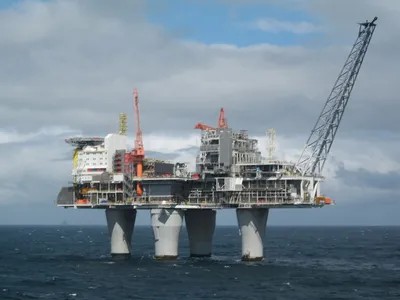
The second-largest gas field in Europe is the Troll field. It lies under the North Sea, less than 100 km (60 miles) off the coast of Norway. It sits in Upper Jurassic sandstones. Discovery was in 1979. Recoverable reserves were estimated at 1.3 tcm (45.9 tcf).
Production began in 1996. It was an immediate game-changer. Norway quickly became one of the largest natural gas producers and exporters in the world. Troll alone contains more than half of Norway’s proven natural gas reserves. Those proven reserves total 2 tcm (72 tcf).
North America
The Giants of North America
The US holds a staggering 9.7 tcm of proven natural gas reserves. That’s 341 trillion cubic feet of fuel sitting underground. The crown jewel is the Marcellus Shale. It spans Pennsylvania, Ohio, West Virginia, and New York. Some estimates suggest it holds up to 14 tcm.
It produces more than 80.3 bcm a year. That makes it the largest source in the country. It’s also one of the biggest gas fields on the planet. The scale is hard to grasp until you look at the output.
Then there is the Hugoton field. Discovered in 1927 in Kansas. It stretches into Oklahoma and Texas. You need a long view to see the full picture. The productive area runs along a 400-km trend. Over 10,000 wells have been drilled there.
The geology is specific. The gas comes from Permian limestones and dolomites. Stratigraphic variations in lithology control the accumulations. It’s not just a hole in the ground. It’s a complex trap. The field has an estimated ultimate recovery of 1.5 tcm. They’ve already pulled out about 65 percent of it.
Canada is the next big player. They have 2.1 tcm of proven reserves. Their undiscovered potential matches the US almost exactly. That’s a lot of untapped energy. One major site is the Elmworth field. It was found in Alberta in 1976. It sits in a Cretaceous sandstone reservoir. It contained 560 bcm of gas. That’s 20 tcf of potential.
Mexico is different. They have 356 bcm of proven reserves. Production is scattered. A lot comes from the Canterell oil field in the Gulf of Mexico. Demand is rising. The electric power industry is hungry. But they can’t process it all. Billions of cubic meters of associated gas are flared every year. It’s wasted potential. Or rather, wasted infrastructure.
The Desert Giants
In North Africa, the story is older. The Hassi R’Mel field is the key. It’s located in the central basin of Algeria. It was discovered in 1956. It sits in a large anticline. The reservoir is Triassic sandstone. That’s 200 million years old. It’s capped by salt beds.
Originally, it held about 2.52 tcm of recoverable gas. It still produces 100 bcm a year. That’s 60 percent of Algeria’s total dry gas. The geology is clean. Permeable rock. Salt seal. It’s a textbook reservoir. But it’s also a massive economic engine for the region.
The Middle East
The Middle East holds the rest of the global balance.
The Middle East isn’t just about crude oil. Beneath the sands lies a massive underground bank of gas. This potential is tied to the Arabian-Iranian basin. Its backbone is the Permian Khuff formation. It sits under most of the region. It’s a key horizon for holding gas.
This layer holds the world’s largest nonassociated natural gas field. Qatar calls it the North Field. Iran calls it South Pars. It spans offshore waters. The reserves are staggering. Estimates put them at over 28 trillion cubic meters. That’s 1,000 trillion cubic feet.
This wealth has rankings. Iran holds the third-largest natural gas reserves. Qatar is fourth. Only Russia has more. The Khuff formation is the reason. It’s not just oil country anymore. It’s a gas superpower.
Asia’s Reef Reservoirs
Move east. Asia has its own giant. The Arun field. Discovered in 1971. It sits in the North Sumatra basin of Indonesia. The rock here is different. It’s reef limestone. It dates to the middle Miocene Epoch. That’s 16 million to 11.6 million years ago.
Original reserves were estimated at 383 billion cubic meters. Or 13.5 trillion cubic feet. Huge numbers. But they aren’t piped to neighbors. The gas is liquefied. Export only. This changes the logistics entirely. You need cold chains. You need specialized tankers. The value is in the mobility.