It’s expensive. It is brittle. However, it is starting to be used to replace steel in engines, jets and even the human body.
This is the paradox of advanced structural ceramics. For decades, they were seen as niche materials. Too fragile for general use and too expensive for mass use. But in an environment where eat metal for breakfast, ceramic is the only option. We are talking about high heat, deep corrosion and intense friction. In these areas, the strong chemical bonds that make ceramic hard make it hard. Difficult things break.
The problem is not a lack strength. The problem is that we lack toughness. Cracks began to appear, and then they ran away. Quickly. until the material breaks down.
But engineers are fighting back. Researchers have found a way to prevent cracks in their tracks by tweaking the microstructure. They are trying to turn fragile ceramics into something that behaves more like steel. This is not magic. This is micro engineering.
Here is how they are doing it.
Why ceramics matter (if metal fails)
First, we need to clear up a misunderstanding. Advanced structural ceramics are not used in the build a bridge. Their high costs and variable mechanical properties make safe calculations difficult. These are expensive alternatives to metals and polymers.
But consider the inside of a car engine. Or jet turbine blades. Or the hip implant in a patient.
In these cases, you need materials that can withstand:
Extreme heat so it won’t melt or warp.
* Chemical or body fluid corrosion.
* Erosion caused by wear particles or constant friction.
The metal melts. Polymer burns. Composites delaminate. Ceramics? They just sit there chemically inert and thermochemically stable.
Let’s take mineral processing equipment as an example. grinding rocks into dust. Ordinary steel wears out in a few months. High-quality ceramics are very wear-resistant and can be used for many years. Or consider bone substitutes. The body is a highly corrosive environment. Metals corrode and release toxic ions. Some ceramics are biocompatible and chemically inert. They don’t react. They just hold the load.
“Ceramics have strong chemical bonds, so they withstand very harsh conditions.”
This durability comes from the atomic level. The bonds are so strong and not easily deformed. But that same resistance means they won’t give up. They don’t stretch. They break.
In order to make them suitable for everyday structural applications, the problem of fragility must be solved. stop the cracks.
Fragile fault
The biggest obstacle to using these materials everywhere is their inherent susceptibility to defects. Ceramics are not uniform. There is a small fault. Microscopic voids. small crack.
Metals deform when pressure is applied to them. It stretches. It absorbs energy. In ceramics, stress is concentrated at the tips of small defects. Crack propagation. Suddenly the whole assembly failed.
This is no small problem. This is a fundamental limitation of the material. Achieving advanced structural ceramics requires that the ceramics respond to stress. The energy required for crack propagation must be increased.
There are three main ways to do this.
Strengthening ceramics: changes in microstructure
One way is to change the internal structure of the ceramic. Instead of using a uniform mesh of particles, engineers create microstructures using fibrous or interlocked grains.
Think of it like rebar in concrete. However, the rebar is part of the ceramic itself.
When a crack tries to pass through this material, it hits an obstacle. You can’t go straight. You have to deflect. You have to zigzag. This increases the crack path length. A longer crack path means more energy is needed to move it.
At the same time, the particles behind the crack tip fill the gap. hold the crack closed. They work like little stitches.
This is done with whisker-reinforced ceramic composites and fiber-reinforced ceramic composites. As a result, the area of the fracture increases significantly. The material absorbs more energy before it breaks. This is no longer a single clean break. This is a complex and energy-intensive process.
Microcracks: Let go and move on
The second mechanism is counterintuitive. This means the intentional creation of small cracks. Instead, let it form in a controlled manner.
This occurs in single-phase polycrystalline ceramics with grain anisotropy. Their properties vary depending on the direction. It is also suitable for purposeful two-phase polycrystalline microstructures.
This is what happened. As the main crack approaches, smaller microcracks open on both sides of it. It’s at the tip of the crack.
This serves two purposes.
First, energy is expended to open these secondary cracks. This makes less energy available for the main crack to propagate. It’s like paying the toll and moving on.
Second, and this is important, the microcracks following the main crack increase the volume. This extension aims to close the main crack. The more the crack propagates, the greater the resistance to propagation. As the pressure increases, the material essentially repairs itself or at least withstands further damage.
This is a passive defense system. It is built into the material’s DNA.
Phase change amplifier: Ceramic steel
This is the most promising approach. And it changes the game.
This is called transformation toughening. Turns ceramic into something like steel.
The prototype material is zirconium oxide (zirconium dioxide, ZrO2).
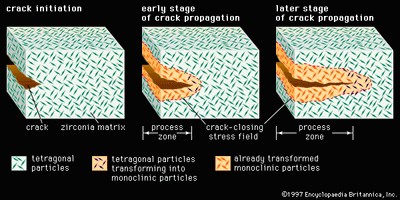
Pure zirconia changes dramatically when cooled below 1,150 °C (2,100 °F). The crystal shape changes from tetragonal to monoclinic. This is not a subtle change. The volume has increased by 3%.
This expansion often causes the material to crack or crumble. But engineers have found a way to exploit it.
They have very fine tetragonal particles dispersed in a matrix of cubic zirconia or alumina. The particles are less than 1 micron. Close contact with the matrix keeps the tetragonal structure stable at room temperature. The pressure is on, but it’s still there.
Then the crack approached.
The stress field preceding the crack triggers the transformation. Tetragonal grains become monoclinic. They scale it up.
This expansion applies a closing force to the advancing crack. It’s like squeezing toothpaste tubes from behind. The pressure presses on the crack, causing it to close.
A process zone is formed behind the crack, where all the particles are transformed. Increased cumulative volume creates greater resistance. The longer the crack, the greater the resistance.
These ceramics are often called “ceramic steels”. Why? This is because the strain response to stress is similar to that of steel. They don’t shatter. It gets a little distorted. They yield.
The basic phase transformation is martensitic. This is the same mechanism that produces martensitic in rapidly cooled steel. We borrowed nature’s best techniques from metals and applied them to ceramics.
The way to the future
We don’t just learn these materials. We design them.
toughened ceramics offer a wide range of possibilities. Generators that operate more efficiently at higher temperatures, to aerospace vehicles that can withstand re-entry temperatures without melting. From industrial grinders that never need to be replaced to medical implants that last a lifetime.
Obstacles remain. Variability of properties. The complexity of manufacturing. Cost.
But the science is solid. The toughening methods works. The materials are ready.
We just need to scale it up. They are always intended to become an everyday reality.
The math of breaking
The toughness of reinforced ceramics is much lower than that of metals, but it is significantly better than ordinary vitreous ceramics. To understand why this is important, you need to look at the numbers. The Fracture toughness, denoted KIc, measures the intensity of stress at which cracks begin to form. The unit is the product of the megapascals times and meters. This is an accurate measure of fragility.
Glass is at the bottom of the scale and has a KIc value of 1. It is very brittle. Break it, and it shatters. Metals sit high up. Aluminum alloys hovers in the range of 30-45. Steels push into 40-65. This is a big gap.
Traditional ceramics? They sit in the 3–4. Almost the same as glass. If you drop the ceramic plate, it may break. Particle-reinforced composites grow slightly to 4-6. Still brittle. But adding whiskers and fibers shift the needle. Whisker-reinforced composites hit whisker-reinforced composites range from 8 to 10. Fiber-reinforced ones can have 10-25.
Next is transformation-toughened zirconia (TTZ). These materials land in the 6–15 range. This area is important. It allows for TTZ ball bearing to repeatedly bounce against the concrete floor. No visible damage. You might think that this kind of abuse would cause the ceramic to crack. It doesn’t. The microstructure absorbs shocks.
The price of resilience
If these materials are so tough, why aren’t they everywhere? Production costs are high.
Ceramics cannot replace metals unless there is a clear economic benefit. They have to save money in other ways. Perhaps higher operating temperatures are possible. Maybe it will last longer. If a ceramic part costs twice as much but lasts three times as long, buyers might care. What if it cost twice as much and broke just as much? Nobody would buy it.
There are also thermal deficiencies. These toughened properties usually disappear when the object is heated. As the temperature rises, the driving force of the phase change decreases. Eventually it disappeared. The material loses its strength. It is back to fragile state.
Whiskers and fibers in ceramic matrix composites face another problem: oxidation. they degrade at high temperatures. Because of this, they are effective toughening agents. The matrix returns to brittle behavior. Engineers are still struggling to design microstructures that remain tough even when heated. This is still a big challenge in ceramic engineering.
Where they live
Advanced structural ceramics are already in use. These applications are covered in corresponding articles on nuclear ceramics, bioceramics, tribological ceramics and automotive ceramics. They are not just theoretical concepts. They are in engines, implants, industrial machines, etc.
They also enhance traditional uses. Refractory materials and abrasives see improved performance and abrasion properties. The basic features remain unchanged, but the structure has become tougher. More tough. It is more resistant to heat and wear.
The gap between ceramics and metals is closing in certain areas. It is not closing everywhere. The cost barrier is real. The thermal limits are real. However, in applications where weight, heat resistance and corrosion resistance are more important than the original purchase price, ceramics are taking over. The next hurdle is Whether they can survive high temperatures without losing toughness.