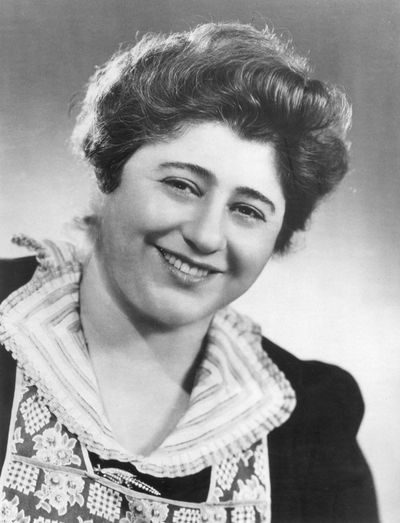
Gertrude Berg didn’t just write for radio. he lives there
Born in New York in 1899, he was a force of nature who built an empire around his talkative mother. By the time of his death in 1966, Berg had successfully transformed his work from a 15-minute radio sketch to a television phenomenon, a Broadway play and even a film. His story is the ultimate case study in managing intellectual property before industry tries to take it away.
The story begins in the classroom. In 1918, a young Gertrude Edelstein met and married Louis Berg while taking a playwriting class at Columbia University. He has already written the script. He was already thinking about radio waves. He presented a weekly series for NBC called “The Rise of the Goldbergs.”
The year is 1929. The radio was still new. The concept is innovative.
The show features a Jewish family living in the Bronx. It focuses on family adventures, neighborhood gossip and the unique challenges of immigrant life. But magic is not part of the plot. Delivery is underway. Berg plays matriarch Molly Goldberg. Molly often went out on the porch and chatted with the neighbors. He is very philosophical. He is very curious. he is real
Berg wrote the show. He produced it. He acted in it. This triple power was rare at the time. He created an entire community of characters and events that eventually attracted millions of viewers.
The play premiered on November 20, 1929 and was a huge hit. By 1931, the program was broadcast five times a week. Berg used his fame to publish a book also called “The Rise of the Goldbergs”. The radio series had a complicated existence, airing weekly until 1934, then being taken off the air for several years, then briefly revived in 1936, 1937, 1938-1945, and finally 1949-1950.
When “The Goldbergs” ruled the airwaves, Berg didn’t stay quiet. In 1935, he created another radio series, “The Glass House.” He has also written scripts for other programs. He made his film debut in “Make a Wish” (1937). In 1948, he brought his radio personality to the stage in a Broadway production of Me and Molly, based on the play.
Then there is the television.
The Goldbergs appeared on the small screen in the late 1940s. This is a big blow. The show aired weekly from 1949 to 1951, with additional seasons in 1952 and 1953. In 1950, Berg won an Emmy Award for his work. The network has finally found its first big sitcom star.
It’s not just a franchise. In 1951, the Goldbergs appeared in a movie called Molly. Mr. Berg is the co-author of this book. After that, he hid in the summer theater for several years. But he was still hungry.
In 1959, he returned to Broadway in A Majority of One. This work was highly praised by critics. he won