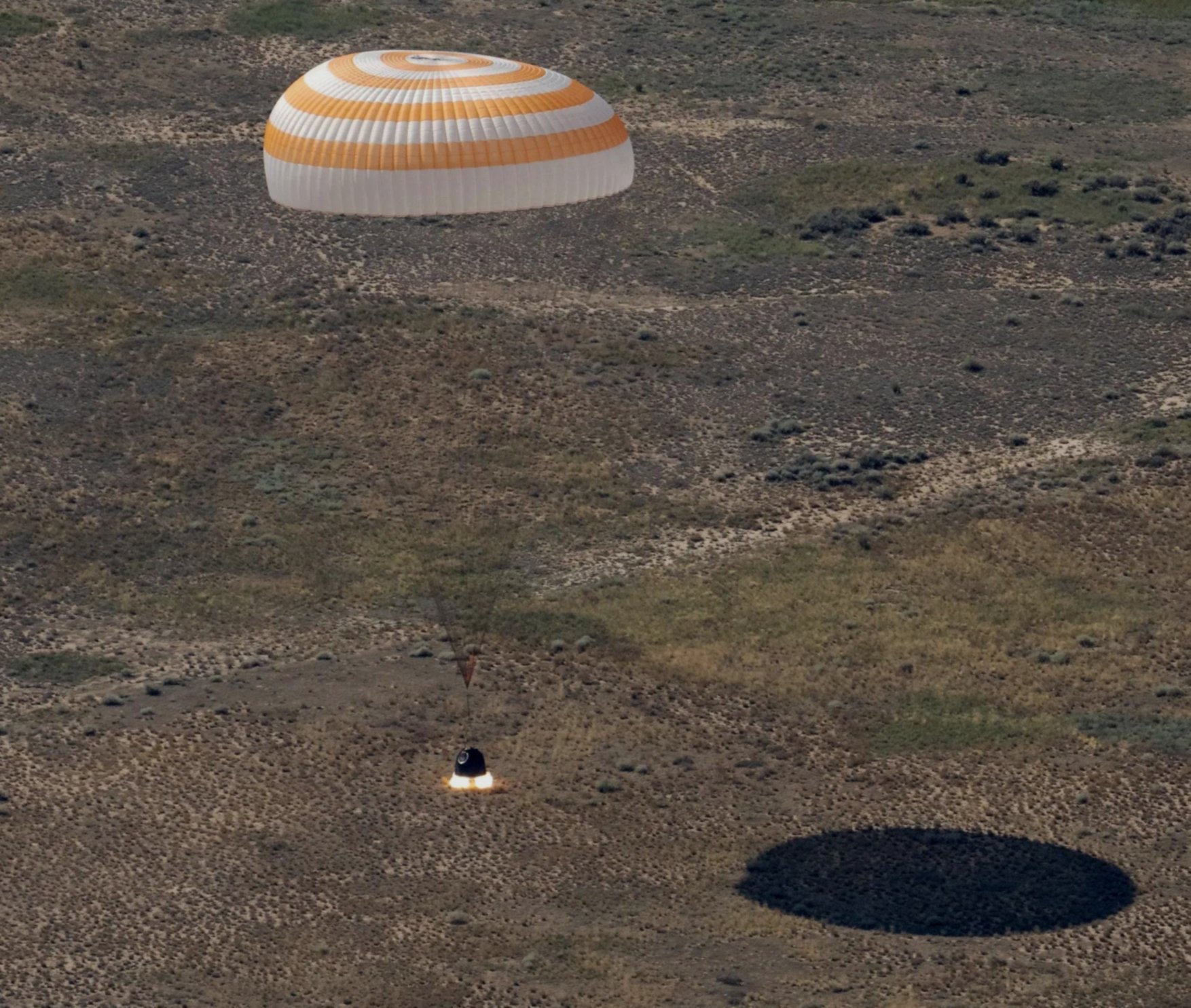
The parachute opened. Then came the dust.
Chris Williams was back on Earth. Sunday morning, July 26. The Soyuz MS-28 capsule settled southeast of Dzhezkazgan, Kazakhstan. The time? 5:27 a.m. Central Daylight Time. Or 3:27 p.m. local time. If you’re wondering where Chris Williams landed after his space mission, it’s right there in the steppe.
He wasn’t alone. Cosmonauts Sergey Kud-Sverchkot and Sergei Mikayev came home with him. Together they covered a lot of ground. Specifically, 3,856 orbits around the planet. More than 102 million miles of vacuum travel. It’s hard to wrap your head around 102 million miles until you remember Earth is round and they flew it nearly 4,000 times.
Williams, 43, spent 241 days up there.
The launch had happened on November 27, 2o25. That’s eight months of microgravity, scientific data, and staring out windows that show no horizon line, just curvature. For Williams, it was a first. For Mikaev, a first too. Kud-Sverchkot? He’s been here before. This was his second flight.
Why Williams’ Cancer Research Matters
Let’s look at the science. It’s not just floating around.
Williams worked on experiments that could actually change medicine back home. Specifically, cancer research. Why does that matter in zero-G? Because cells behave differently. Without gravity pulling them down, protein crystals form better. They form larger, purer. Which means we can map their structures more easily. That’s the first step toward new drugs.
He didn’t just sit there, though. He tested advanced manufacturing too. High-performance computer components need materials that don’t degrade when heated or cooled rapidly. Space is the perfect oven for that kind of trial. Better electronics on the ISS mean better sensors. Better sensors help with everything from climate tracking to telecommunications.
Then there were the spacewalks. Two of them.
The first was about power. The station’s systems needed upgrades. You can’t just swap a battery in orbit. You need cables. Connectors. Seals. Williams went out into the void to help prep those upgrades.
The second spacewalk? Mechanical fix. Canadarm2 broke. Or rather, a joint failed. A robotic arm the size of a bus got stuck. Williams went out to replace that faulty joint. One small piece of metal in the hand of a giant robot. Without that repair, the station loses its ability to move cargo and support astronauts. Simple as that.
Who Returned from the ISS With Williams?
The crew list matters because it shows how international cooperation works when the lights go out and the alarms go off.
- Chris Williams: NASA astronaut. First spaceflight. Lead researcher on the ISS science payload.
- Sergey Kud-Sverchkot: Roscosmos cosmonaut. Veteran. Second mission. Pilot of the Soyuz return.
- Sergei Mikaev: Roscosmos cosmonaut. First flight. Engineer. Helped with the Canadarm2 repair.
Three guys. Three nations’ worth of training. All packed into a metal tube designed for seven, flying home in one.
What Did Williams Do on the International Space Station?
You might be asking what he actually did day-to-day.
It wasn’t zero work. It wasn’t zero gravity fun either. It was a grind of schedules. Wake up. Exercise. Two hours a day just to keep bones from turning to chalk. Then lunch. Then science.
He conducted studies on fluid physics. Why? Because fluids act weird without gravity. Surface tension takes over. Capillary action does wild things. Understanding this helps us design better fuel systems for rockets. Better cooling systems for servers. Maybe even better water recyclers for deep space habitats.
He also maintained the station. When a joint breaks on Canadarm2, you don’t wait for a SpaceX dragon to ferry a replacement part next week. You fix it yourself. That’s the job. Prepare for Moon, prepare for Mars, keep the lab running.
How Williams Prepared for Moon and Mars Missions
Why send people to the Moon and Mars if they can’t fix a robotic arm or study cancer cells in real-time?
Because the ISS is a testbed. It’s proving that humans can live, work, and survive in space for long periods. 241 days isn’t record-breaking, but it’s significant. It adds to the data set. Long-duration spaceflight poses risks. Radiation. Muscle atrophy. Psychological strain. Williams and his crewmates logged the metrics. NASA takes that data back to Houston. They plug it into the models. Then they adjust the suits, the food, the schedules for Artemis.
Artemis is going back to the Moon. Mars is the long game. You can’t skip the steps. The ISS is step four.
The End of an Era? Not Yet.
Humans have lived on the ISS continuously for over 25 years. That’s a quarter of a century of eyes on Earth from orbit. A quarter-century of physics experiments that would fail on the ground.