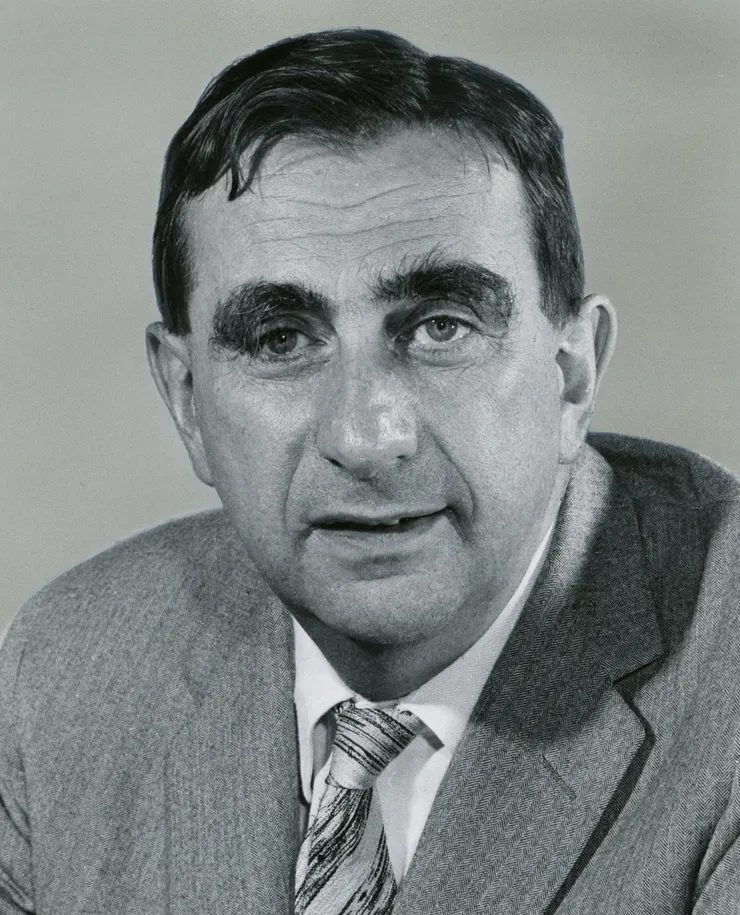
Edward Teller was the man who lived in the shadow of the atom and later helped develop the largest bomb in history. He was born on January 15, 1908 to a wealthy Jewish family in the Austro-Hungarian Empire and grew up in Budapest. In 1930, he received his doctorate from the University of Leipzig. The political situation around him changed quickly. Nazi Germany rose to power. Teller left Germany in 1933 and settled in America in 1935.
In 1941, he worked in Enrico Fermi’s team. Their goal was simple and terrifying: to achieve the first spontaneously propagating nuclear reaction. This work became the basis of the Manhattan Project. J. Robert Oppenheimer (J.
Teller was recruited by Oppenheimer in 1943. Teller was a brilliant physicist, but he was also a theorist. He was a staunch anti-communist. He believed that the United States must stay ahead of the Soviet Union at all costs.
The Push for the Hydrogen Bomb
After World War II, Teller didn’t look toward disarmament. He looked toward escalation. He supported the development of a fusion bomb. The government objected. They don’t want another nuclear arms race. Teller persisted. Finally, he was allowed to continue.
This attempt led to the creation of the Hydrogen Bomb.
In 1952, working with Stanislaw Ulam, Teller developed to develop a viable design for such a thermonuclear weapon. It was far more powerful than the atomic bomb dropped on Japan. That same year, he helped found the Lawrence Livermore Laboratory in California. It became America’s largest nuclear weapons factory. Teller’s vision had taken physical form. It’s a huge industrial complex that specializes in making better bombs.
The Fall of Oppenheimer
Teller’s influence extended beyond weapons design. It extended into the corridors of power. In 1954, he joined the opposition in J. Robert Oppenheimer’s Continuing Security Review. The hearing was intense. Oppenheimer, the father of the atomic bomb, was stripped of his clearance. Teller testified against him. Many saw this as a betrayal of scientific collegiality. Teller saw it as a necessary act of patriotism. He believed Oppenheimer’s caution was a threat to national security.
He devoted much of his energy to maintaining America’s leadership in the nuclear weapons market. He opposed treaties that sought to limit these weapons. He argued that any pause in development was a surrender.
The Star Wars Proposal
Decades later, his influence remained potent. He was primarily responsible for convincing President Ronald Reagan of the need for a strategic defense initiative. It’s a “Star Wars” project. The plan proposes the construction of a space-based missile defense system. Critics called it unrealistic and destabilizing. Teller saw it as a way to render nuclear weapons obsolete. At the very least, it makes them less effective against enemies.
Taylor died on September 9, 2003 in Stamford, California at the age of 95. That same year, he was awarded the Presidential Medal of Freedom, the country’s highest civilian award.
Is he a visionary or a villain? History has