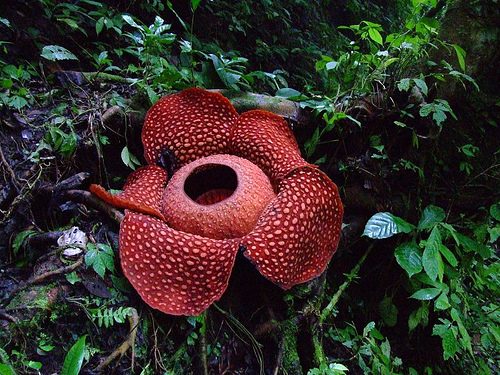
The record for the largest single flower on Earth belongs to Rafflesia arnoldii. It is a bizarre organism. No roots. No stems. No leaves. Just a massive, fleshy bloom that can reach one meter in diameter and weigh up to 10 kilograms. It does not photosynthesize. It is a pure parasite, living off the vines of its host plant in the rainforests of Sumatra and Java.
Why does the largest flower smell like rotting meat?
You would think a flower wants to smell like nectar. Not Rafflesia. It stinks. Intensely. The aroma mimics decaying flesh. It repels most humans and pets, but it is a magnet for carrion flies and beetles. These insects are drawn to the scent of death, mistaking the bloom for a feast. Once they land, the flower traps them. The flies crawl inside, picking up pollen on their bodies. When they eventually escape, they carry that pollen to other Rafflesia blooms. The bad smell is not a flaw. It is the entire pollination strategy.
Is Rafflesia actually the biggest plant structure?
Not necessarily. It depends on what you measure.
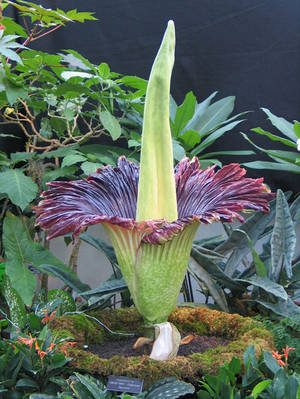
If you define “largest flower” as a single blossom, Rafflesia arnoldii wins. But botanists often distinguish between a flower and an inflorescence. An inflorescence is the entire arrangement of flowers on a stalk. By that metric, the titan arum (Amorphophallus titanum ) is a serious challenger.
Originating from Sumatra, the titan arum’s inflorescence can tower to 2.70 meters high. It is not a single petal structure like Rafflesia. It is a massive spike surrounded by a large, hood-like spathe. While Rafflesia wins on diameter and weight of a single bloom, the titan arum wins on overall height and structural complexity. Both are giants of the rainforest, using completely different evolutionary tricks to survive. Which one is “bigger” is a technicality that matters less than the sheer strangeness of both.
Why the stink draws in beetles, not bees
The smell is a dealbreaker for most people. Visitors at the Brest botanical conservatory found that out the hard way during a 2009 bloom of the titan arum. The plant emits a scent like rotting meat. It is not there to please humans.
It is bait.
The target audience is scavenger beetles. These insects are attracted to decaying flesh. They arrive to feed, but in doing so, they pollinate the plant. The exchange is simple: the plant offers a food source, and the beetles transfer pollen.
The 72-hour window matters
The entire event lasts only 72 hours. That is three days. The flower spikes, releases its scent, attracts the beetles, and completes pollination before the show is over.
This brevity makes the odor more intense by necessity. The plant has to catch the right insects fast. No second chances.
Why this strategy works in nature
You might ask why it does not use a sweeter scent like many flowers do. Bees and butterflies are common pollinators, but they are not available in the specific environments where titan arums grow, or they are not the ones needed for this species. Scavenger beetles are reliable. They are motivated by decomposition. The plant mimics that signal perfectly.
The smell is not a flaw; it is a highly targeted advertising campaign with a strict deadline.
The biology is efficient. It avoids competition with other nectar-feeders. It speaks directly to a niche group of pollinators. The result is successful reproduction despite the repulsive experience for onlookers.
For anyone planning to visit a botanical garden, the takeaway is practical: check the bloom schedule before you go. If you want to see a titan arum in action, you need to be there during those three days. Miss it, and you miss the pollination. The smell will not linger, and neither will the opportunity.