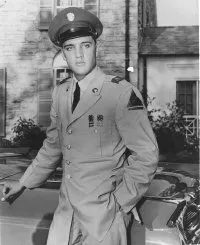
The uniform didn’t change the man, but it certainly changed his life. By the time Elvis Presley actually joined the Army in 1958, he was already a global phenomenon. But the transition from Sun Records to Fort Hood was jarring. He’d spent his two-week leave in June recording tracks in Nashville, keeping RCA fed with new material while he was technically “off the grid.” Then came the real shift. He got permission to live off-base with what the Army called his “dependents.”
That meant a three-bedroom trailer. He moved in with his parents, Vernon and Gladys, his grandmother Minnie Mae, and his friend Lamar Fike. It was cozy. Then cousins Gene and Junior Smith showed up. Suddenly, the trailer was too small. So Elvis rented a house nearby, staying there on weekends while attending advanced tank training during the week. Friends dropped by. Gladys cooked for everyone. It was a makeshift family bubble.
Then the bubble burst.
Gladys had been anxious since Elvis’s induction. The distance terrified her. Now, she was sick. Really sick. Unable to eat, she was admitted to Methodist Hospital in Memphis on August 9, 1958, with acute hepatitis. Elvis had just finished his tank training and was about to start basic unit training when the call came. The Army granted emergency leave.
He rushed to the hospital. For a moment, seeing her son, Gladys rallied. But it wasn’t enough. In the early hours of Thursday, August 14, while Vernon sat by her side and Elvis was at home, she suffered a massive heart attack. She was 46.
The grief was violent. Elvis broke down repeatedly during the days leading to the funeral. When the Blackwood Brothers sang her favorite gospel hymns at the Memphis Funeral Home, he sobbed hysterically. At the grave site in Forest Hill Cemetery, he cried out, “Oh God, everything I has gone.” It wasn’t just a loss of a parent. It was the loss of his anchor.
His fans knew this. They sent over 100,000 cards and letters. 500 telegrams. More than 200 floral arrangements. They understood the weight of the loss. But life, and the Army, didn’t stop for mourning. Elvis returned to Fort Hood on August 24. Within a month, he shipped out to West Germany with the 1st Medium Tank Battalion, 32nd Armor, 3rd Armored Division.
Before he left the country, Colonel Tom Parker organized a press conference in Brooklyn when the troop train arrived. Reporters asked about his duty, his music, and his mother. Elvis gave a raw answer that highlighted exactly what he had lost.
“Everyone loses their mother, but I was an only child, and Mother was always right with me all my life. And it wasn’t only like losing a mother, it was like losing a friend, a companion, someone to talk to. I could wake her up any hour of the night if I was worried or troubled about something…she’d get up and try to help me.”
On the U.S.S. General Randall, crossing the Atlantic, Elvis bonded with Charlie Hodge, a fellow singer he’d met on the train to Brooklyn. They ran a talent show together. But without Gladys to talk to, Elvis seemed adrift. Lonely.
West Germany offered a different kind of pressure. More press conferences. More meet-and-greets. Vernon and Minnie Mae (“Dodger,” as Elvis called her, a nickname from a childhood baseball incident) set up residence with Elvis, Red West, and Lamar Fike in hotels near Frankfurt and Bad Nauheim.
The routine was military, even if Elvis wasn’t acting like it. He woke at 5:30 AM. Dodger made him breakfast. He left for base by 6:30 in a black Mercedes taxi. He came back for lunch and dinner. Friday was the only break in the pattern. That’s when soldiers cleaned the toilets and barracks for inspection. The King of Rock and Roll mopped floors. He wanted to be seen as just another guy. Or at least, he tried.
Sneaking out was easier than cleaning. Elvis and his friends would slip into theaters after the lights went down, staying just long enough before the credits rolled to slip out unnoticed. They even went to Bill Haley concerts. He dated local girls. He kept in touch with Anita Wood back in Tennessee.
Through November and December, Private Presley went on maneuvers at Grafenwohr. He was promoted to Private First Class for his work in field exercises. This is where the dark turn began. It’s reported that around this time, a sergeant introduced him to amphetamines. A tool to stay awake during long training hours. For Elvis, it wasn’t a tool. It became a habit.
He returned to Bad Nauheim for the holidays, helping decorate the company Christmas tree on Christmas Eve. Then, in early January 1959, Elisabeth Stefaniak moved into the Hotel Grunewald. She was 19. German mother. American stepfather. Bilingual. She accepted an invitation to work as his secretary. She set up in a corner room of the hotel. She answered his fan mail. She became romantically involved with him.
She knew he was seeing other girls. She stayed anyway. Did Elvis find comfort in her presence? Or did he just need someone to fill the space Gladys had left? The amphetamines kept him awake. The girls kept him distracted. But the loneliness remained.
The German Years: Glamour, Drugs, and the Search for Connection
The story of Elvis in Germany is often told through the lens of his later scandals, but those years were foundational. The amphetamine use didn’t stop after Germany. It set a precedent. The routine of sleeping pills to crash and amphetamines to rise became a cycle that would define his later career. But in 1959, it was new. It was a secret shared only with the inner circle.
Elisabeth Stefaniak wasn’t just a secretary. She was a buffer. Between Elvis and the press. Between Elvis and the Army. Between Elvis and the grief he refused to process. She managed his correspondence, filtering the 100,000 cards his fans had sent. She kept him grounded, or so it seemed.
Yet, the duality of his life in West Germany was stark. By day, he was a soldier. By night, he was a celebrity on leave. He didn’t have to hide his fame, exactly. But he had to hide his fragility. The army didn’t know about the drugs. The press didn’t know about the heartbreak. They just saw the uniform and the smile.
Was he happy in Germany? Probably not. He was surrounded by people who loved him for what he could give them, not who he was. Gladys had loved him for him. Elisabeth loved him for his potential. The Army loved him for his discipline. Everyone wanted something.
This period in West Germany is often overlooked in biographies, but it’s critical to understanding the man who would later retreat into Graceland. The isolation began there. The coping mechanisms began there. The performative masculinity of the soldier vs. the vulnerable boy who lost his mother began there.
When he finally returned to the States in March 1960, he didn’t just bring back memories. He brought back a blueprint for survival. One that involved pills, parties, and pretending everything was fine. The King had died in that trailer in Memphis. The soldier was born in Germany. But the man? He was still lost.
Life on Leave and the End of the Line
The army years weren’t just about drills and discipline. When Elvis got leave, he didn’t exactly fade into the background. He was everywhere. The press followed his every move in Germany, turning a routine military posting into a media circus. He ate at the finest restaurants, shopped for expensive suits, and occasionally drove his Mercedes through the streets of Bad Nauheim, waving to crowds that had somehow found him. It was chaotic. It was loud. It was distinctly un-military.
“The army gave him structure, but fame made sure he never really fit in.”
His time in service eventually wound down, but not without a certain irony. He was discharged as a sergeant, a rank he had earned through time and performance, yet he left with a heart full of mixed emotions. He missed the routine. He missed the camaraderie. But more than anything, he missed the stage.
The end of his military career marked a pivot point. He wasn’t just a soldier anymore. He was a returning icon. The uniform came off, but the spotlight remained. He looked forward to what came next, though the details of his post-army trajectory—specifically his leave activities and final discharge details—are explored in the broader narrative of his life.
For those tracking the full arc of his career, here are some direct paths to more detailed records:
- Elvis Presley : The definitive timeline of his rise and fall.
- Elvis Presley Quotes : Words that defined his persona and private thoughts.
- Elvis Presley Collectibles : From concert tickets to signed photos, the artifacts of his legacy.
- Elvis Presley Songs : The tracks that kept him relevant long after the army days.
- Elvis Presley Movies : His Hollywood ventures, which began just as his military service ended.