It starts with a risk.
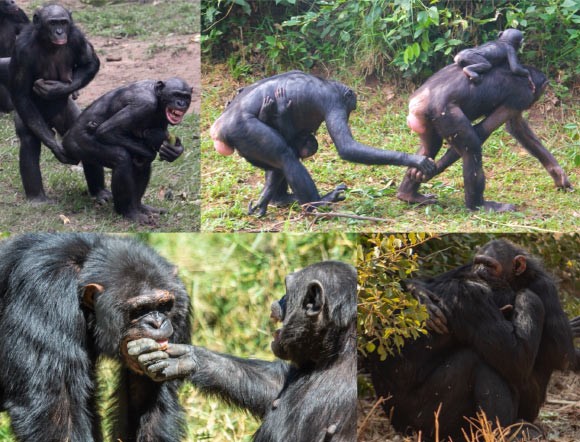
A chimp reaches out. Not to grab food, or to strike. But to put his fingers inside another male’s mouth. It’s dangerous. Teeth are close. Saliva is exchanged. In a world driven by hierarchy and resources, this makes zero evolutionary sense unless trust is the currency.
That’s exactly what a new study from Durham University suggests.
Embraces. Pats. The “reassurance train” (where chimps line up, one behind another, settling like dominoes of calm). These aren’t just cute interactions. They are ancient, calculated tools for defusing tension.
And they might have been part of the human family tree for six million years.
The Science Behind Social Touch
Researchers filmed 116 apes—both chimpanzees (Pan troglodytes ) and bonobos (Pan paniscus )—across five semi-wild African sanctuaries. The setup was simple: five-minute windows right before food was dropped into a shared space. High stakes. Hungry animals.
What they tracked? Who touched whom beforehand. Then they watched the feeding. Did they share peacefully? Or did aggression break out?
The pattern was clear. Apes that engaged in reassuring body contact before the meal were significantly more likely to feed side-by-side without fighting.
“Social tolerance… is considered a pre-requisite for information transmission,” Professor Zanna Clay explained. “In primates, tolerant social climates are linked to prosocial behavior, empathy, and social learning.”
This isn’t just about being nice. It’s about survival. Tolerance allows groups to gather around valuable resources with minimal violence. For early humans—and their predecessors—this ability to co-feed was a survival multiplier.
Bonobos vs. Chimpanzees: Different Strategies, Same Goal
Bonobos are the chill cousins. Known for sexual resolution and female alliances. Chimpanzees are the aggressive ones. Males form strong bonds but are prone to warfare.
Despite these differences, both species used touch to manage the same problem: competition over food. But the who varied.
- Bonobos: The calming effect of touch was strongest between females. This mirrors their society, where female coalitions drive social structure.
- Chimpanzees: The effect peaked between males. Reflecting the complex male-bond dynamics that keep peace in a hierarchical male-dominated group.
Crucially, the researchers noted that these behaviors were most effective in groups already known for higher social tolerance. This suggests that reassurance isn’t just a reflection of a calm group—it creates and reinforces that calm.
The “Reassurance Train” and Trust Signals
One observation stopped the researchers in their tracks. In the most tolerant chimpanzee group, a male embraced another from behind. Then a second male joined in. Then a third. Until a chain of chimps settled down, one after another.
They called it a “reassurance train.”
But the most striking gesture was the mouth-to-body contact. Placing fingers in another’s mouth is a high-vulnerability act. It signals, “I trust you not to hurt me right now.”
This risky behavior appeared far more often in tolerant groups. It serves as a potent signal of trust, lowering cortisol levels and reducing the likelihood of aggressive posturing.
“Chimpanzees are often associated with violence, but these behaviors reveal a deep willingness to be vulnerable,” noted Dr. Jake Brooker.
Did Humans Inherit This From Ape Cousins?
If chimps and bonobos both use touch to manage competition, and their last common ancestor lived roughly six million years ago, it’s highly probable that this trait existed in our shared ancestor too.
Social touch predates language. Long before we had words to say “I mean no harm,” or “We are a team,” we had our hands and arms.
The study argues that this is an evolutionary holdover—a preserved behavioral toolkit. We still rely on it.
Think about it. When you’re anxious at a party, you might touch your friend’s arm. When two rivals are about to clash, a firm hand on the shoulder can break the tension. We do this because it works. Because it was coded into our biology millions of years ago.
“The riskier mouth-to-body contacts were particularly striking,” Brooker added. “They highlight how much we depend on preserved tools from our ape cousins to navigate challenging moments.”
Why It Matters Today
We focus a lot on aggression in human evolution. The hunt. The war. The competition for status. But this research reminds us that our lineage also evolved rich, flexible strategies to avoid conflict.
To protect social relationships. To promote harmony.
The study, published in Proceedings of the Royal Society B: Biological Sciences, confirms that social touch is not merely a soft skill. It is a fundamental mechanism of social stability.
It’s a reminder that before we had politics, or treaties, or polite conversation, we had hugs. And they worked just as well then as they do now.
But here’s the thing we might miss: in a world increasingly mediated by screens, we’re losing the data. We’re forgetting the signal. When was the last time you actually looked at your friend’s eyes while reassuring them? Not typing. Not posting. Just being there, physically present, trusting enough to bridge the gap with nothing but your hand.
The apes know how to do it. Maybe it’s time we remembered why they do.