We’ve all heard the excuse. When the search for extraterrestrial life hits a wall of silence, experts shrug and say we simply haven’t looked hard enough. The Milky Way has 100 billion stars, after all. Checking them one by one would take lifetimes. So, the lack of alien radio signals just means we’re early to the party, right?
Not exactly. And not as early as you think.
Louisa Mason, a researcher at the University of Manchester, recently realized something unsettling. We have already swept through a massive chunk of our galaxy. We just didn’t know we were doing it.
The Hidden Count in the Noise
The discovery didn’t come from a new telescope or a breakthrough in signal processing. It came from looking at old data through a new lens. Mason used the Besançon Galactic Model—a detailed simulation of our galaxy’s structure—and cross-referenced it with sky surveys from two major instruments: the Green Bank Telescope in West Virginia and the Parkes Telescope in Australia.
Here is the baseline. The telescopes conducted 1,327 distinct observations. Star catalogues listed exactly 288,315 visible stars in those fields of view. A nice, clean number. A manageable dataset.
But the Besançon Model tells a different story. It accounts for stars that exist but remain invisible to our optical eyes because they are too faint. When Mason plugged the survey geometry into this model, the number jumped. We hadn’t looked at 288,000 stars. We had looked at more than 6.1 million.
Most of these stars were ghost-like to optical telescopes. They are dim red dwarfs or distant suns swallowed by interstellar dust. But to a radio telescope? They are just sources of potential noise or, hopefully, structure.
“Even a very small observation can contain a hundred thousand stars that we might never have intended to investigate.”
This is the power of commensal SETI. The strategy relies on piggybacking. A radio telescope is already pointing at a specific target for astronomy research—mapping a galaxy, studying star formation. It is listening. During that listen, it captures everything in its field of view. If an alien civilization were transmitting on those frequencies while astronomers were looking at a bright star nearby, the signal would be recorded. Buried in the noise, yes. But recorded.
The Gaia Limitation and the Radio Advantage
Why did we miss this for so long? Because standard star counts rely on catalogs like the European Space Agency’s Gaia mission, which maps positions and brightness. Gaia is miraculous, but it has a hard cutoff. It sees what is bright. It misses the billions of faint, cool, low-mass stars that dominate the galaxy by count if not by mass.
Radio waves do not care about visible light. They penetrate the dust that blinds our eyes. They reflect off the ionization in space that hides optical faintness. A star invisible in an optical catalog can still be a radio beacon. Mason’s work proves that the “parameter space” we’ve already scanned is exponentially larger than our catalogs suggest.
So, are we done? Did we already scan the universe and find nothing?
No. And that brings us to the real problem. It’s not that we haven’t looked enough stars. It’s that we haven’t looked at the right frequencies long enough.
Breaking Free of the ‘Water Hole’
Since 1960, SETI has been obsessed with a specific band of the radio spectrum known as the “water hole.” The concept is seductive in its simplicity.
Atomic hydrogen emits at 1,420 MHz. Hydroxyl (OH) emits at 1,665 MHz. Hydrogen plus hydroxyl makes water. It’s the universal solvent. It’s the stuff of life. If intelligent beings wanted to send a signal that screams “we are here and we understand chemistry,” they’d likely choose the quiet, empty channel between those two frequencies.
The water hole also happens to be in a radio window—a slice of the spectrum where Earth’s atmosphere doesn’t absorb the signal. Plus, the hydrogen line is critical for astronomy. If aliens are watching our transmissions, they’d know this frequency is special to us, too. It’s a cosmic meeting point.
But focusing here has limitations. The band is narrow. It’s crowded with natural astrophysical noise. And, crucially, it assumes aliens think like chemists who value water as we do. That’s a big assumption.
Going to the Submillimeter
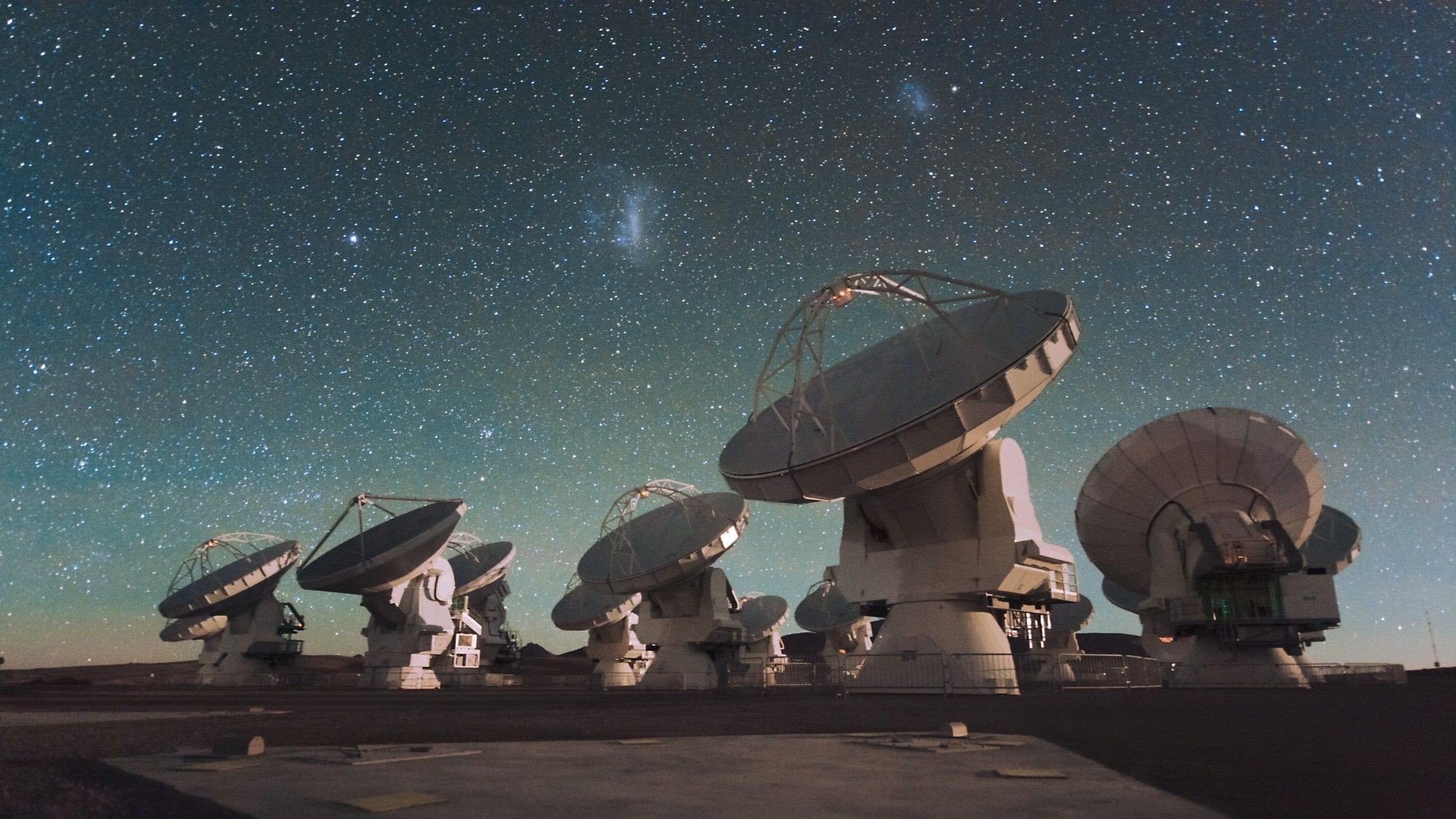
Mason’s follow-up work moved out of the familiar radio bands and into the unexplored frontier of millimeter and submillimeter wavelengths. She analyzed archive data from ALMA (the Atacama Large Millimeter/submillimeter_array) in Chile.
Why ALMA? High frequencies behave differently than low ones. Lower-frequency radio waves suffer from dispersion as they travel through space. Electrons in the interstellar medium delay the lower frequencies more than the higher ones. This stretches and distorts the signal over long distances. A sharp pulse from a thousand light-years away might arrive as a smeared echo at 1 GHz. At the higher frequencies used by ALMA, that dispersion is minimal. The signal stays sharp.
The trade-off is technical difficulty. Higher frequencies are harder to detect and more susceptible to interference from Earth-based sources like satellites and cell networks. ALMA, located in one of the driest places on Earth, minimizes the water vapor that blocks these waves.
Mason didn’t find aliens. The archives were quiet. But the attempt matters. The millimeter wave band remains almost entirely unexplored for intelligent life detection. It opens up a new parameter space. A new place to look.
The Signal We Missed
We are listening to more stars than we thought. We are using wider bandwidths than we once believed necessary. But time is still the enemy.
Radio telescopes spend only a fraction of a second on any single target. They scan, they record, they move on. A signal from another civilization might be a short burst, a repeating pulse, or a steady carrier wave. If the alien transmitter is beaming at us only during a narrow window of its rotation, or if it operates at a frequency we aren’t currently checking, we will miss it.
The sheer scale of the galaxy makes false negatives inevitable. We have swept 6 million stars, perhaps more, across a slice of the sky. That sounds impressive until you remember there are 100 billion stars in our galaxy. And millions of other galaxies beyond.
We are casting a wider net. We are checking deeper waters. But the ocean is still vast. The silence might not be emptiness. It might just be that we aren’t listening loudly enough, or in the right place, at the exact right moment.
Mason’s work changes the math. It tells us we’ve done more homework than we realized. But it doesn’t change the result. We are still waiting. And in the meantime, the universe continues its quiet, unbroken hum.