“Scientists told them ‘No.’ They did it anyway.”
That sums up the Hayabusa2 mission’s latest chapter. It wasn’t in the original script. It wasn’t safe. It was arguably the dumbest idea JAXA engineers and scientists ever hatched together. And it was brilliant.
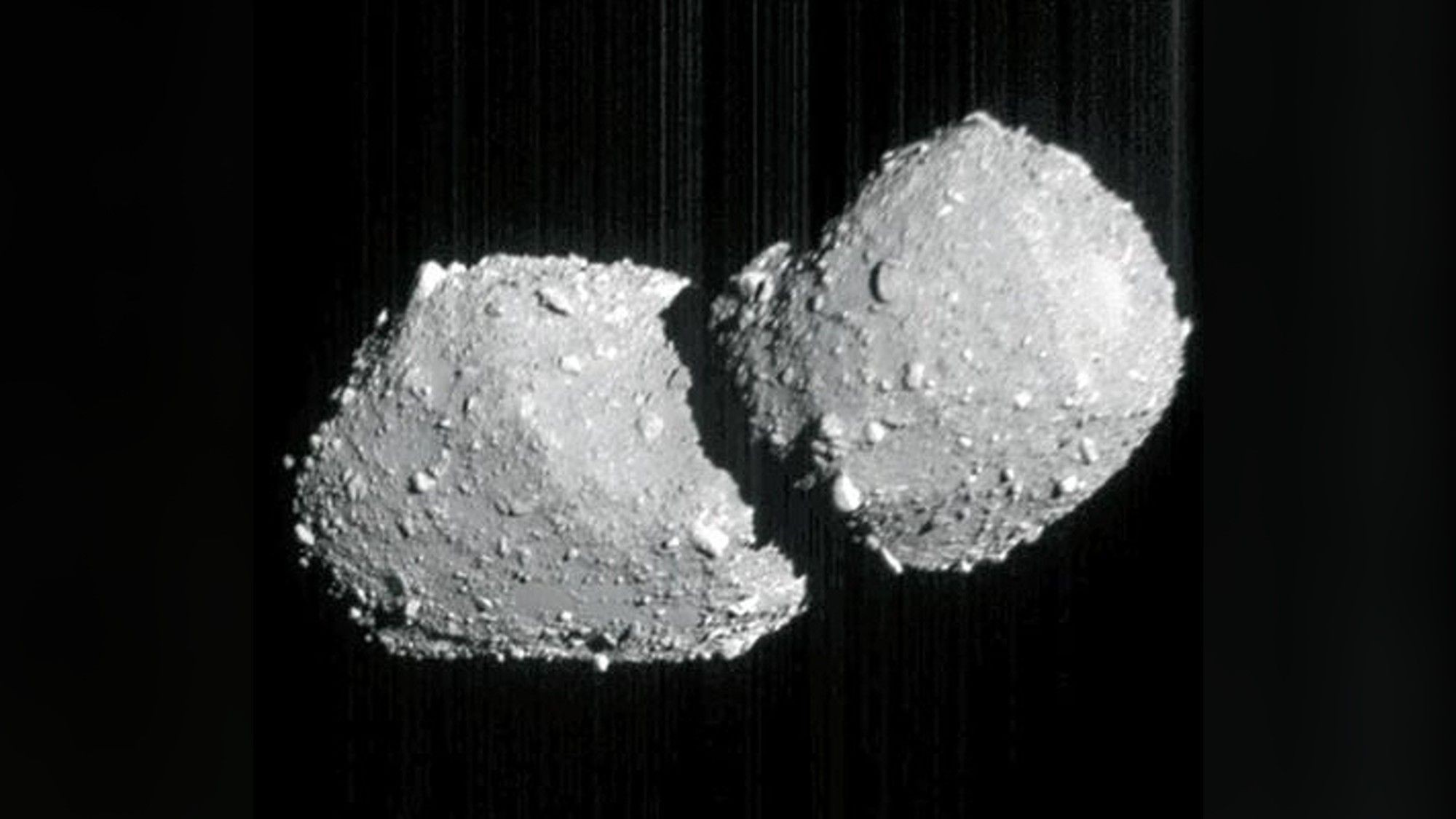
On the morning of July 5 Japan time, the aging spacecraft performed a flyby of the near-Earth asteroid Torifune. The results arrived on July 6, delivering two shocks that had no place on the risk assessment forms. Torifune isn’t just a lump of rock. It’s a contact binary—a pair of chunks glued together by gravity. And the images were huge. Clearer. Brighter than anything the mission team thought possible for a spacecraft this old and fast-moving.
“We did not imagine such a contact binary,” said Makoto Yoshikawa, Hayabusa2’s former mission manager, during a presentation in Poland on July 10. “Originally, we didn’t think we could have such a very large image… But the image was much larger than expected.”
This was the payoff. The result of months of friction, late-night debates, and one specific, last-minute proposal that terrified half the room. The flyby took Hayabusa2 to the very edge of its design limits. It was dangerous. It was unprecedented.
How JAXA Chose to Ignore the Experts
Let’s get the context straight. Hayabusa2 launched in 2014. It met the asteroid Ryugu, dug around, and brought dirt back to Earth in 2022. Mission success? Absolute. The primary goals? Done. So, JAXA gave it extra credit. A side quest.
The plan: swing by 1998 KY25 for a look and meet up with a tinier object called 1998 KY11 in 2031 for a proper rendezvous.
Standard protocol for an asteroid flyby is keeping a safe distance. You stay back. Usually about 100 kilometers (or 62 miles) out. That’s respectful space. It lets your cameras take a decent shape map without risking your multi-billion dollar hardware on a piece of cosmic debris that might have a hidden spike on it.
Yoshikawa noted that for most missions, 100 kilometers is the rule. But for Hayababa2, that was too far. The images would have been blurry blobs. Useless for detailed study. The engineers stepped up with a counter-proposal. Ten kilometers (6.2 miles) instead. The science team nodded. Ten clicks. Tight, but safe enough.
They pushed harder. Engineers confirmed they could get within 1 kilometer (0.7 miles) of Torifune’s center. The scientists were thrilled. Finally, photos they could actually study.
Then came the twist. Just thirty days before the encounter. Yuya Mimasu, the extended mission team leader, suggested something audacious. He wanted 800 meters. Half a mile from a spinning, gravity-less mountain in the middle of nowhere.
The room exploded. Some scientists flat-out said, “No. It’s too dangerous.” A heated argument erupted. You’re choosing between getting data and not destroying a perfectly good spacecraft.
The Risks of Probing an Unknown Asteroid
Why take the risk? Because unknown variables kill missions. Torifune’s exact size wasn’t pinned down. Ground observations suggested a worst-case dimension of 1,400 by 400 meters. Passing within 800 meters meant cutting the corner of that safety buffer.
The spacecraft’s optics were already scarred. Years of kicking up dust during the Ryugu landing had clouded them up slightly. Navigation had to be sharper than a needlepoint.
“The final navigation analysis put the targeting error at around 200,” Yoshikawa said. That left little room for error. But they went. Why?
Because the software had been updated. It was new tech for this specific high-speed maneuver. Hayabasa2 used ground guidance up to three hours out, then switched to onboard processing. “We developed software for this,” Yoshikawa recalled. It worked.
The Optical Navigation Camera Telescope snapped stunning images of Torifune’s two lobes. But the real story isn’t just the photos. It’s what they prove we can do when we push hard.
What We Learned From the Torifune Flyby
It wasn’t just one instrument drinking in the glory. All four of Hayabasa2’s science packages came online. The Thermal Infrared Imiger (TIR) recorded nine seconds of heat signatures just before the closest pass. That heat data independently confirmed the contact binary theory. You don’t see that heat distribution unless you have two bodies.
The Near Infrared Spectometer (NIRS3) collected chemical data. The Laser Imager (LIDAR)? That delivered something historically rare: a successful LIDAR measurement during an active high-speed asteroid flyby. Before this, nobody really knew if laser ranging worked in those violent conditions. It does.
Now for the catch. The immediate downlink is tiny. Only the critical 25 megabytes of urgent data has come back to Earth. The rest? About 300 megabytes total. It’s sitting in the hard drives, waiting. Why the delay? The spacecraft needed to head out of danger zone. Hayabusa2’s ion engine fired back up on July 9. It’s cruising now, aiming for two Earth gravity-assist flybys in late 2027 and early 2028.
It’ll fire the ion engines for four months before sending the bulk of the treasure trove back to us. Months of waiting. Of wondering if the data survived the deep-space dark.
But there’s a bigger picture here. One that transcends just another cool photo. Yoshikawa sees this mission as a dress rehearsal for something darker. Something defensive.
“This flyby serves as a demonstration of the fast reconnaissance concept in planetary defense,” Yoshikawa explained at the conference. It proves we can characterize a dangerous, unknown object in a blink.
We might not know what we’re looking at. We might not have time. But thanks to this risky, risky gamble, we know how to grab it, hold it, and learn from it quickly. The world doesn’t have time for 100-kilometer-safe passes when a rock is coming your way. Sometimes, you have to fly close to the fire.
So when the next emergency comes—and it will come—will we sit back at a safe distance and hope for the best? Or will we, like JAXa did with Torifune, decide to see it clearly?
The choice is made. We’re flying close now. We just have to wait for the files.