NASA is prepping to launch the Nancy Grace Roman Space Telescope. The launch date is set for Aug. 30, 2026. But the timing might feel a bit late for cosmic history. By then, the telescope will have a chance to look back at a violent era known as “cosmic noon.”
This was 11 to 12 billion years ago. A chaotic time. A messy time.
And it’s exactly when black holes were tearing stars apart. These events are called tidal disruption events, or TDEs. They’re the key to solving one of astronomy’s biggest headaches: how did black holes get so big so fast?
TDEs Explain the Missing Middle
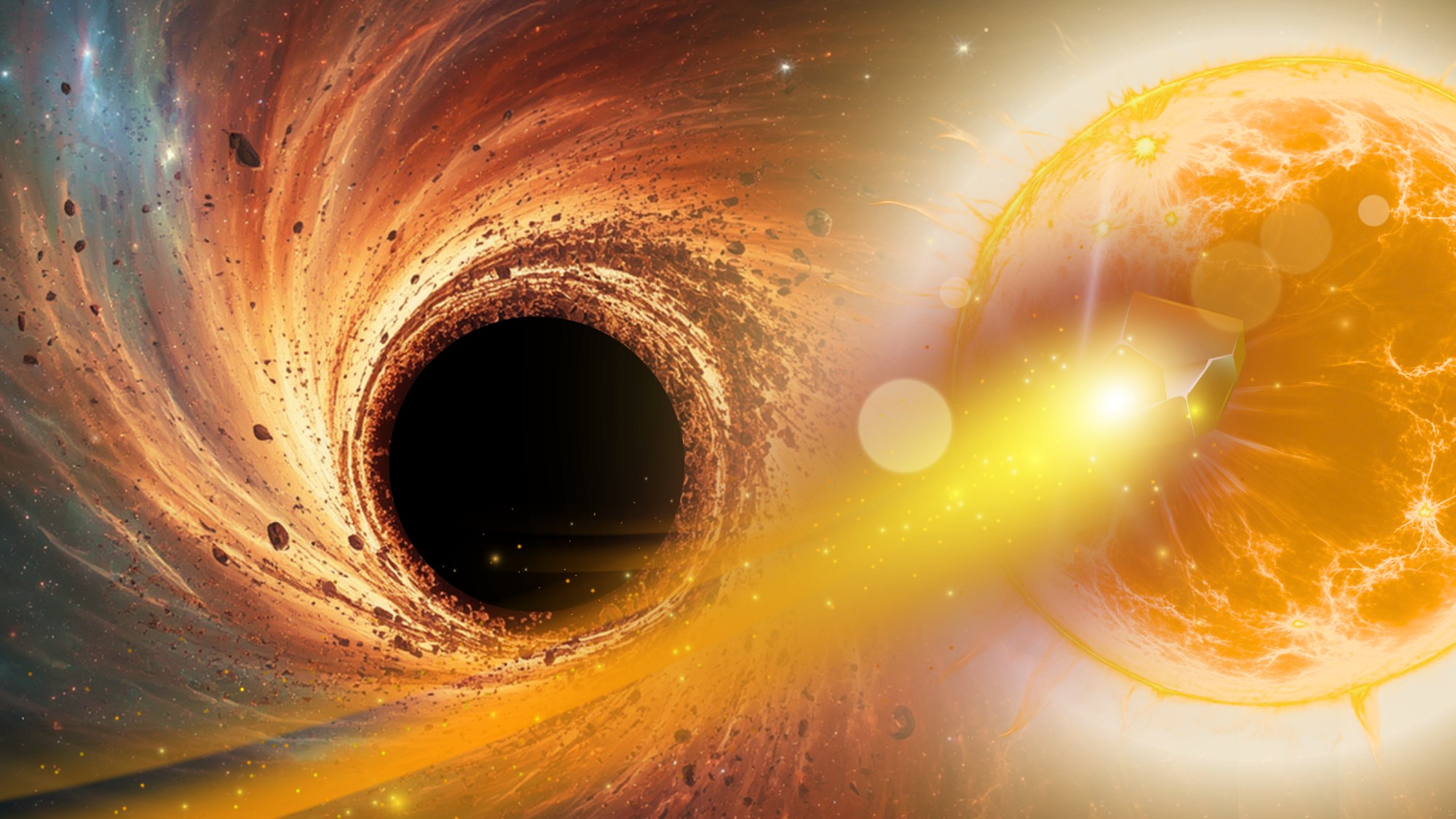
Let’s be clear about the mechanics. When a star drifts too close to a supermassive black hole, gravity wins. The black hole stretches the star out. It’s often called “spaghettification.” The star gets shredded. Plasma swirls. The black hole eats.
It’s messy. It’s bright. And it’s the only way to see lighter black holes.
Supermassive black holes usually hide behind event horizons. Light can’t escape. You can’t see them unless they’re eating. And not all black holes are hungry.
The lighter ones—the ones between 100,000 and 100 million times the mass of our sun—are picky. They don’t constantly gobble matter. They go dormant. Until a star makes a mistake.
That’s where TDEs come in. They flash bright enough to outshine the entire host galaxy. They turn on the lights for black holes that would otherwise stay dark.
But here’s the puzzle. Previous science suggested TDEs were rare in the early universe. Why? Because early black holes were thought to be too small to shred stars. Too small means no tidal disruption. No TDEs.
New data disagrees. A recent study suggests TDEs might have been common during cosmic noon. Specifically, 1 to 2 billion years after the BigBang.
Roman’s Survey Strategy
Enter the Roman Space Telescope.
It’s not just another Hubble successor. It’s a specialized tool. Its High-Latitude Time-Domain Survey will repeatedly stare at patches of sky. The area it covers equals 90 full moons.
Repeatedly.
Why repeat the view? Because transients—events that flare and fade—are fleeting. Roman needs to catch them changing.
Scientists estimate Roman will spot thousands of TDEs every year. And not just near ones. Hundreds of those will date back to cosmic noon.
“The Roman Space Telescope is going to be transformative for [transient science],” said Mitchell Karmen. “We can find multiple tidal disruption events out to [greater distances and] earlier cosmic times than ever before.”
He’s from Johns Hopkins University. He knows what he’s talking about.
This matters. It’s not just about counting events. It’s about counting the right ones.
Solving the Black Hole Growth Puzzle
The James Webb Space Telescope has been sending back data since July 2022. What it’s found is problematic.
JWST keeps spotting supermassive black holes when the universe was less than 1 billion years old.
Think about that timeline. One billion years. That’s it. For black holes to reach those masses—millions or billions of suns—they need time. They need mergers. They need food. One billion years isn’t enough time under standard models.
Unless… the seeds were different.
There are two main theories for how these monsters started.
The Light Seed Theory
This is the stellar collapse model. Massive stars die. They collapse into small black holes. These start with just a few hundred solar masses.
Then, they eat. They merge. They grow fast. But they start small.
If this is true, the early universe should be packed with these intermediate-mass black holes. And if they’re intermediate, they should be producing TDEs.
The Heavy Seed Theory
This one is more direct. No stars needed. Just giant clouds of primordial gas and dust collapsing directly into black holes.
These start big. Maybe thousands of solar masses. They skip the small phase. They grow from the jump.
But this process is rare. It requires specific, dense conditions. If heavy seeds are the rule, then intermediate black holes—and their TDEs—should be scarce during cosmic noon.
So, how do you choose?
You count the TDEs.
If Roman detects thousands of tidal disruption events during this epoch, it points toward light seeds. The black holes were common, they were growing from stellar remnants, and they were shredding stars.
If the count is low? Then heavy seeds are likely the primary pathway. The black holes grew from direct collapse, leaving few intermediate objects to cause disruptions.
The Hunt Begins
Roman won’t just confirm these theories. It will refine them.
The telescope’s high sensitivity allows it to see faint, distant flares. Flares that Hubble or even JWST might miss. It’s hunting the ghosts of early galaxies.
And it’s hunting them efficiently.
The sky is crowded during cosmic noon. Galaxies are merging. Gas is flowing. It’s a turbulent environment. Black holes are active. Stars are falling in.
Roman will look right into the mess.
Will it find the light seeds? Or will the heavy seeds hold their ground? The data will tell.
And it will do so by watching the sky break apart. Again. And again. And again.