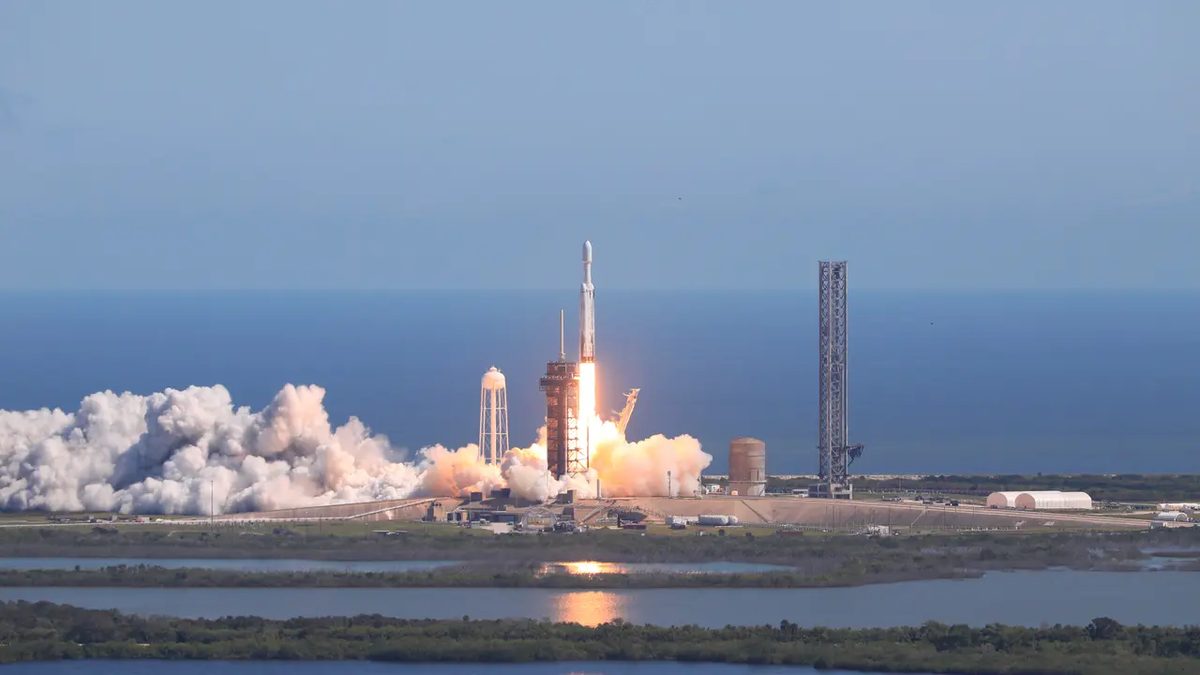
SpaceX launched the Falcon Heavy just twenty-four hours after Starship’s dramatic test flight, and the payload was far heavier than a booster recovery operation. The target: NASA’s Europa Clipper probe, bound for Jupiter’s moon, Europa.
This isn’t a quick trip. The spacecraft weighs 5.7 tonnes. Getting it there in six years requires massive power. The two side boosters burned every drop of fuel they carried. There was no reserve for the return. They were sacrificed to launch speed.
The Hunt for Habitable Conditions
The mission’s goal is specific. It wants to know if Europa’s subsurface ocean can support life. It will not dig for fossils. It won’t land. That’s technically impossible right now. Only a surface mission could do that, according to Athena Coustenis, a researcher at the Paris Observatory and member of both the Juice and Europa Clipper teams.
Right now, we’re looking for the ingredients. We’re checking the environment. Is it habitable?
“This probe is not looking for traces of life, extinct or active. Only a surface mission can do that.” — Athena Coustenis
A Six-Year Gauntlet
The journey takes six years. It’s a complex ballet of gravity assists.
- Mars flyby: March 2025.
- Earth flyby: December 2026.
- Jupiter arrival: April 2030.
This timeline is tight. It beats the European Space Agency’s Juice mission by six months. Juice launched in April 2023 on an Ariane 5. It arrives in July 2031.
Both probes study Jupiter’s moons. They share a fundamental goal: understanding habitability. But they look at different places. Juice targets Ganymede. Europa Clipper targets Europa. The habitats they investigate are completely different.
Why does this timing matter? Because space is expensive and large. Two missions hitting similar scientific targets at almost the same time doubles the data. It covers more ground. It reduces the risk of a single point of failure.
Europa is intriguing. Its ocean is hidden under ice. We can’t see it. We have to infer its properties from the surface and the magnetic field. The probe will fly through plumes if they exist. It will map the ice thickness.
This is how we prepare for the future. We check the doors before we try to open them. The heavy lifting is done. The science begins in six years. We wait.


The real news isn’t in the feed. It’s in the lab.
The quiet revolution in quantum storage
Most people think quantum computing is about speed. It isn’t. It’s about stability.
For years, the dream has been a quantum hard drive. One that holds information without collapsing. The problem? Noise. Heat. Vibration. Any interaction with the outside world destroys the delicate state of a qubit.
Now, researchers are testing a new approach. It doesn’t fight the noise. It works with it.
“We stopped trying to isolate the system completely. We started designing around the chaos.”
This shift in perspective changed everything. Instead of creating a vacuum-sealed tomb for quantum states, scientists built a system that accepts environmental interference as part of the process.
How error correction evolved
Traditional error correction requires too many physical qubits to protect one logical qubit. It’s inefficient. It’s heavy.
The new method uses topological protection. Think of it like a knot. You can pull and twist the string. The knot remains. The information is encoded in the geometry of the system, not just the state of individual particles.
This means less hardware. Less cooling. Less energy.
It’s not a magic fix. The technology is still in early stages. But the path forward is clearer.
Why this matters for your phone
You might wonder why a quantum storage breakthrough matters to someone who only cares about email and Netflix.
Because this research forces a rethinking of how we store data at the smallest scale. The materials science developed for this experiment has applications in memory chips. In sensors. In low-power devices.
We are moving toward a world where computation and storage are less distinct. Where devices can process data locally without sending it to the cloud. Privacy improves. Latency drops.
The next hurdle
The team faces a scaling problem. The current prototype works with a handful of qubits. A useful system needs thousands.
But the principle holds. If you can make one qubit stable in a noisy environment, you can make thousands. The math doesn’t lie. The engineering is the hard part.
Funding is flowing. Big tech is watching. Not because they want a quantum computer today. But because they see the long game.
The race isn’t just about who builds the first working machine. It’s about who builds the first practical one. And practical means robust. Meaningful. Useful.
We’re getting closer. Just not in the way we expected.