The sky put on a show this past Sunday. On June 21, the Moon slid across the Sun, creating that dramatic “ring of fire” spectacle known to astronomers as an annular eclipse. It was a grand event for anyone on Earth lucky enough to be in the right spot. But you do not need to look up from our blue marble to witness such celestial mechanics.
Mars has its own front-row seat.
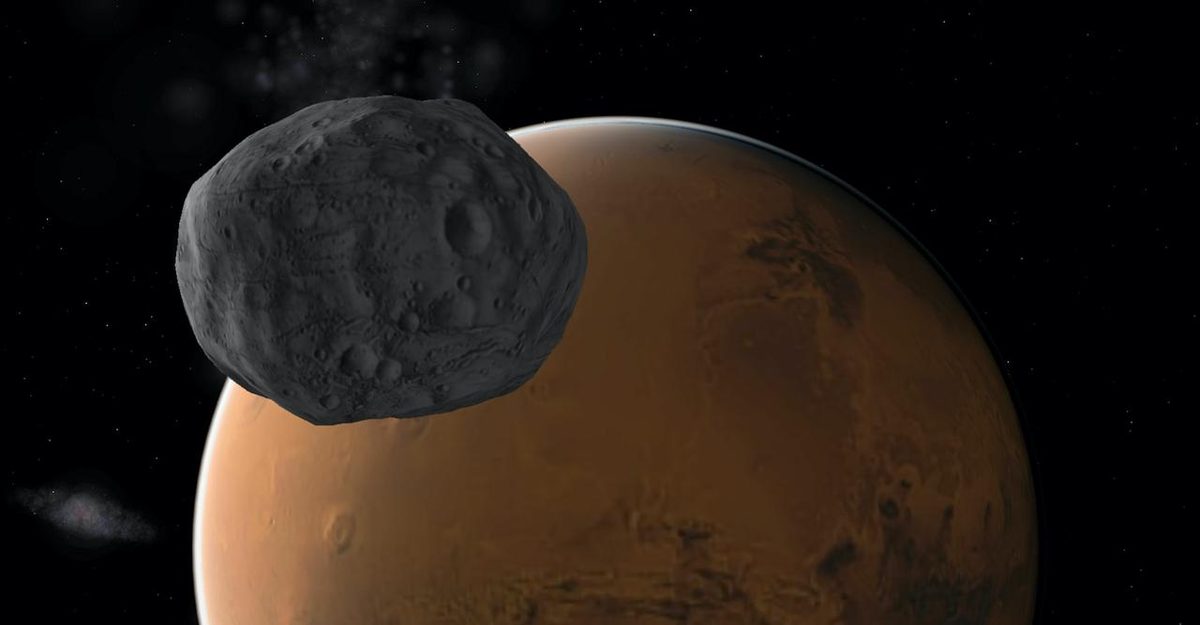
The NASA rover Curiosity has watched these events happen right from the Red Planet’s dusty surface. In fact, it has recorded several instances where the Sun was blocked out by Mars’ other moon. Just a few weeks ago—specifically on April 4, 2020—Phobos, the largest of Mars’ two small natural satellites, played hide-and-seek with the star.
Curiosity captured images of that solar eclipse by Phobos. It serves as a stark reminder that while we marvel at our own lunar alignments, our neighbor in the solar system experiences its own unique, albeit smaller, shadows.

Moons in Motion
The celestial mechanics of Mars aren’t just background noise. They’re a daily spectacle. Back in late March 2019, the rover Curiosity captured a striking image: an annular solar eclipse caused by Phobos. The moon didn’t block the sun completely. Instead, it left a bright ring of fire around its dark silhouette. A few days prior, the scene shifted. Curiosity turned its cameras toward Deimos, Mars’s other, smaller satellite. Deimos was smaller still. It didn’t eclipse. It transited. A tiny, dark speck moving slowly across the face of the sun.
These weren’t accidents. They were predictable events, governed by strict orbital laws. Yet seeing them unfold in real-time, on another planet, changes how you see the sky. Most people think of Mars as a barren desert. A red rock. But look up. The sky there is thin and butterscotch-colored. And it moves.
The motion of Phobos and Deimos across the Martian sky is faster and more erratic than any moon we see from Earth.
Why does this matter? It’s not just about pretty pictures for the JPL press room. It’s about understanding gravity. About how small bodies orbit larger ones. About how we plan for human missions. If astronauts land on Mars, they need to know when the sky will darken. They need to calculate orbits that won’t collide with debris. The transit of Deimos and the eclipse of Phobos are data points. They are checks and balances. They are reminders that Mars is not static. It is a system.
Consider the scale. Phobos is roughly 22 kilometers across. Deimos is about 12 kilometers. Both are irregular lumps of rock, likely captured asteroids. Or perhaps remnants of a larger body shattered eons ago. The leading theory suggests they formed from debris after a massive impact. Or maybe they drifted in from the asteroid belt and got caught in Mars’s gravity well. The debate continues. But the observations don’t lie. Phobos rises in the west. Sets in the east. Completes an orbit in just 7.6 hours. Deimos takes 30.3 hours. It rises in the east. Sets in the west. Slower. Steadier. Like a clock hand ticking through a Martian day.
When Curiosity watched these events, it wasn’t just looking up. It was calibrating. The rover’s navigation cameras had to account for the shadows. The dust storms. The changing light. Every pixel mattered. Every second of darkness or dimming provided feedback. How deep was the shadow? How quickly did it move? What was the texture of the moon’s surface? Rough. Pitted. Ancient.
This is how we learn. Not through grand declarations. But through small, careful observations. A transit. An eclipse. A shadow falling on red soil.


Skip the algorithm games. There are smarter ways to stay in the loop when it comes to science and tech news. You can actually control your feed if you know where to look.
Get Updates Directly on WhatsApp
The app you probably use to talk to your aunt is also a powerful tool for science news. Futura uses WhatsApp to push breaking updates right to your phone. It is fast. It is direct. You do not have to scroll through a noisy homepage.
Pro tip: Add the Futura WhatsApp channel to your favorites.
Stay Sharp with Google News
Google is more than a search engine. It is a news aggregator. By following Futura on Google News, you let their algorithm do the heavy lifting. The platform learns what you care about. If you read about quantum computing, it will show you more. If you prefer space exploration, the feed shifts. It is personalized. It is efficient.
Why This Matters
Algorithms on social media are designed to keep you angry or addicted. They are not designed to keep you informed. When you subscribe to these channels, you take back some control. You get the facts. You get them early.
You do not need to check five different websites every morning. One channel. One app. The news finds you.