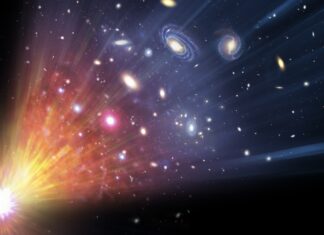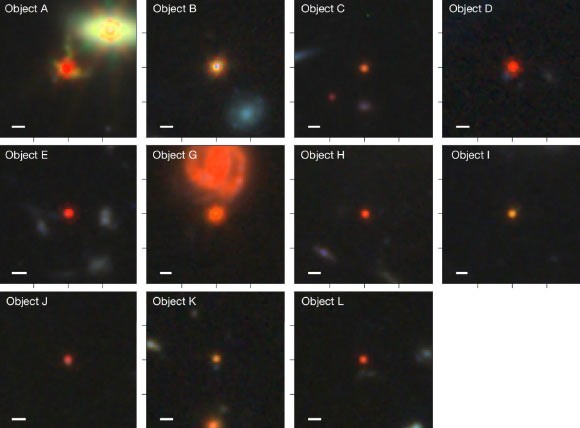
Astronomers have finally solved the mystery of the enigmatic “little red dots” appearing in early Universe images captured by the James Webb Space Telescope (JWST). These specks, scattered across the sky from a time only a few hundred million years after the Big Bang, are not massive early galaxies, but young supermassive black holes actively feeding on dense clouds of ionized gas. The discovery provides key insight into how these cosmic behemoths grew so quickly in the Universe’s infancy.
The Mystery Unveiled
Since JWST’s launch in 2021, the red dots have puzzled scientists. Initial theories proposed exotic phenomena or unusually massive galaxies forming at unprecedented rates. However, a team led by Professor Darach Watson at the University of Copenhagen conducted two years of rigorous analysis, revealing the true nature of these objects.
The dots are black holes, roughly one hundred times less massive than previously assumed, enveloped in thick cocoons of ionized gas. As these black holes consume the surrounding gas, the friction generates intense heat. This heat emits radiation that filters through the cocoon, appearing as the characteristic red glow detected by JWST’s infrared sensors.
How Black Holes Grow: Fuel and Spotlight
These early black holes aren’t just small in mass; their growth is also remarkably efficient. While black holes are typically inefficient eaters, blasting much of their inflowing material back into space, the dense gas cocoons act as both a fuel source and a natural spotlight. The cocoon allows astronomers to observe black holes in an intense growth phase previously unseen.
“We have captured the young black holes in the middle of their growth spurt at a stage that we have not observed before,” Professor Watson stated. “The dense cocoon of gas around them provides the fuel they need to grow very quickly.”
Implications for Supermassive Black Hole Formation
The findings address a long-standing puzzle in astrophysics: how supermassive black holes, like the one at the center of our Milky Way, grew so quickly in the early Universe. The newly identified black holes, weighing up to 10 million times the mass of the Sun, demonstrate a plausible mechanism for rapid growth.
This discovery isn’t just about confirming the existence of smaller black holes; it’s about understanding how they became the supermassive giants we observe today. The early Universe provided the perfect conditions for these black holes to rapidly consume gas, accelerating their growth in a way that is no longer possible in the modern cosmos.
The research, published this week in Nature, provides a crucial piece in the puzzle of black hole evolution, bridging the gap between theoretical models and observational data.
“The little red dots are young black holes, a hundred times less massive than previously believed, enshrouded in a cocoon of gas, which they are consuming in order to grow larger.” – Professor Darach Watson.
The study provides the first direct observation of black holes during this critical early growth phase, revolutionizing our understanding of how they shaped the Universe’s evolution.