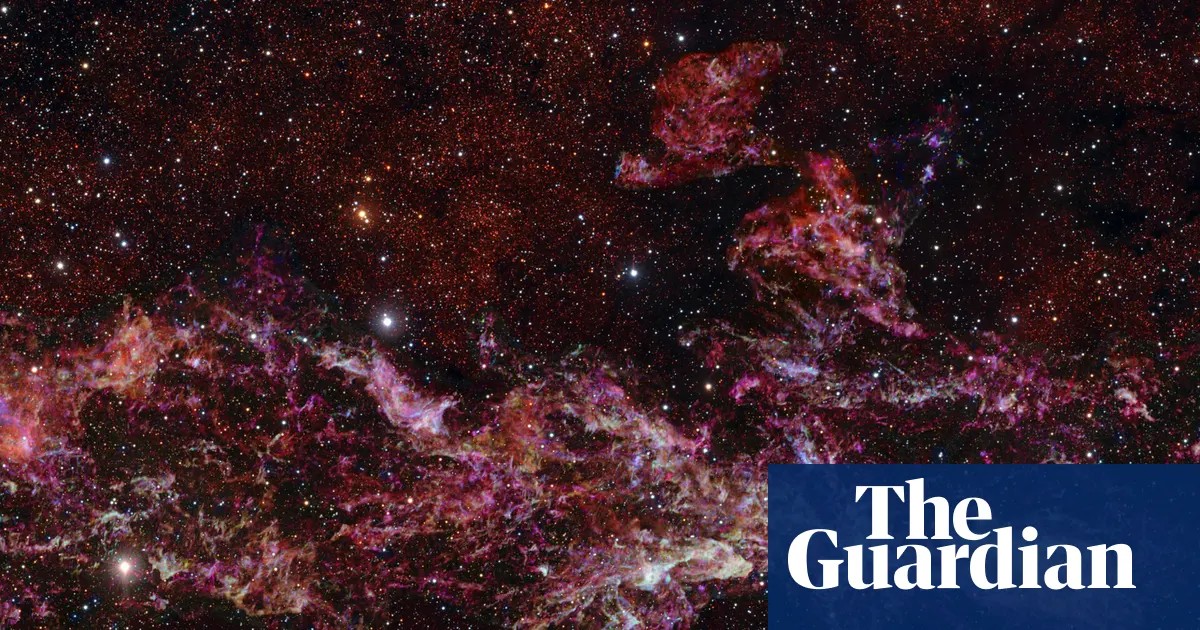
Scientists have unveiled the most detailed image to date of the Milky Way galaxy’s core, offering an extraordinary look at the chaotic, star-forming region at the heart of our cosmic home. Captured by the Atacama Large Millimeter/submillimeter Array (ALMA) radio telescope in Chile, this breakthrough isn’t just visually striking; it provides crucial insights into the conditions of the early universe.
Unprecedented View of Galactic Center
For years, observations of the Milky Way’s center have been fragmented, like isolated snapshots of a sprawling city. Previous data showed only small patches, making it impossible to grasp the overall structure. The new ALMA image changes this by providing a comprehensive map of the central region, revealing the interconnectedness of gas clouds, star-forming regions, and flowing matter.
“It was like having a few snapshots of individual streets but no map of the city,” explains Steven Longmore, principal investigator of the ALMA CMZ Exploration Survey and professor of astrophysics at Liverpool John Moores University. “We could see gas here, a star-forming cloud there, but we were missing how it was all connected.”
Echoes of the Early Universe
The conditions within the Milky Way’s center—extreme temperatures, pressures, and turbulence—mirror those of galaxies in the early universe when most stars were being born. This makes our galactic core a unique laboratory for studying star formation.
Longmore elaborates: “The conditions at the center of our galaxy are very similar to the conditions in galaxies in the early universe… but we can observe individual stars and planets forming within it.” This ability to study star formation up close offers a window into the distant past.
Unexpected Filamentary Structures
One of the most surprising discoveries was the presence of long, thin filaments of matter flowing towards star-forming regions. These structures were not predicted and suggest that the mechanisms driving star birth in the galactic center are more complex than previously understood.
“These long, thin filaments that we see are streams of matter that are flowing along to make stars and planets, and that was unexpected,” Longmore stated.
Future Observations and Combined Data
Researchers now hope to combine ALMA’s millimeter-wave observations with data from other telescopes, such as the James Webb Space Telescope and the Extremely Large Telescope (under construction in Chile). This multi-wavelength approach will allow for even more detailed analysis.
By combining observations, scientists can pinpoint cause-and-effect relationships: for example, confirming whether gas cloud collisions trigger star formation. The team has already applied for Webb telescope time, though competition is fierce.
“When astronomers combine observations at different wavelengths, we create color images where each color represents different physical information… That is the kind of cause-and-effect we can start to pin down when we combine these datasets.”
The new image of the Milky Way’s center not only advances our understanding of galactic evolution but also highlights the inherent beauty of the universe. As Longmore puts it, the physics that makes the image scientifically valuable is also what makes it visually stunning.
This groundbreaking image marks a significant step forward in astrophysics, offering a glimpse into our galaxy’s core and providing valuable insights into the processes that shaped the universe we inhabit.