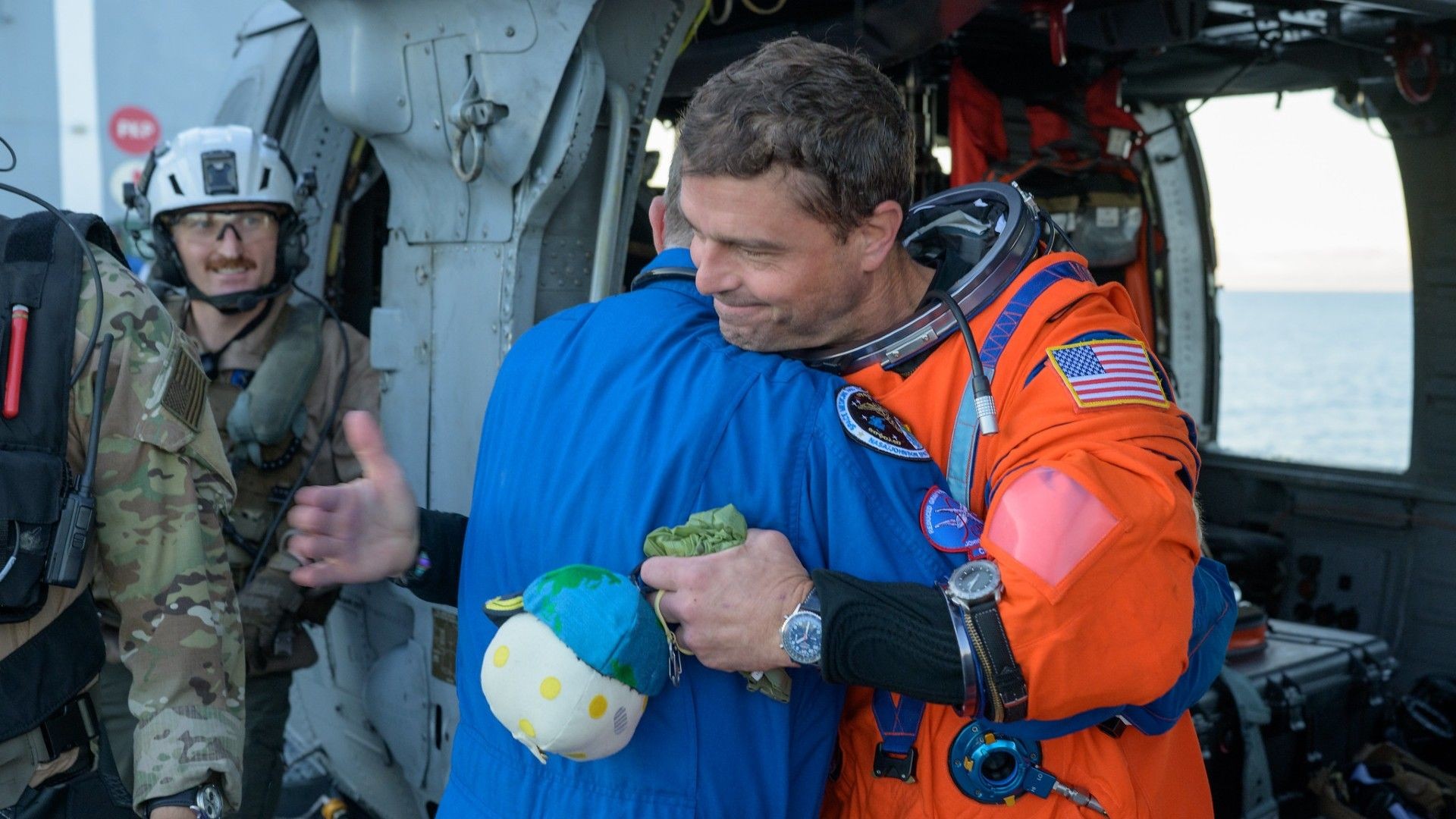
The Artemis 2 mission marked a historic milestone: the first human lunar flyby in over five decades. While the technical achievements of the mission were monumental, the journey was defined equally by a profound human connection to a small, plush mascot named Rise.
What began as a scientific demonstration evolved into a deeply personal tribute, bridging the gap between high-stakes space exploration and the intimate realities of human loss.
The Story of Rise
Rise is more than just a toy; it is a functional zero-gravity indicator. Designed by Lucas Ye, a third-grader from California, the miniature moon features an Earth-colored cap filled with stars. Hidden inside the mascot is an SD card containing over five million names of people from around the world, all wishing to have their names accompany a human mission to the Moon.
Throughout the 10-day mission, Rise served several roles:
– A scientific tool: Demonstrating the effects of microgravity.
– A social media star: Capturing the attention of millions during NASA’s livestreams.
– A crew companion: Floating alongside astronauts Reid Wiseman, Victor Glover, Christina Koch, and Jeremy Hansen.
A Personal Tribute in Orbit
As the mission unfolded, the mascot took on a much deeper meaning for the crew. During a livestreamed moment on April 6, the crew shared a poignant tribute to Carroll, the wife of mission commander Reid Wiseman, who passed away from cancer in 2020.
In a moving gesture, the crew suggested naming a lunar crater after her—a proposal that will be formally submitted to the International Astronomical Union. This moment highlighted a recurring theme in space exploration: even in the most advanced technological environments, the crew remains deeply connected to their personal histories and loved ones left on Earth.
Observers later noted that a prototype of Rise had been inscribed with the name “Carroll,” signaling that the mascot had become a vessel for the crew’s collective remembrance.
Defying Protocol to Bring the Mascot Home
Upon the spacecraft’s successful splashdown in the Pacific Ocean, NASA’s standard post-landing checklist dictated that certain items be left behind in the Integrity Orion capsule for later retrieval. However, Commander Wiseman chose to deviate from this procedure.
Driven by a personal connection to the mascot, Wiseman took several steps to ensure Rise returned to Earth:
1. Securing the mascot: He placed Rise in a dry bag from the survival kit and attached it to his pressure suit.
2. The recovery: The mascot traveled from the splashdown site via raft and U.S. Navy helicopter to the USS John P. Murtha.
3. The journey home: Wiseman kept the mascot close, even securing it to a water bottle with a lanyard during transit to California.
Wiseman expressed his sentiment simply on social media: “It’s hard not to love this little guy. I can’t let Rise out of my sight.”
What Happens Next?
The future of Rise remains uncertain. Under NASA guidelines and U.S. law, the disposition of “space-flown artifacts” is strictly regulated. While the mascot has already appeared at celebratory events in Houston and in a photo with Wiseman’s daughters, its official status as a historical artifact is yet to be determined.
The journey of Rise illustrates how even the most technical missions are shaped by human emotion, turning a simple educational tool into a symbol of memory and resilience.
The Artemis 2 mission proved that while humanity reaches for the stars, we carry our most important earthly connections—and our grief—with us into the void.