







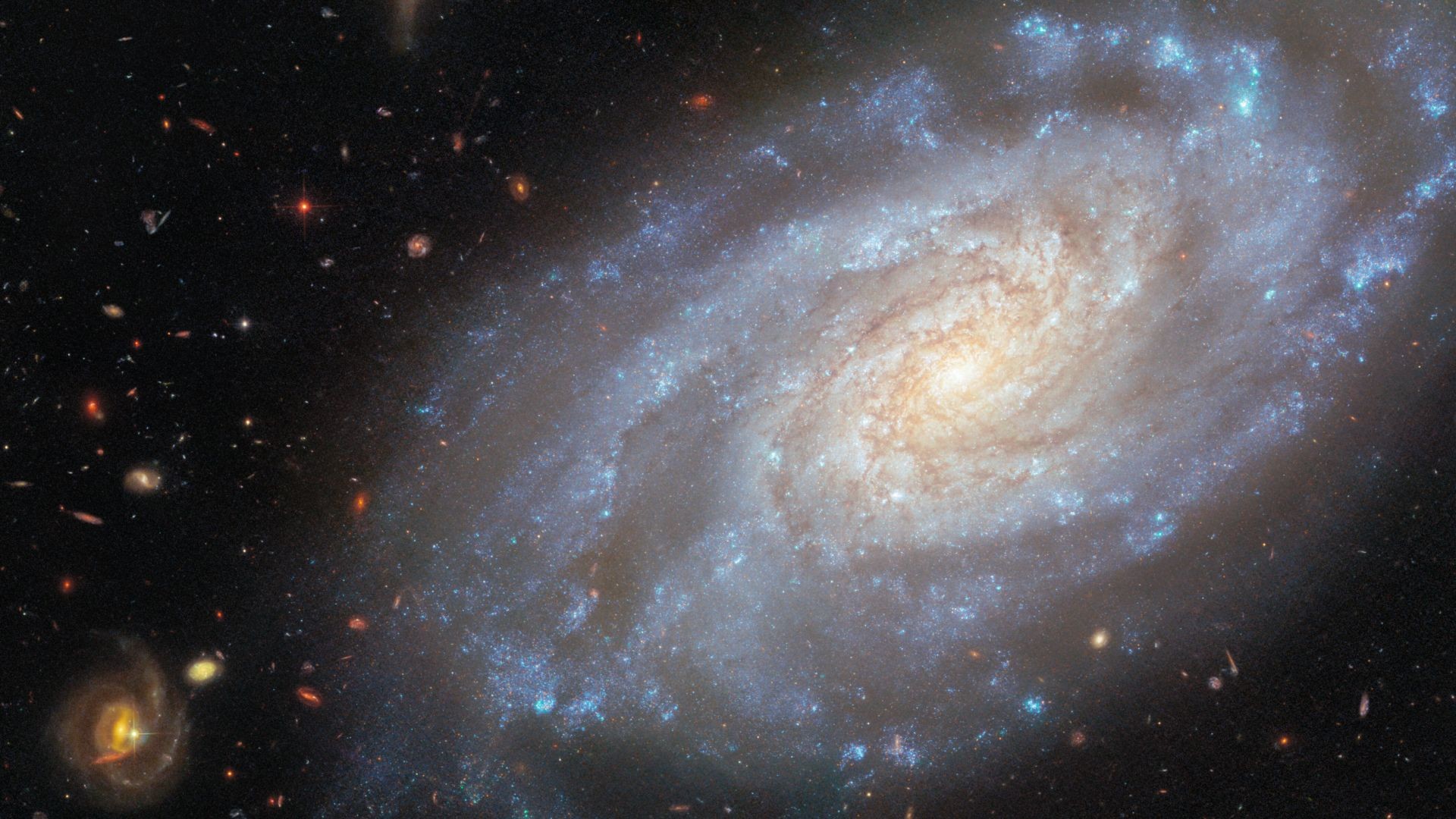
The Hubble Space Telescope has turned its gaze towards NGC 3370, a captivating spiral galaxy nestled within the Leo constellation. This image, released as the Photo of the Day for November 2025, offers a detailed view of a galaxy that’s held a special interest for astronomers for years. NGC 3370’s inclusion in a small group of galaxies previously observed by Hubble underscores its value in helping scientists decipher the complex dance of galactic evolution.
Understanding Galactic Groups and Interactions
NGC 3370 isn’t an isolated island in space; it belongs to a small group of galaxies. This context is key to understanding its significance. Studying galaxies within groups like this allows astronomers to observe firsthand how galaxies interact, influence each other’s formation, and evolve over vast stretches of cosmic time. These interactions are crucial to galactic development – think of them as galactic neighborhood dynamics.
What is a Spiral Galaxy?
Spiral galaxies are perhaps the most iconic and recognizable structures in the universe. They are characterized by their elegant, swirling arms that emanate from a bright, central core. Within these arms, you’re likely to find a vibrant mix of young, newly formed stars, older, more established stars, plus swirling clouds of gas and cosmic dust – the raw material for new star birth.
Our own Milky Way galaxy is a prime example of this type. Examining other spiral galaxies, like NGC 3370, provides valuable insights into the broader processes of galactic formation and evolution. By studying these distant galaxies, we are essentially studying the history of galaxies like our own.
Location and Distance: A Glimpse 90 Million Light-Years Away
NGC 3370 resides within the Leo constellation, a remarkable 90 million light-years from Earth. This vast distance means that the light we see today left the galaxy millions of years ago, providing us with a window into its distant past.
Standard Candles: Measuring the Universe
What makes NGC 3370 particularly fascinating to astronomers are two specific types of celestial events that occur within it: Cepheid variable stars and Type Ia supernovas. Both act as what astronomers call “standard candles.”
Cepheid Variable Stars: Pulsating Clues
Cepheid variable stars are stars that brighten and dim in a predictable rhythm. The key is that the longer the cycle of pulsation, the brighter the star. This allows astronomers to determine their intrinsic brightness, and by comparing that to their apparent brightness as seen from Earth, they can calculate their distance.
Type Ia Supernovas: Consistent Explosions
Type Ia supernovas are even more useful. These occur when a white dwarf star – the remnant core of a sun-like star – undergoes a catastrophic thermonuclear explosion. A defining feature of Type Ia supernovas is their almost uniform peak brightness. This allows astronomers to use them to measure distances over even greater spans of space.
Measuring Cosmic Distances and the Expanding Universe
Both Cepheid variable stars and Type Ia supernovas are vital for building what’s known as the cosmic distance ladder. By combining the distances to these objects, astronomers can measure how quickly the universe is expanding. The accuracy of this measurement has revolutionized our understanding of the universe’s age, size, and fate.
NGC 3370’s inclusion of both of these “standard candles” makes it a valuable addition to the astronomer’s toolkit for mapping the cosmos and furthering our comprehension of the universe’s grand scale and motion.