


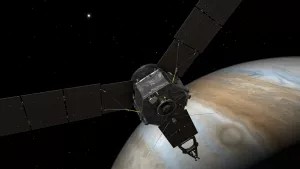
The night sky shifted on July 5, 2016. After a grueling five-year journey through the void, NASA’s Juno spacecraft finally slipped into orbit around the solar system’s heavyweight champion: Jupiter. It had been a long time since the gas giant received a close visit, leaving it shrouded in mystery for decades. Scientists had mapped its storms and counted its moons, but the core of the planet remained a locked box.
Juno’s arrival changed that.
The mission wasn’t just about taking pretty pictures of swirling clouds. The real goal was far more ambitious. Juno carried a suite of instruments designed to drill down into Jupiter’s atmosphere, its magnetic field, and its gravitational pull. By analyzing these forces, researchers hoped to answer fundamental questions about how our solar system formed. Did Jupiter form quickly or slowly? Does it have a solid core? How deep do its iconic storms reach?
For years, astronomers could only speculate. Ground-based telescopes offered glimpses, and earlier probes like Galileo provided some data, but they were limited. They couldn’t penetrate deep enough or map the global fields with sufficient precision. Juno was built to break those barriers.
The timing was significant. July 2016 marked the first time a spacecraft had successfully orbited Jupiter in such a polar trajectory, allowing Juno to peer down from above the poles rather than skimming the equator. This unique vantage point provided a comprehensive view of the planet’s magnetosphere, the region dominated by Jupiter’s powerful magnetic field.
The data streaming back has rewritten textbooks. Juno revealed that Jupiter’s magnetic field is more irregular than previously thought, with intense magnetic storms near the poles. It showed that the planet’s famous bands of clouds extend far deeper than expected—hundreds of kilometers down—before fading into a uniform haze. Perhaps most surprisingly, Juno’s gravity measurements suggested that Jupiter’s core might be “fuzzy” or diluted, rather than a distinct, compact ball of rock and ice.
This wasn’t just a triumph of engineering. It was a direct answer to the question of how planetary giants evolve. Understanding Jupiter’s internal structure helps scientists understand the formation of all gas giants, including those orbiting distant stars. If we can decode Jupiter, we get a blueprint for exoplanets millions of light-years away.
Juno didn’t just visit. It listened. And what it heard was a planet far more complex, and far more dynamic, than anyone imagined. The secrets are still unfolding, but the conversation has finally begun.
Jupiter doesn’t just sit in the sky. It dominates it. No other planet in the solar system comes close to its mass, its sheer physical size, or its rotational speed. The storms it generates are violent enough to swallow Earth whole. Its gravity has shaped the architecture of our cosmic neighborhood since the beginning. Ancient eyes looked up and saw a bright wanderer among the stars. Today, that same bright point of light hangs low over the western horizon at dusk. It’s visible without a telescope. But appearance is deceptive.
The Mystery of the Hot Core
For decades, we’ve had data, but not answers. The Galileo probe, which orbited the gas giant for years starting in 1995, sent back streams of images and numbers. They were invaluable. They were also incomplete. We still didn’t know where the planet’s internal heat came from. Jupiter radiates more energy than it receives from the sun. Why? What drives the chaotic weather patterns in its atmosphere? Does a solid core even exist at the center, or is everything just swirling fluid? And how does it generate a magnetic field so powerful it traps radiation belts capable of frying satellite electronics?
These questions lingered. They remained open wounds in our understanding of planetary science. Until now.
Juno’s Mythological Advantage
The new mission has a name that fits the job perfectly. Juno. In Roman mythology, Jupiter’s wife possessed the gift of seeing through the clouds and deceptions her husband used to hide his infidelities. NASA chose this name to symbolize the probe’s mission: to look past the thick, deceptive layers of ammonia clouds and see the truth underneath.
It’s a clever nod to the science. The probe is equipped with instruments designed to penetrate deep into the atmosphere, measuring gravity, magnetic fields, and water content. It’s not just taking pictures. It’s doing forensic work.
Tiny Passengers, Big Science
The mission carries a peculiar cargo. Three miniature Lego figures are secured inside the radiation-shielded electronics bay. You’ve got Jupiter, the king. You’ve got Juno, the all-seeing wife. And you’ve got Galileo Galilei, the man who first mapped the four largest moons and proved they orbited something other than Earth.
They’re small. Insignificant to the physics of the mission. But they serve a purpose. They remind us that this isn’t just abstract data collection. It’s a continuation of human curiosity. A lineage of observation. From Galileo’s telescope to Juno’s sensors. The tool changes. The intent remains the same.
We are finally getting close enough to ask the hard questions. The answers might rewrite what we think we know about gas giants. Or they might just add another layer of confusion. Either way, the sky is no longer a mystery. It’s a laboratory. And the experiment is just beginning.
The mission profile is aggressive. Juno has at least a year and a half to wring every ounce of data from Jupiter. It isn’t just flying by; it is diving in. The goal is to pierce the cloud deck, map the deep atmosphere, and use gravity to see through the planet’s opaque bulk to its core. At the same time, it needs to characterize the most powerful magnetic field in the solar system. This isn’t just about cataloging features. It’s about rewriting the textbook on gas giant formation.
To do this, the probe carries a heavy scientific payload. There is no single instrument that does it all. Instead, Juno relies on a suite of sensors working in tandem to answer the question: what is Jupiter actually made of?
Mapping the Deep Atmosphere with Microwaves
Standard telescopes only see the top layer. They show us the swirling ammonia clouds and the violent storms raging on the surface. But the real story is deeper. To get there, Juno uses a Microwave Radiometer.
This instrument acts like a thermal CT scan for the planet. It measures the heat radiating from deep within the atmosphere. By analyzing these microwave emissions, scientists can map the movement of gases and determine the structure of the atmosphere far below the visible cloud tops. More importantly, it identifies specific elements and molecules. It looks for water, ammonia, and methane.
Why does this matter? Because the ratio of these elements tells the story of where Jupiter formed. Did it build its core quickly? Did it migrate inward? The chemical fingerprint left in the deep atmosphere holds the answers to the solar system’s early history.
Probing the Magnetic Field and Polar Regions
Jupiter’s magnetic field is monstrous. It is thousands of times stronger than Earth’s. To understand such a beast, Juno carries a highly sensitive Magnetometer. But a magnetometer alone is not enough.
The probe also carries specialized particle detectors. These sensors measure the high-energy electrons and ions trapped in the magnetosphere. They track how these particles flow along magnetic field lines toward the poles. This data helps map the structure of the magnetic field itself, revealing its asymmetries and intense regions.
To complement this, Juno uses a thermocamera to observe the polar regions. The interaction between the magnetic field and solar wind creates spectacular auroras. By measuring the heat signatures of these polar lights, scientists can infer the energy transfer processes happening high in the atmosphere. An ultraviolet and infrared spectrograph then analyzes the upper atmosphere, looking at the chemical composition and temperature gradients in the layers above the main cloud decks.
Eyes on the Storms
Amidst the complex science instruments, there is a standard camera. It might seem redundant given the spectrographs and radiometers, but human perception still matters. This camera will capture stunning, high-resolution images of Jupiter’s clouds and storms.
These images provide context. They show the visual scale of the phenomena being measured by the other instruments. When the microwave radiometer detects a deep plume of ammonia, the camera can show the corresponding storm structure at the top. It bridges the gap between raw data and visual reality.
Why This Data Changes Everything
The combination of these instruments allows for a holistic view. We are not just looking at a snapshot. We are looking at a dynamic, three-dimensional model of a gas giant.


