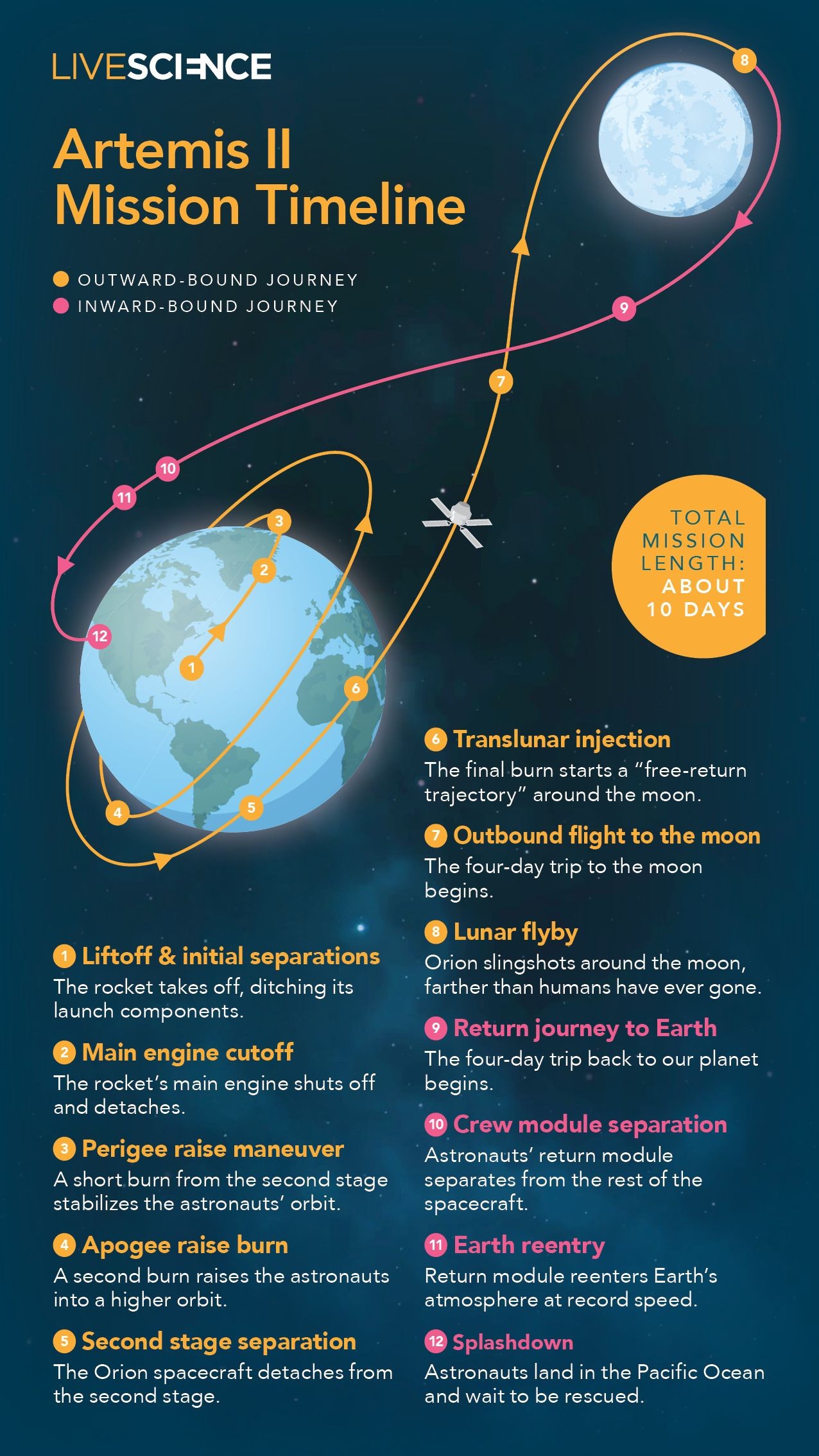
After decades of anticipation, NASA is poised to send astronauts around the Moon once again with the Artemis II mission. Scheduled for launch no earlier than April 1st, this flight represents humanity’s first crewed lunar mission since Apollo 17 in 1972, and a crucial step toward establishing a long-term lunar presence.
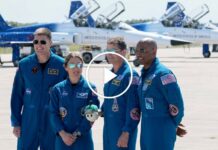
The four-person crew — Commander Reid Wiseman, Pilot Victor Glover, and Mission Specialists Christina Koch and Jeremy Hansen — will embark on a 10-day journey aboard the Space Launch System (SLS) rocket and Orion capsule. This isn’t just another space flight; it’s a carefully orchestrated sequence of events, pushing the boundaries of human space travel. Here’s a breakdown of the 12 key stages that will take them to the Moon and back.
Liftoff and Initial Ascent (T+0 to T+2:08)
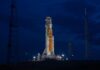
The mission begins 49 hours before launch with rigorous safety checks. Three hours before liftoff, the crew will strap into the Orion capsule atop the 322-foot SLS rocket, which holds over 700,000 gallons of cryogenic fuel. Ignition of the four main engines will occur seven seconds before launch, followed by the ignition of solid-fuel boosters at T-0. The rocket will clear the launch tower in 6.5 seconds, subjecting the crew to up to 4 G’s of force as they break the sound barrier after 56 seconds. At around 2 minutes and 8 seconds into flight, empty boosters will be jettisoned to reduce weight, falling back to Earth in the Atlantic Ocean.
Main Engine Cutoff and Orbital Insertion (T+6:06 to T+49)
Six minutes after liftoff, the rocket’s main engines will shut down, detaching and either burning up in the atmosphere or falling into the Pacific Ocean. The crew will then enter a highly elliptical orbit, reaching an altitude of 1,400 miles. Over the next 40 minutes, Koch and Hansen will prepare the spacecraft for operations, including setting up life support systems. First-time astronaut Jeremy Hansen faces a 50% chance of experiencing space adaptation syndrome (severe motion sickness), requiring careful movement to mitigate discomfort.
Perigee Raise and Stabilization (T+49)
Once life support is established, the Interim Cryogenic Propulsion Stage (ICPS) will execute a burn to raise the spacecraft’s lowest point in orbit (perigee) to match its highest point (apogee). This ensures the spacecraft doesn’t fall back to Earth. This maneuver will be fully automated, with Wiseman and Glover monitoring the process.
High Earth Orbit and CubeSat Deployment (T+1:47:57)
An hour later, a longer burn with the ICPS will propel the spacecraft into a high Earth orbit with an apogee of 43,500 miles. Here, the crew will deploy four research satellites from Argentina, South Korea, Germany, and Saudi Arabia. This marks the transition from Earth-centric operations to lunar trajectory preparation.
Proximity Operations (Prox Ops) and System Checks (T+3:24:15)
With the ICPS depleted, it will separate from the capsule. Pilot Victor Glover will then take manual control for proximity operations (“prox ops”), maneuvering around the spent engine as a test target for future missions. This is the first time humans will pilot the Orion spacecraft in space, ensuring its readiness for Artemis III and IV. The crew will then rest, eat, and prepare for the final push towards the Moon.
Translunar Injection (TLI) (T+25:5)
The final major burn, using the European Service Module (ESM), will propel the spacecraft toward the Moon. This “translunar injection” is the point of no return. If conditions aren’t right, the crew must wait another 23.5 hours for a second opportunity. Once successful, the spacecraft enters a free-return trajectory, meaning it will swing around the Moon and return to Earth without further major maneuvers.
Outbound Journey and Lunar Flyby (Days 4-6)
For four days, the astronauts will drift toward the Moon, conducting experiments, monitoring their health, and preparing for the flyby. At its closest approach, the Orion capsule will pass behind the far side of the Moon, reaching a record-breaking distance of 250,000 miles from Earth. During this time, they will test laser communication systems and capture images of the lunar far side.
Return Trajectory and Preparations (Days 7-9)
The journey back to Earth mirrors the outbound trip, with the crew continuing experiments and monitoring systems. The seventh day will be largely for rest, but they will collect physiological data, including blood, urine, and saliva samples.
Crew Module Separation (T-20 minutes)
As the spacecraft approaches Earth, the Orion capsule will separate from the ESM. A final burn will adjust its angle for reentry. The ESM will reenter the atmosphere shortly after, likely breaking apart due to extreme heat.
Earth Reentry (T-10 minutes)
Reentering the atmosphere at over 25,000 mph, the capsule will endure temperatures of up to 3,000 degrees Fahrenheit. NASA is confident the heat shields will withstand this intensity. Radio communication will be lost for several minutes during peak heating.
Splashdown (Final Stage)
Deploying drogue and main parachutes, the capsule will slow to 17 mph before splashing down in the Pacific Ocean. Airbags will inflate to ensure a safe landing, and U.S. Navy vessels will recover the crew, completing the Artemis II mission.
The Artemis II mission is more than just a test flight; it’s a critical step in establishing a sustainable human presence beyond Earth. The journey highlights the complex interplay of engineering, biology, and international collaboration necessary for deep space exploration.