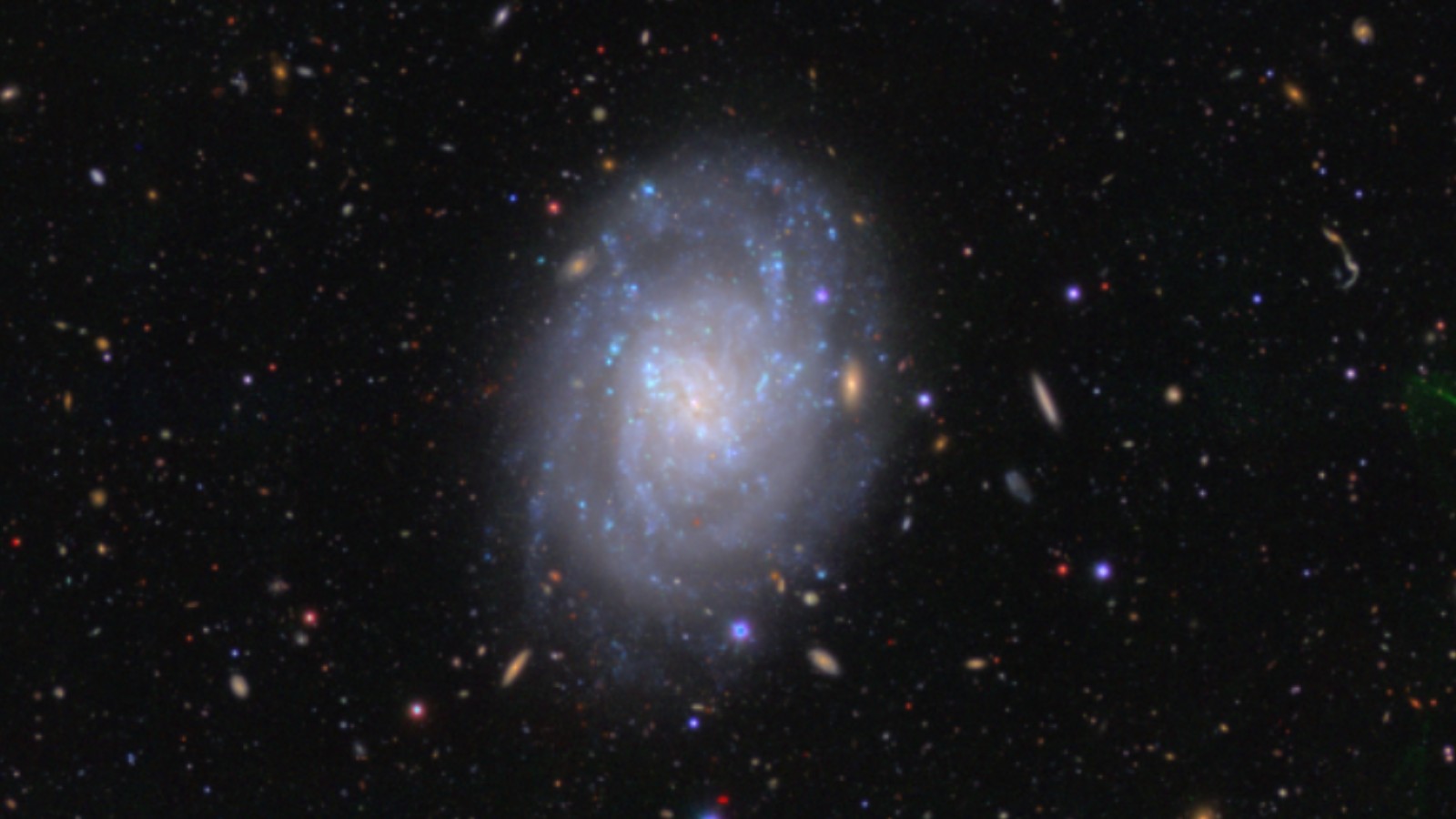
Astronomers have released a breathtaking image of spiral galaxy NGC 941, taken with the Subaru Telescope atop Maunkea in Hawai’i. The photograph reveals the galaxy’s structure, hinting at the ongoing processes of star formation within its swirling arms.
Galaxy Details
Located approximately 55 million light-years from Earth in the constellation Cetus, NGC 941 is classified as an intermediate spiral galaxy. This means it exhibits characteristics between fully barred and unbarred spirals: a subtle central structure rather than a distinct bar of stars.
Why does this matter? The classification of galaxies helps scientists understand how they evolve over time. Intermediate spirals like NGC 941 provide clues about the stages between more defined types, shedding light on galactic development.
Key Features in the Image
The image shows NGC 941 as a vibrant blue spiral, with dark lanes of cosmic dust concentrated at its core. These dust lanes are regions of active star birth, where gas and dust collapse under gravity to ignite new stars.
Notably, the image also contains orange blobs that are not part of NGC 941. These are distant background galaxies, appearing through the intermediate spiral due to its relatively faint light. This phenomenon illustrates how the universe appears layered when viewed from Earth.
This is significant because it demonstrates how astronomers use overlapping celestial objects to study the depth and distances within the cosmos.
About the Subaru Telescope
The Subaru Telescope is a powerful research facility renowned for its high-resolution imaging capabilities. Situated at the summit of Maunkea, its location minimizes atmospheric distortion, allowing for exceptionally clear observations of distant galaxies.
This new image of NGC 941 provides valuable data for astronomers studying galactic structure, star formation, and the evolution of the universe.
The ongoing study of galaxies like NGC 941 will continue to refine our understanding of the cosmos.