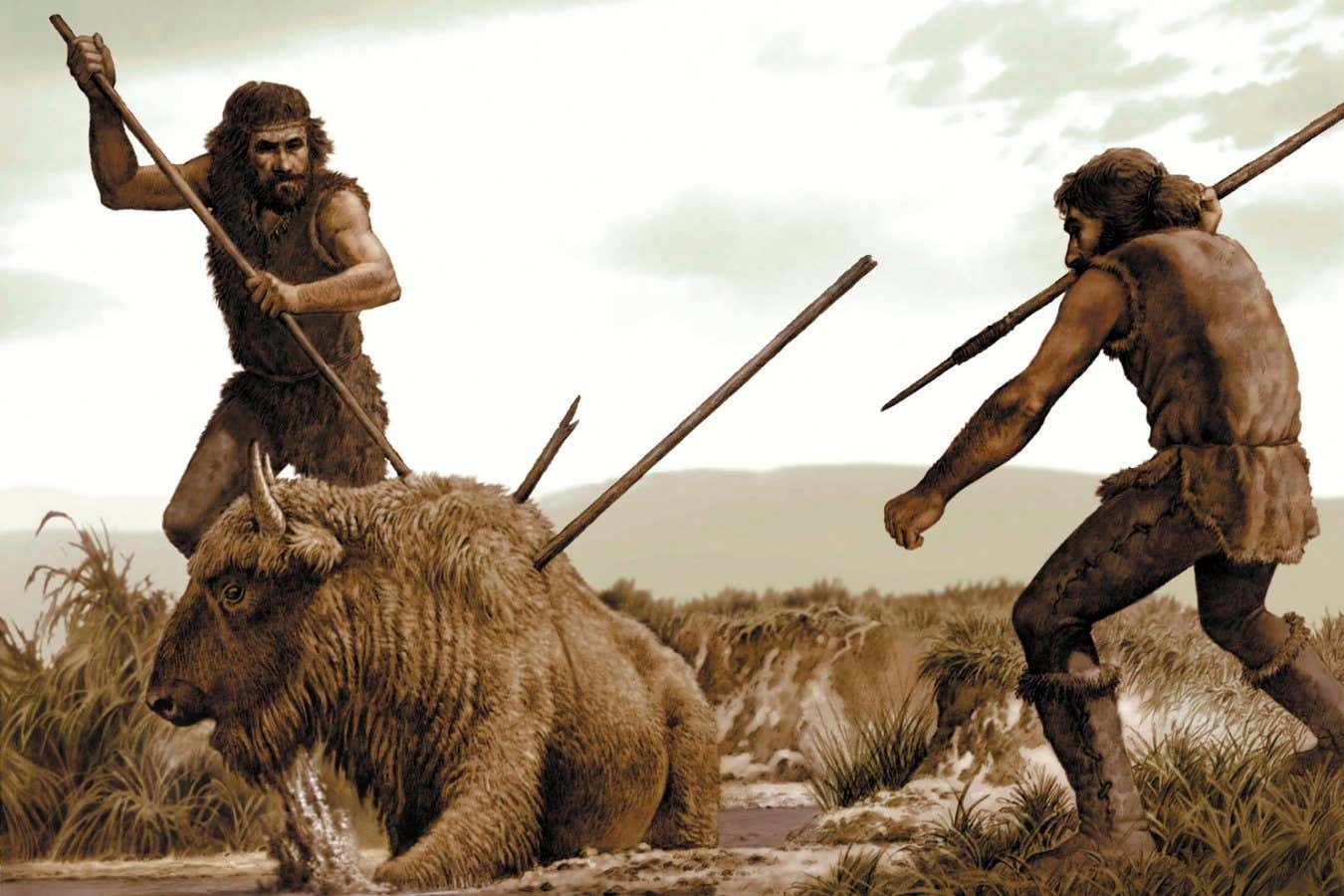
A significant shift in human evolution may not have been driven by sudden biological leaps, but by a desperate need to adapt to a changing food supply. New research suggests that the disappearance of megafauna —massive animals like ancient elephants and rhinos—forced our ancestors to abandon heavy stone tools in favor of sophisticated, lightweight kits, ultimately driving the evolution of the human brain.
The Great Tool Transition
For over a million years, early human species relied on a “heavy-duty” toolkit. These included massive axes, cleavers, and stone scrapers designed for a specific purpose: butchering enormous plant-eating mammals (megaherbivores).
However, a dramatic technological shift occurred between 400,000 and 200,000 years ago. In the Levant region, the archaeological record shows a curious phenomenon:
– The disappearance of heavy tools: The massive stone implements used for large prey vanished.
– The rise of precision kits: A new wave of smaller, more diverse, and sophisticated tools—such as blades and fine scrapers—began to dominate.
Connecting the Dots: Tools and Prey
A study led by Vlad Litov of Tel Aviv University provides the missing link between these tools and the environment. By analyzing 47 archaeological sites across the Levant, researchers cross-referenced stone tool types with animal remains.
The data revealed a striking correlation: as heavy-duty tools disappeared, so did the animals heavier than 1,000 kilograms. As the megaherbivores declined—possibly due to overhunting—the availability of smaller prey increased, perfectly mirroring the rise of the lightweight, sophisticated toolkits.
“As megaherbivores declined, humans increasingly relied on smaller prey, which required different hunting strategies, more flexible planning, and the use of lighter and more complex toolkits.” — Vlad Litov, Tel Aviv University
The Cognitive Cost of Hunting Small
This transition was not merely a matter of changing equipment; it was a fundamental shift in how humans lived and thought.
When a single elephant carcass could feed a group of 35 people for months, its disappearance created an energetic crisis. To survive, hunter-gatherers had to hunt dozens of smaller animals, such as fallow deer, to match the caloric intake previously provided by one large kill.
This new way of life demanded much more from the human mind:
1. Complex Planning: Tracking and catching multiple small, elusive animals requires more foresight than scavenging or hunting a single large target.
2. Social Cooperation: Coordinated group hunting became essential to secure enough food.
3. Technological Innovation: The need for precision tools required higher levels of manual dexterity and cognitive processing.
A Scientific Debate: Intelligence or Adaptation?
While Litov argues that these environmental pressures “selected” for larger brains, other experts suggest a more nuanced reality.
Some researchers, like Ceri Shipton of University College London, suggest the process was iterative. The decline in large prey likely drove cognitive changes, which in turn enabled humans to become better at hunting smaller, more difficult prey. Others, such as Nicolas Teyssandier, caution against viewing this purely as an “intelligence” boost, noting that the ability to design heavy tools for large animals was also a sign of high intelligence.
Ultimately, the shift represents a profound moment of human resilience. Whether it was a sudden leap or a slow adaptation, the loss of the world’s giants may have been the very thing that forced our ancestors to become the most intelligent hunters on the planet.
Conclusion: The decline of megafauna likely created an energetic vacuum that forced humans to adopt more complex hunting strategies and tools, creating an evolutionary feedback loop that favored the development of larger, more capable brains.