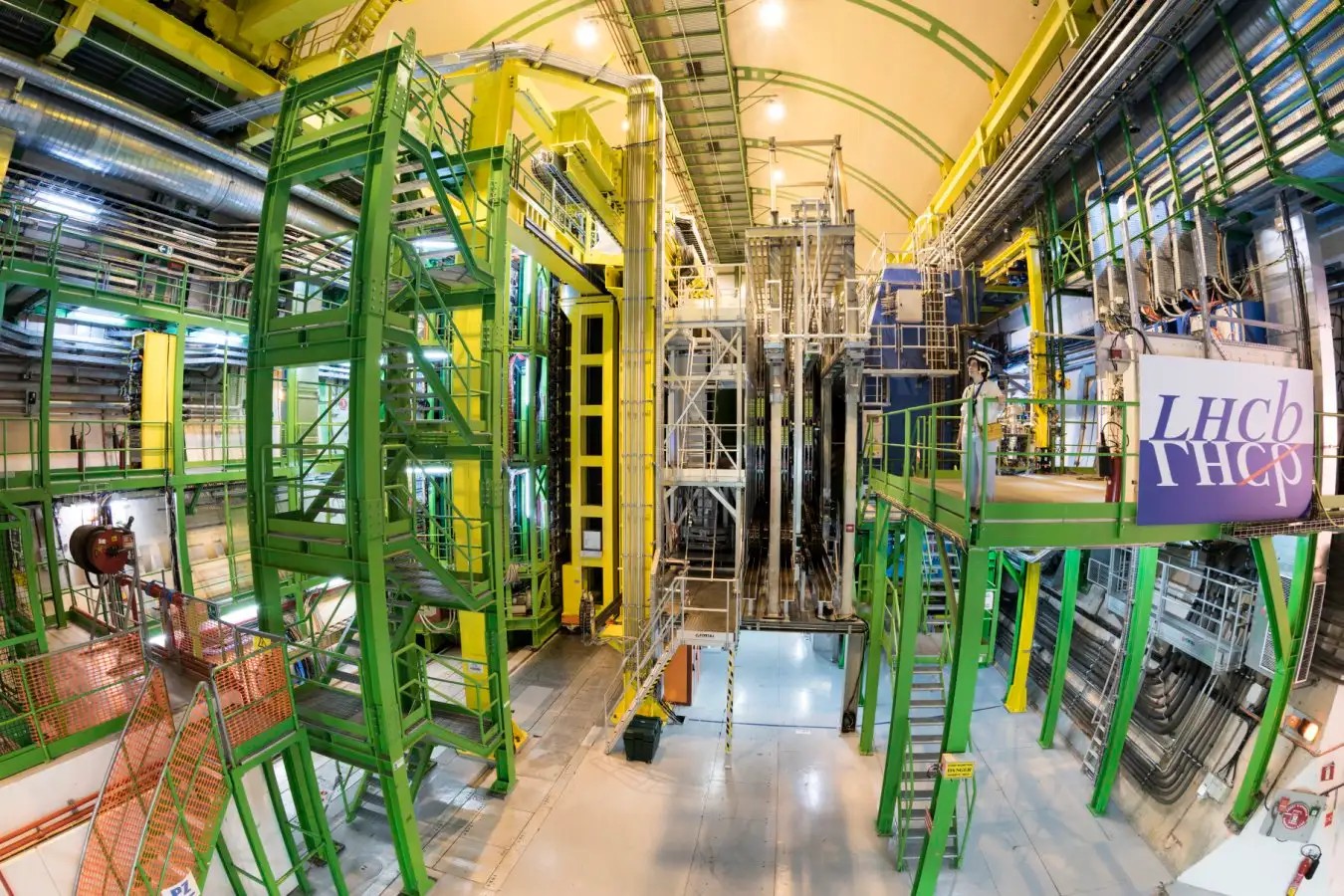
Physicists at CERN’s Large Hadron Collider (LHC) have confirmed the existence of a rare, heavy particle containing two charm quarks – a discovery that closes a 20-year-old debate about its mass and sheds light on the fundamental forces governing matter. The new particle, dubbed Xicc+, is an exotic baryon, a type of composite particle built from quarks.
What are Baryons and Why Do They Matter?
Baryons are fundamental building blocks of matter. Ordinary particles like protons and neutrons fall into this category. Each baryon consists of three quarks, which come in different “flavors.” Protons, for instance, are made of two “up” quarks and one “down” quark. However, heavier quarks—such as charm quarks—can also combine to create baryons, though these are inherently unstable and decay rapidly.
The Xicc+ particle is composed of two charm quarks and one down quark. Its existence was predicted by theoretical models, but it’s notoriously difficult to detect due to its extremely short lifespan: less than a trillionth of a second.
Resolving a Long-Standing Discrepancy
This discovery isn’t just about finding a new particle; it resolves a discrepancy dating back to 2002. The SELEX experiment at Fermi National Accelerator Laboratory claimed to have spotted a similar particle but at a significantly lower mass than expected. The LHCb experiment, after an upgrade to enhance its sensitivity, has now detected the Xicc+ at a mass consistent with theoretical predictions.
“Now we’ve found it, but it’s at a mass which is similar to its partner [Xicc++] that we found a few years ago, and not at the mass that was predicted by SELEX,” says Chris Parkes from the University of Manchester.
The statistical significance of the new detection exceeds 7 sigma—a level so high that physicists are confident it isn’t a statistical fluke.
Implications for Particle Physics
The discovery of Xicc+ provides insights into how the strong nuclear force binds quarks together, especially heavier ones. Current theoretical models struggle to accurately predict the behavior of these particles.
Some physicists, such as Juan Rojo at Vrije University Amsterdam, suggest that the discovery doesn’t immediately offer groundbreaking revelations. However, the new data could become critical in refining theoretical frameworks.
“The data is now ahead of the theory for these kinds of particles,” says Rojo, “but it could be that in five years from now, this measurement is able to answer some very important theory questions.”
The finding underscores the power of upgraded particle colliders like the LHC, demonstrating that even after decades of research, fundamental physics still holds surprises. The Xicc+ particle is not just a confirmation of existing theory but a catalyst for further exploration into the most basic constituents of matter.