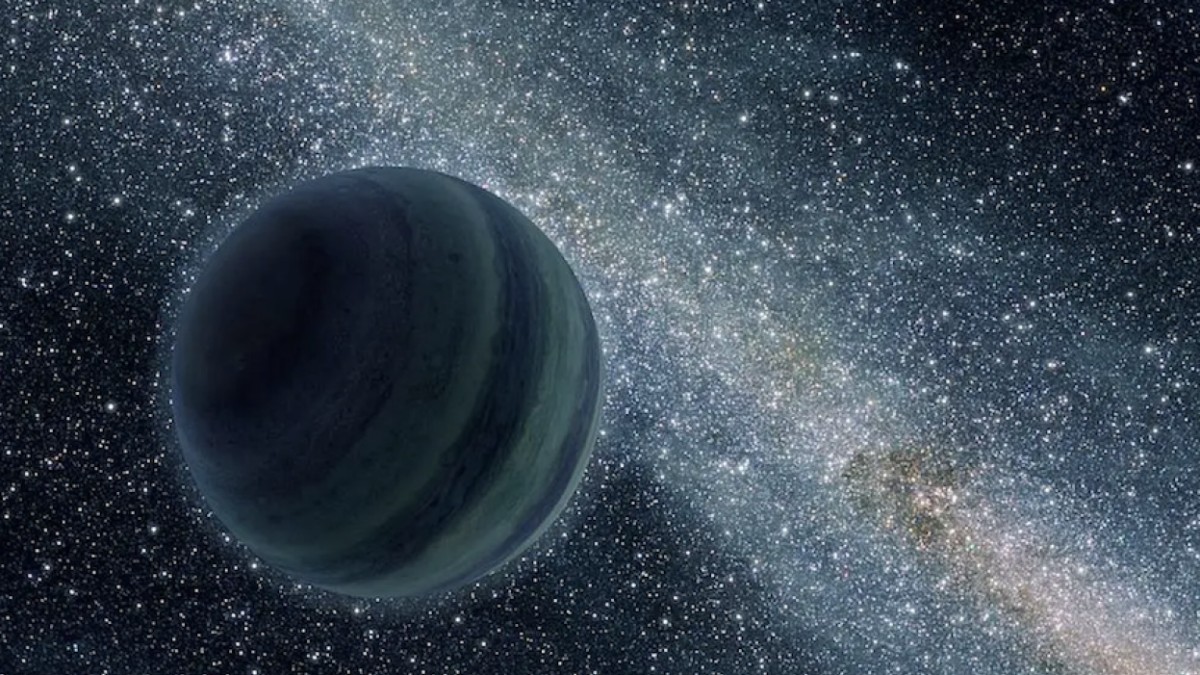
Astronomers have, for the first time, directly confirmed the existence of a Saturn-mass planet wandering alone through interstellar space. This discovery provides concrete evidence that the galaxy is populated by numerous orphaned exoplanets – worlds ejected from their original star systems.
The First Direct Measurement
Until now, rogue planets (those not orbiting a star) were identified only through indirect methods like gravitational microlensing, where a planet briefly magnifies the light of a background star as it passes in front. This new observation bypasses those limitations. Researchers combined data from ground-based telescopes and the European Space Agency’s Gaia spacecraft to measure the planet’s mass with unprecedented precision.
The key breakthrough was using “microlens parallax,” a technique exploiting the slightly different perspectives of Earth-bound and space-based observations. Just as human depth perception relies on the distance between our eyes, this method leveraged the million-mile separation between Gaia and ground observatories.
Why This Matters: Rogue Planets as Planetary Ejecta
The confirmed mass – equivalent to Saturn – strongly suggests that this rogue planet didn’t form in isolation like a small star (a brown dwarf). Instead, it likely originated within a solar system before being gravitationally kicked out.
This ejection could have resulted from violent collisions between planets, close encounters with other worlds, or the chaotic influence of unstable multi-star systems. The finding reinforces the growing theory that planet ejection is a common, perhaps even routine, outcome of planetary formation. Some developing solar systems may lose one or two worlds in the process.
The Hunt for More Rogue Worlds
Detecting these objects is difficult because they emit minimal light and lack a host star. Microlensing events – detectable for hours to days – are the only reliable method. However, future missions like NASA’s Nancy Grace Roman Space Telescope will dramatically improve our ability to find them.
The discovery of this Saturn-sized rogue planet provides a glimpse into a vast, previously hidden population of interstellar wanderers. Understanding these worlds could reveal critical insights into planetary formation, evolution, and the prevalence of ejected planets throughout the galaxy.
As Subo Dong, lead researcher at Peking University, stated: “We only have a glimpse into this emerging population of rogue worlds and what light they can shed on the formation of the bodies in the planetary systems of the universe.”