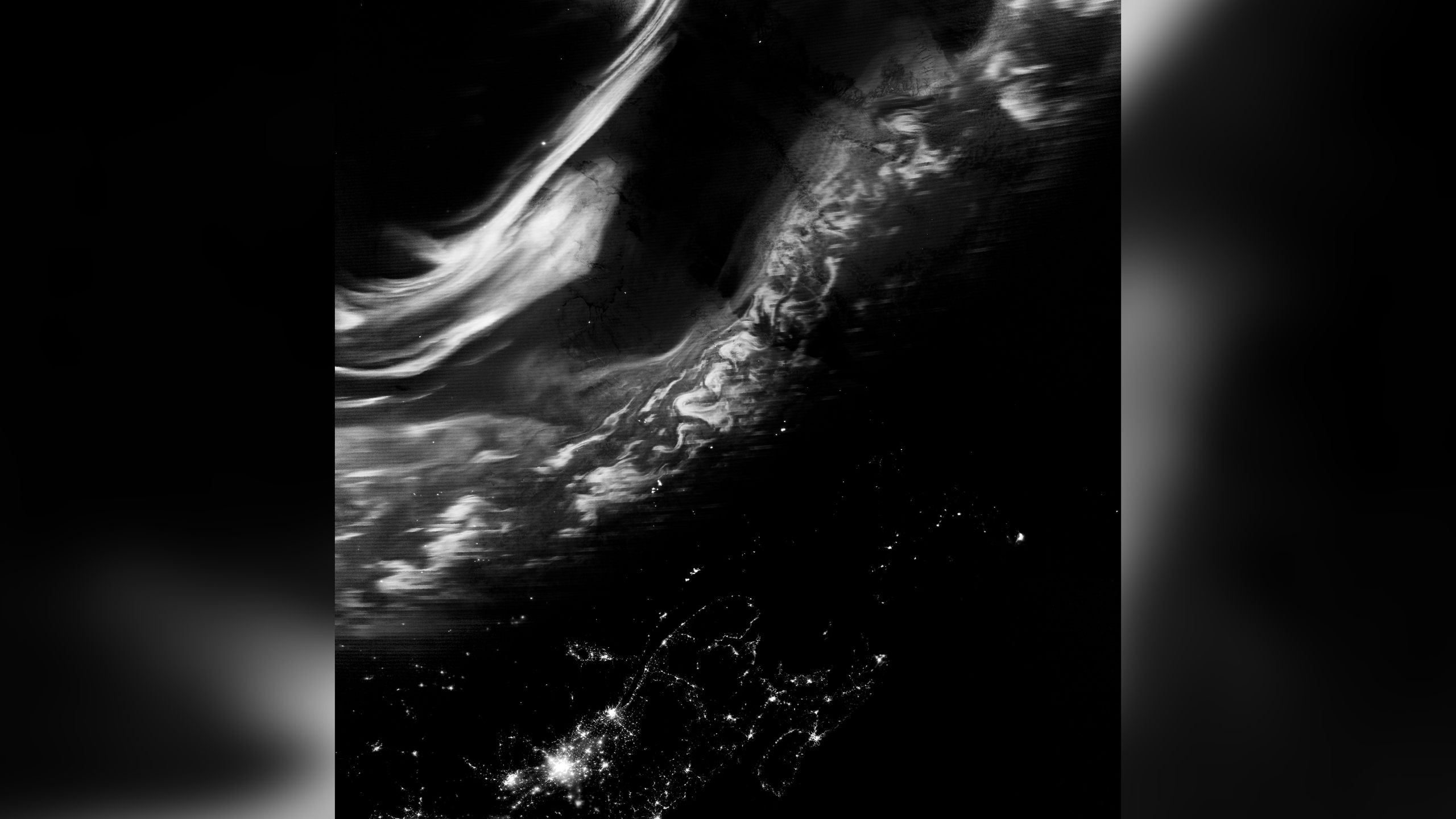
A recent minor geomagnetic storm produced a stunning auroral display over Iceland and eastern Canada on February 16, 2026, as observed by the Suomi NPP satellite. The images, captured by the Visible Infrared Imaging Radiometer Suite (VIIRS), offer a unique overhead perspective of the phenomenon.
What Causes the Northern Lights?
The aurora borealis, commonly known as the northern lights, occurs when charged particles from the sun interact with Earth’s magnetosphere. These particles, carried by solar wind or coronal mass ejections (CMEs), funnel toward the poles along Earth’s magnetic field lines. The collision with atmospheric gases releases energy in the form of light, creating the vibrant auroral displays.
The geomagnetic storm that triggered this event was classified as a G1 – the weakest level on a scale of five, with G5 being the most severe. Despite being minor, the conditions were favorable enough to produce visible auroras at high latitudes.
How Do Auroral Colors Form?
The colors of the northern lights depend on the altitude and type of atmospheric gases colliding with incoming solar particles:
- Green: The most common color, produced by oxygen molecules at 60 to 90 miles (100 to 300 kilometers) altitude.
- Red: Occurs when particles collide with oxygen at higher altitudes (180 to 250 miles or 300 to 400 km).
- Blue and Purple: Less frequent, typically seen during stronger storms, resulting from nitrogen collisions at lower altitudes (around 60 miles or 100 km).
While the satellite imagery is grayscale, ground observers likely saw curtains of green, magenta, and red rippling across the sky.
Where Were the Auroras Seen?
The satellite captured two images:
- At 11:45 p.m. EST (0445 GMT), bright auroras stretched from Greenland to Iceland.
- Around 1:30 a.m. EST (0630 GMT), the lights were visible over the Canadian provinces of Québec, Newfoundland, and Labrador, with city lights from Montreal visible below.
This event highlights how space-based observation complements ground-level viewing of geomagnetic phenomena, providing a broader understanding of the sun-Earth connection.
The ability to monitor and visualize these events from space is crucial for predicting space weather, which can affect satellite operations, power grids, and communication systems.