


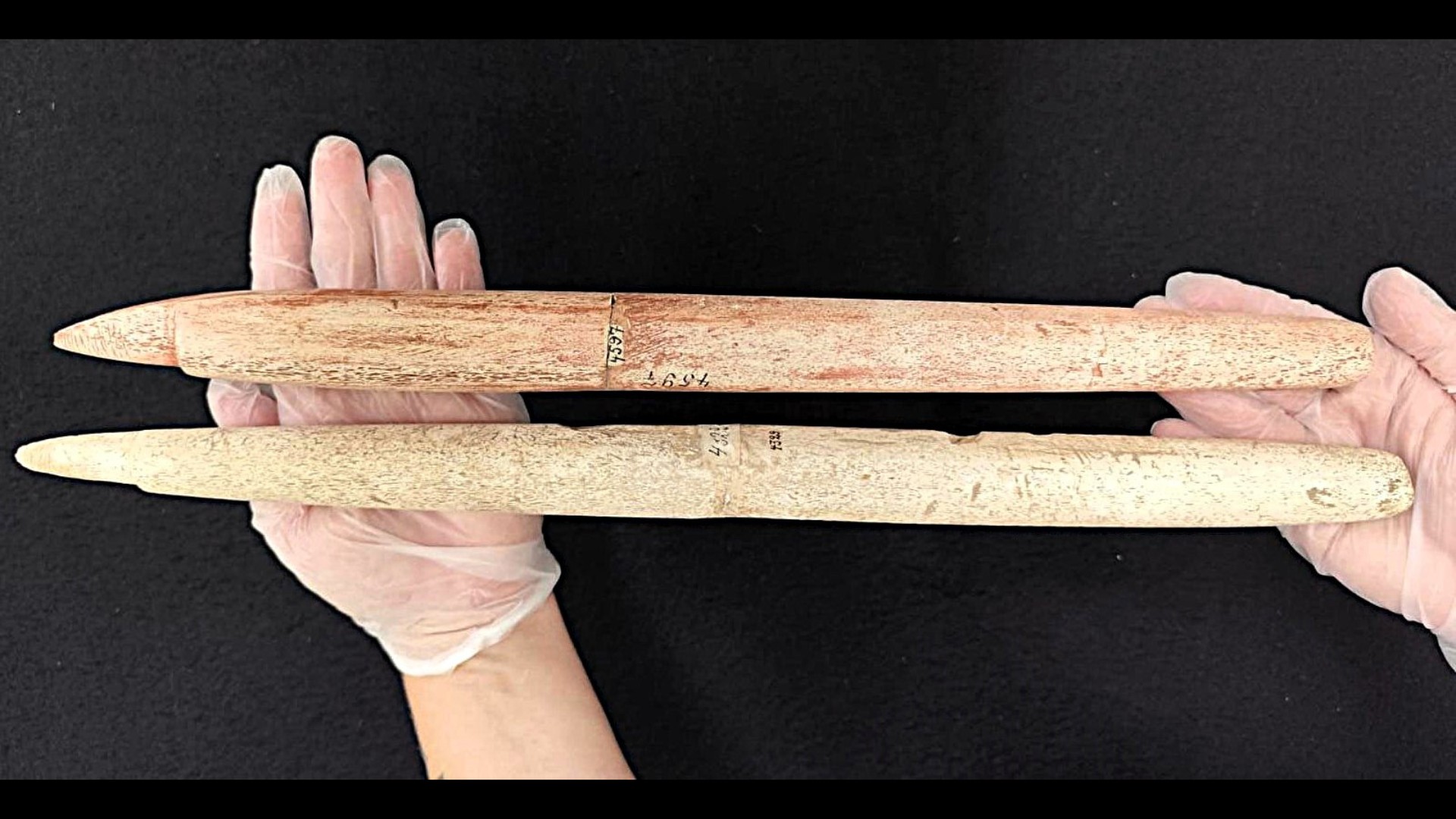
For millennia, whaling has been linked to cold-water environments and the cultures of the Northern Hemisphere. Recent findings shatter this assumption: Indigenous communities in what is now Brazil were actively hunting whales as far back as 5,000 years ago, according to a study published in Nature Communications. This discovery pushes back the timeline for whaling in the Americas and demonstrates that complex maritime hunting practices were not limited to temperate or polar regions.
The Discovery: Bone Harpoons and Whale Remains
Archaeologists analyzing artifacts from the Joinville Sambaqui Archaeological Museum in Brazil unearthed 118 whale bones, including those from humpback and southern right whales, alongside 15 distinct harpoon elements crafted from whale rib bones. The tools, ranging in age from 4,710 to 4,970 years old, bear clear design features for use in whaling: hollow centers for wooden shafts and precisely carved tips.
This is significant because it’s often difficult to distinguish between bones from animals that were hunted versus those scavenged from beached carcasses. The sheer number of bones from the same species, alongside the crafted tools, provides concrete evidence of deliberate hunting.
Challenging Conventional Wisdom
The Sambaqui people, known for their large shell mounds (Sambaquis), were previously believed to focus on mollusk collection and small-scale fishing. The discovery of these harpoons challenges the long-held idea that these communities lacked the technology for large-scale marine hunting.
“The conventional idea was that the Sambaquis didn’t have the technology,” explained study co-author André Carlo Colonese. “This is telling us that they were actually hunting.”
Why This Matters: A Global Perspective on Maritime History
For prehistoric societies, whales represented a massive resource: food, oil for heating, and bones for tools and ornamentation. While opportunistic scavenging of beached whales dates back at least 20,000 years, evidence of active hunting is much more recent. The Brazilian harpoons are over 1,000 years older than previously known examples from the Arctic and sub-Arctic regions.
This discovery shifts the focus of early whaling studies. It demonstrates that complex maritime exploitation systems were not confined to the Northern Hemisphere and highlights the ingenuity of Indigenous populations in adapting to and utilizing marine resources in diverse environments. The find expands our understanding of whaling practices worldwide.
The study emphasizes that Indigenous communities in Brazil, despite living in tropical conditions, possessed the skills and technology to hunt whales, reshaping our perspective on ancient maritime cultures.


