


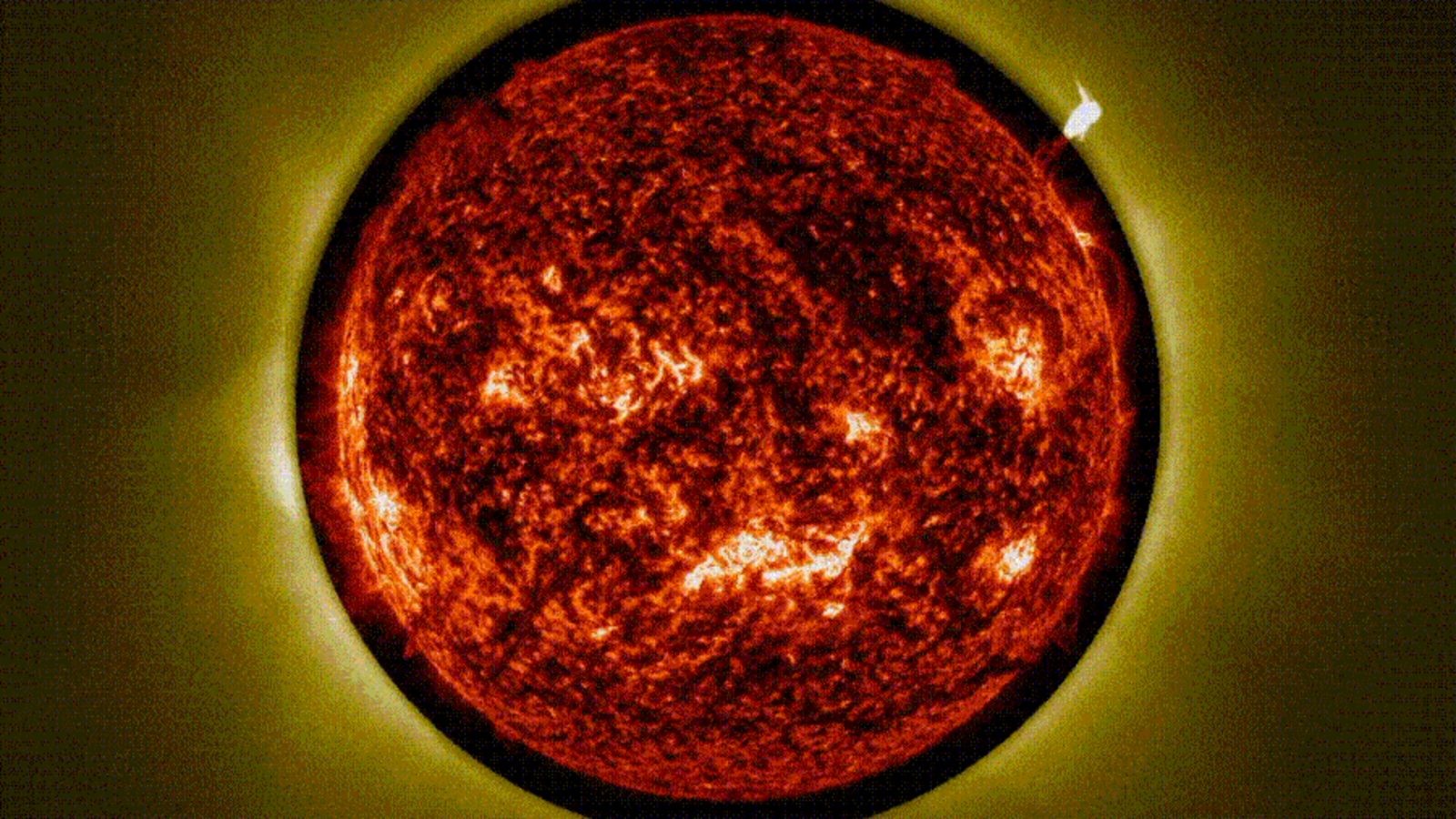
The European Space Agency (ESA) has released striking new footage revealing three major solar eruptions captured using an innovative “artificial eclipse” technique. The time-lapse, recorded by the Proba-3 mission, provides scientists with a unique opportunity to study the sun’s elusive corona and potentially solve long-standing mysteries about its extreme temperatures.
The Artificial Eclipse: A New Way to View the Sun
The Proba-3 mission consists of two spacecraft – a coronagraph and an occulter – which create a controlled solar eclipse by precisely aligning in orbit around Earth. This allows researchers to block out the sun’s blinding glare and observe the faint, outer atmosphere, or corona, with unprecedented clarity. Unlike natural eclipses, this artificial method can be repeated frequently and sustained for longer periods.
The recently released video, captured on September 2, 2025, condenses a five-hour observation into just four seconds. The footage combines data from Proba-3’s coronagraph (using a helium filter to highlight the corona) with concurrent surface images from NASA’s Solar Dynamics Observatory. This combined view reveals the complex interaction between the sun’s surface and its outer atmosphere in remarkable detail.
Prominences, Not Flares: Understanding Solar Explosions
The time-lapse showcases three powerful plasma plumes erupting from the sun. While these initially resemble solar flares – the violent explosions that can trigger space weather events on Earth – closer inspection reveals they are actually prominences. These are towering loops of plasma that extend from the sun’s surface and eventually snap, releasing ionized gas into space.
Prominences, though less energetic than flares, offer crucial insights because they are typically harder to observe. According to Andrei Zhukov, principal investigator of Proba-3’s coronograph, “Seeing so many prominence eruptions in such a short timeframe is rare… we managed to capture them so clearly.” The eruptions appear exceptionally bright, suggesting extreme heat, but their plasma is actually cooler – around 10,000 degrees – compared to the million-degree corona.
The Corona’s Mystery: Why So Hot?
The sun’s corona remains one of the biggest unsolved puzzles in astrophysics. It is 200 times hotter than the sun’s surface, a counterintuitive phenomenon that scientists have struggled to explain. Observations like those from Proba-3 are critical to unraveling this mystery, providing data that may finally reveal the mechanisms behind the corona’s extreme heat.
Expanding Solar Observation Capabilities
Proba-3 has already conducted over 50 artificial eclipses in its first seven months of operation, with hundreds more planned. This mission joins a wave of new technologies revolutionizing solar physics. NASA’s CODEX telescope (mounted on the International Space Station), ESA’s Solar Orbiter, and the Daniel K. Inouye Solar Telescope in Hawaii have all recently delivered groundbreaking images and data, including the first-ever view of the sun’s south pole. NASA’s Parker Solar Probe, repeatedly diving closer to the sun than any previous spacecraft, also continues to provide critical insights.
This surge in observational power promises to reshape our understanding of the sun and its influence on Earth.
The sun remains a dynamic and unpredictable star, and these new tools are giving us the best view yet of its hidden processes. Continued observation will be vital for predicting space weather events and protecting our technology-dependent society.


