


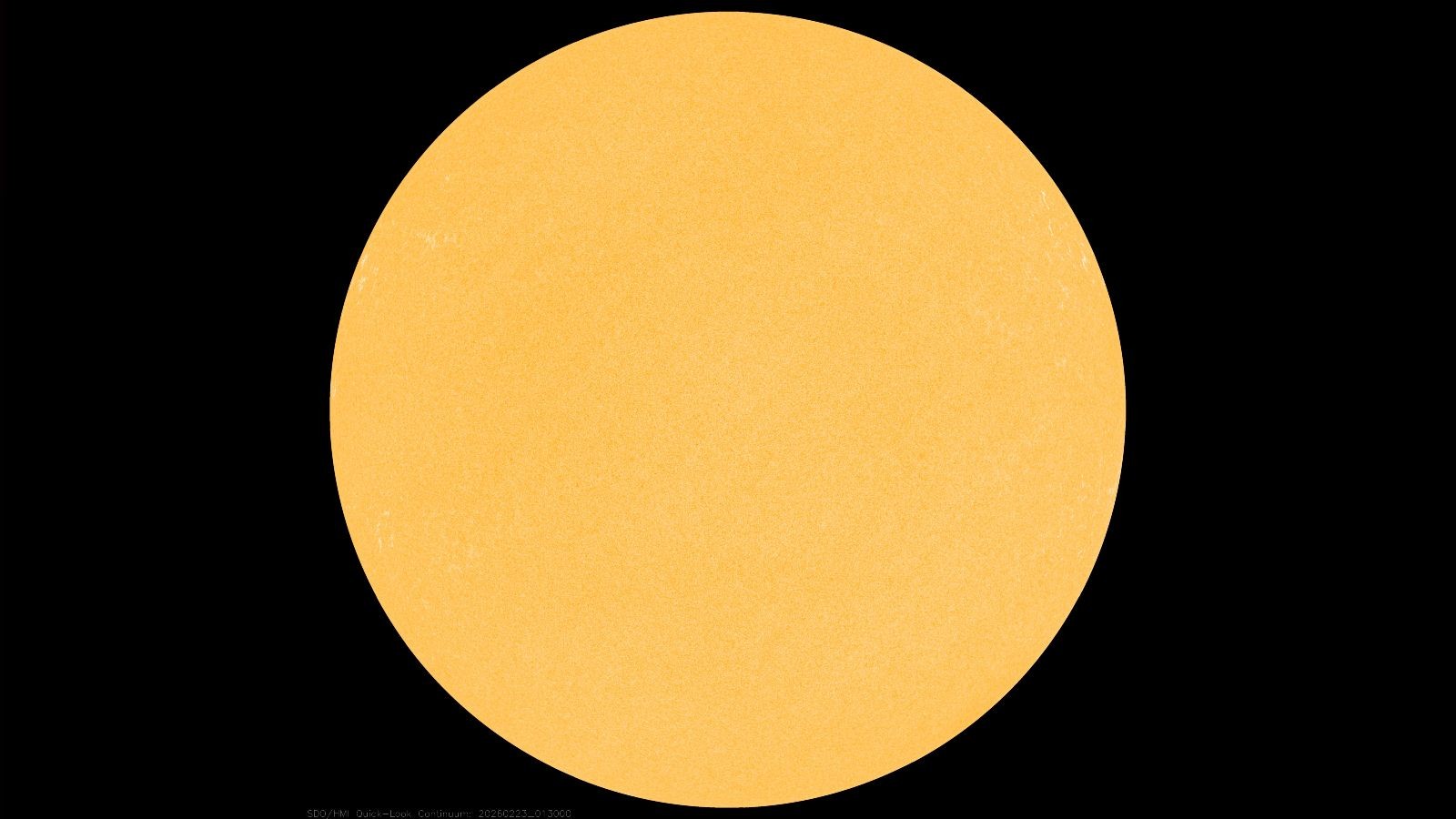
The sun has recently experienced three consecutive days without visible sunspots – the first such period since June 2022 – signaling a potential decline in solar activity. However, experts caution that this brief respite does not eliminate the threat of powerful solar storms, which could still disrupt Earth-based technology.
The Recent Shift in Solar Activity
For nearly four years, the sun was consistently marked by dark sunspots, indicators of magnetic instability. These spots are often associated with solar flares and coronal mass ejections (CMEs), which can impact Earth’s atmosphere and technological systems. The sudden absence of sunspots between February 22nd and 24th ended a 1,335-day streak of constant sightings. Though the quiet period was short-lived, with new sunspots reappearing on February 25th, it highlights an emerging trend.
Why this matters: Sunspots are not just cosmetic blemishes. They’re visual manifestations of the sun’s magnetic field, and their absence can indicate a slowdown in overall activity. However, even during quieter periods, the sun can still produce dangerous space weather.
Solar Cycle 25 and Unexpected Activity
This development is particularly surprising given that the sun recently passed through its solar maximum – the peak of its roughly 11-year cycle. During this phase, sunspots are abundant, and activity is typically high. In fact, Solar Cycle 25 has been more active than predicted, reaching peak sunspot counts not seen in over two decades. The recent increase in X-class flares and the Mothers’ Day storm of 2024 further emphasize this unusually intense cycle.
The context: The sun’s cycles aren’t perfectly predictable. Unexpected surges and quiet periods can occur, making long-term forecasting challenging. The current cycle’s higher-than-expected activity suggests that the transition to a quieter phase may be less stable than usual.
The “Battle Zone” and Future Risks
Experts, including Scott McIntosh of Lynker Space, have warned that the years following solar maximum – dubbed the “battle zone” – can be particularly chaotic. The sun’s newly flipped magnetic field remains unstable, increasing the potential for large geomagnetic storms.
The danger: The most extreme scenario is a superstorm comparable to the Carrington Event of 1859, which could cripple satellites, disrupt power grids, and cause widespread technological failure. While the probability is currently estimated at around 5%, the risk is real, given the intensity of Solar Cycle 25.
What to Expect Next
The sun is likely to remain active for several years before entering its next solar minimum – a period of prolonged quiet. However, even during this transition, unpredictable events can occur. The magnetic configuration of sunspots, not just their size or frequency, determines their danger level, meaning that even small spots could trigger significant storms.
“Solar Cycle 25 still has years of life left in it… these spotless days tell us that the current cycle is waning.” – Spaceweather.com representatives
The sun’s behavior is complex and often defies simple predictions. Monitoring solar activity remains crucial, as even a seemingly quiet star can unleash powerful space weather events.


