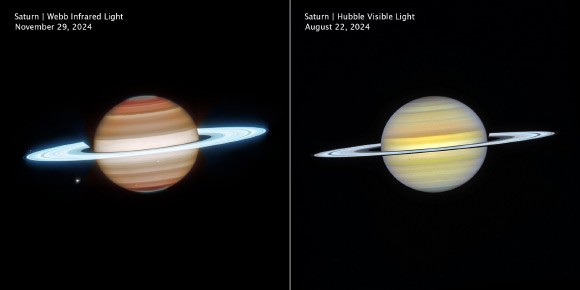
Astronomers have combined the capabilities of the James Webb Space Telescope (JWST) and the Hubble Space Telescope to capture the most detailed views of Saturn to date. The new images reveal striking atmospheric features, including powerful jet streams, lingering storm systems, and the planet’s iconic rings, in a way never before seen.
Saturn’s Dynamic Atmosphere
The JWST’s infrared observations highlight a long-lived jet stream, known as the “ribbon wave,” meandering across Saturn’s northern mid-latitudes. This jet stream is influenced by atmospheric waves that are otherwise invisible to conventional telescopes.
Just below, a remnant of the massive “great springtime storm” from 2011-2012 remains visible as a distinct spot. Numerous other storms are scattered across Saturn’s southern hemisphere, demonstrating the planet’s turbulent weather patterns.
This level of detail matters because Saturn serves as a natural laboratory for studying fluid dynamics under extreme conditions. The winds and waves beneath the visible cloud deck create environments that mimic those found in other gas giants, offering insights into planetary atmospheres beyond Earth.
The Enigmatic Hexagon and Polar Features
The images also reveal the faint edges of Saturn’s hexagon-shaped jet stream at its north pole – a feature first discovered by Voyager in 1981.
The hexagon’s persistence over decades suggests that large-scale atmospheric processes on giant planets can remain remarkably stable. However, these high-resolution views may be limited for the next 15 years, as Saturn’s north pole enters winter and shifts into darkness by the 2040s.
Saturn’s poles appear distinctly gray-green in the JWST observations, likely due to high-altitude aerosols scattering light. Another possible explanation is auroral activity, where charged molecules interacting with the planet’s magnetic field create glowing emissions.
Rings in Sharp Focus
Saturn’s rings are incredibly bright in the JWST image due to their composition of highly reflective water ice. The images capture subtle features within the rings, such as spokes and structures in the B ring. The F ring, the outermost ring, appears crisp and well-defined in the JWST data.
The shifting orbital positions of Earth and Saturn determine our changing viewing angle of the planet, with the 2024 observations taken 14 weeks apart showing Saturn transitioning toward the 2025 equinox.
As Saturn moves into southern spring and summer in the 2030s, Hubble and Webb will have progressively better views of that hemisphere.
The combination of JWST and Hubble data provides a unique perspective on Saturn, revealing atmospheric and ring details never before seen with such clarity. These observations are crucial for understanding the complex dynamics of gas giant planets and their long-term atmospheric stability.