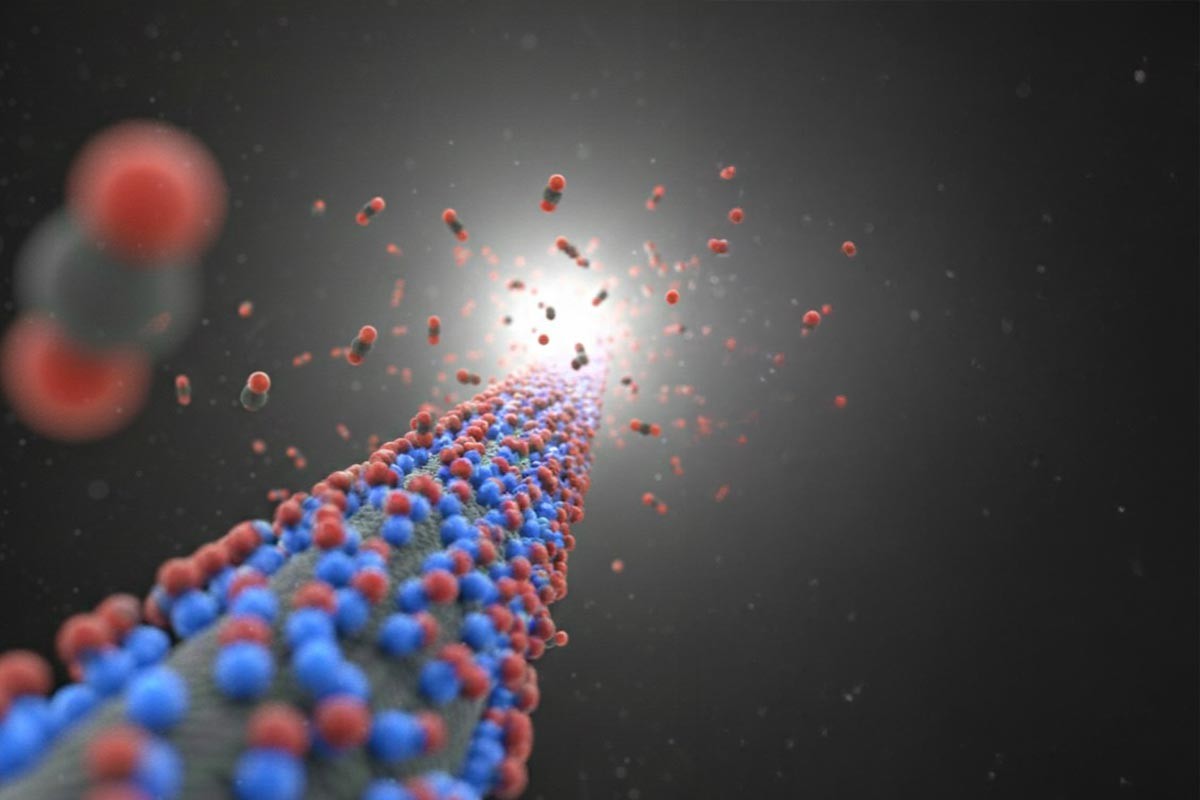
A research team from Chiba University, Japan, has developed a new class of carbon materials called “viciazites” that could solve one of the biggest hurdles in climate technology: the massive energy cost of capturing carbon dioxide (CO2).
The High Cost of “Cleaning” the Air
While carbon capture technology is vital for reducing greenhouse gas emissions, it has struggled to achieve widespread industrial use. The primary obstacle is energy inefficiency.
Currently, the industry standard—aqueous amine scrubbing—requires heating massive volumes of liquid to temperatures exceeding 100°C just to release the captured CO2 so the system can be reused. This high thermal demand makes the process incredibly expensive and energy-intensive, often offsetting some of the environmental benefits.
The Innovation: Precision Molecular Engineering
For years, scientists have looked toward solid carbon materials as a cheaper alternative. These materials are inexpensive and have high surface areas, making them excellent at “soaking up” CO2. However, previous attempts to improve them by adding nitrogen groups resulted in a “random” distribution of atoms. This randomness made it impossible to predict how the material would perform or how to optimize it.
The breakthrough achieved by Associate Professor Yasuhiro Yamada and his team lies in structural control. Instead of random placement, they have engineered “viciazites”—materials where nitrogen groups are positioned adjacently (side-by-side) in a predictable, controlled pattern.
How it Works: Three Distinct Designs
By using different chemical starting points and precise synthesis methods, the researchers created three distinct types of nitrogen arrangements:
- Adjacent Primary Amines (–NH2): Achieved with 76% selectivity.
- Adjacent Pyrrolic Nitrogen: Achieved with 82% selectivity.
- Adjacent Pyridinic Nitrogen: Achieved with 60% selectivity.
The team used advanced tools, including nuclear magnetic resonance spectroscopy and computational modeling, to confirm that these nitrogen atoms were indeed sitting next to each other rather than scattered randomly.
Why This Matters: Low-Heat Desorption
The most significant finding involves how easily the CO2 can be released (desorption) for reuse. The performance varied significantly depending on the nitrogen arrangement:
- The Efficiency Winner: Materials with adjacent –NH2 groups allowed CO2 to be released at temperatures below 60°C.
- The Industrial Advantage: Because these materials work at much lower temperatures, they can be powered by industrial waste heat. This means factories could potentially capture their own emissions using the heat they are already producing, drastically reducing operational costs.
- The Durability Option: The pyrrolic nitrogen variant requires higher temperatures but offers greater chemical stability, suggesting it could be more durable for long-term use.
Beyond Carbon Capture
The implications of this research extend beyond climate change mitigation. Because these viciazites allow for “molecular-level control” of a material’s surface, they could eventually be used for:
– Removing metal ions from water.
– Serving as highly efficient catalysts for chemical reactions.
“This work provides validated pathways to synthesize designer nitrogen-doped carbon materials, offering the molecular-level control essential for developing next-generation, cost-effective, and advanced CO2 capture technologies.” — Dr. Yasuhiro Yamada
Conclusion: By moving from random chemical mixtures to precisely engineered “viciazite” structures, scientists have unlocked a pathway to carbon capture that is both more efficient and capable of running on low-grade industrial heat.