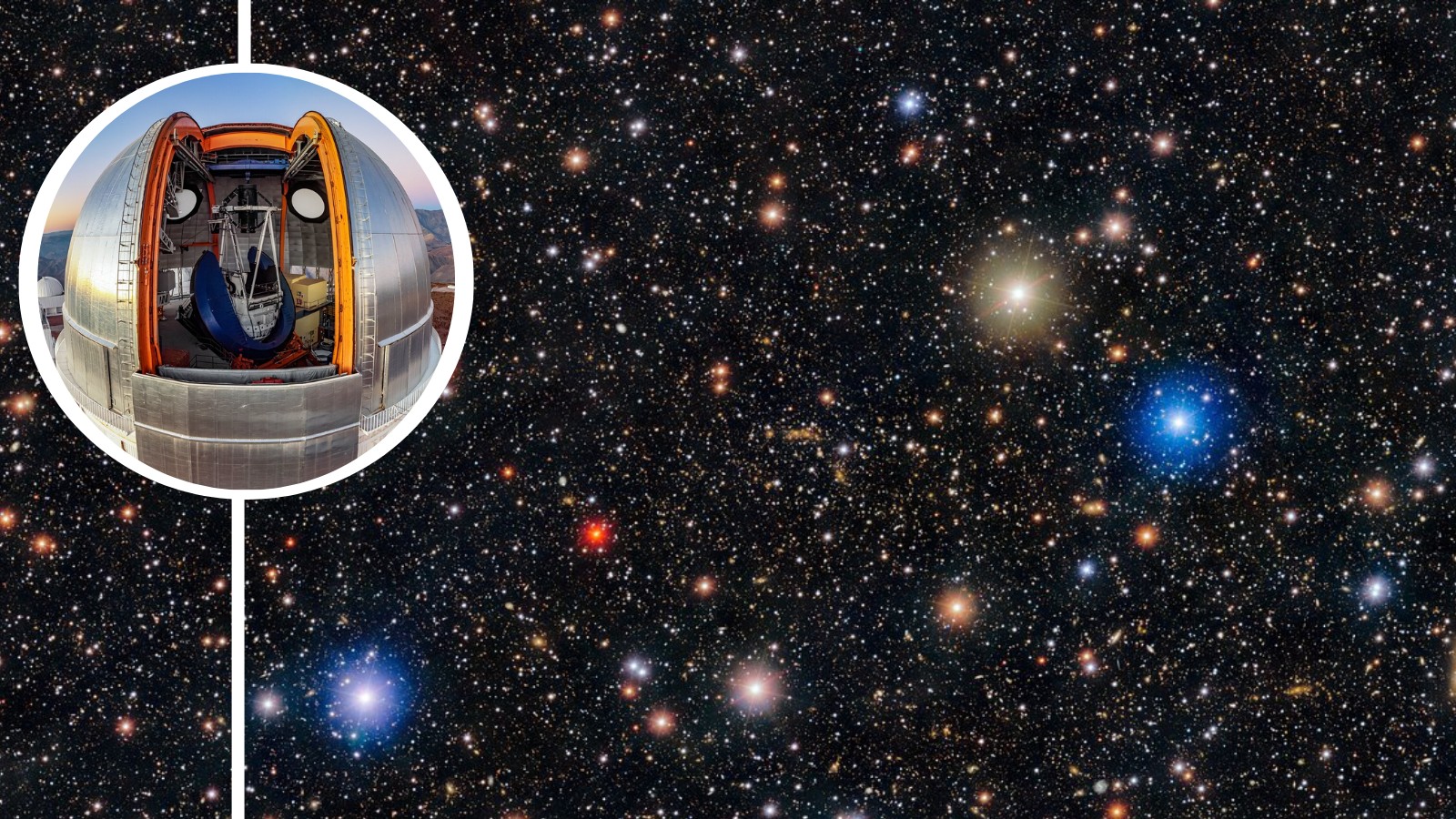
Scientists have achieved an unprecedented level of clarity in mapping the expansion of the universe and studying dark energy, the enigmatic force accelerating this expansion. The breakthrough comes from analyzing six years of data collected by the Dark Energy Camera (DECam) on the U.S. National Science Foundation Víctor M. Blanco 4-meter telescope. This marks the first time four independent methods of studying dark energy have been combined, doubling the precision of previous measurements.
The Data Behind the Discovery
The analysis encompasses 758 nights of observations covering one-eighth of the sky, conducted between 2013 and 2019 by the Dark Energy Survey (DES) Collaboration. The 570-megapixel DECam captured data from a staggering 669 million galaxies, some billions of light-years away. This scale is crucial because understanding dark energy requires observing the universe on the largest possible scales – the effects are subtle, and only become apparent when examining vast cosmic distances.
Why Dark Energy Matters
The existence of dark energy was first hinted at in 1998, when astronomers observed that distant supernovas were receding faster than expected. This meant not only that the universe is expanding, as Edwin Hubble discovered decades earlier, but that its expansion is accelerating. Dark energy now accounts for roughly 68% of the universe’s total energy and matter, yet its nature remains unknown.
The timing of dark energy’s dominance is also key: it only began to overwhelm gravity between 3 and 7 billion years ago. This suggests that the universe’s evolution isn’t a simple, linear process but includes phases where different forces held sway.
Four Ways to Study the Invisible
The DES analysis uniquely combined four methods to probe dark energy:
- Type-Ia Supernovas: The original discovery tool, still vital for measuring distances across the cosmos.
- Weak Gravitational Lensing: The subtle bending of light as it passes massive objects, revealing the distribution of dark matter and dark energy.
- Galaxy Clustering: How galaxies group together provides clues about the underlying cosmic structure influenced by dark energy.
- Baryon Acoustic Oscillations (BAO): Ripples from the early universe preserved as density fluctuations, acting as a cosmic ruler for measuring expansion.
By cross-checking these four independent methods, the DES team has significantly strengthened confidence in their results.
Unexpected Discrepancies
The DES data aligns with both the standard cosmological model (Lambda Cold Dark Matter – LCDM) and a more flexible model allowing dark energy to evolve over time (wCDM). However, the analysis revealed a discrepancy between observed galaxy clustering and predictions from both models.
Modern galaxies appear to cluster differently than expected based on measurements of the early universe, suggesting that current cosmological models may be incomplete. This mismatch, though subtle, is becoming more pronounced with each new observation.
The Future of Dark Energy Research
The next step involves combining the DECam data with observations from the Vera C. Rubin Observatory’s Legacy Survey of Space and Time (LSST), which will catalogue roughly 20 billion galaxies. This will provide an even more comprehensive view of the universe’s history and the behavior of dark energy.
“DES has been transformative, and the Vera C. Rubin Observatory will take us even further,” says Chris Davis of the National Science Foundation. The Rubin Observatory’s unprecedented scope promises to test our understanding of gravity and unlock new insights into dark energy’s true nature.
The universe remains full of mysteries, but these findings bring us closer than ever to unraveling the secrets of its accelerating expansion.