







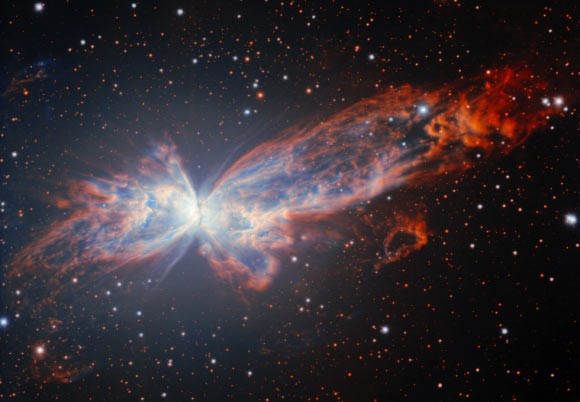
The Gemini South telescope in Chile has released a breathtaking new image of the Butterfly Nebula (NGC 6302), a dying star shedding its outer layers in a spectacular display of cosmic fireworks. The image was selected by students in Chile as part of a contest celebrating the International Gemini Observatory’s 25th anniversary.
A Stellar Farewell: What Is the Butterfly Nebula?
Located roughly 2,417 light-years away in the Scorpius constellation, NGC 6302 is a planetary nebula – a glowing shell of ionized gas expelled by a massive star nearing the end of its life. Early astronomers named them “planetary nebulae” because, through early telescopes, they resembled planets in appearance.
The nebula’s distinctive butterfly shape stretches over two light-years, roughly half the distance between our Sun and Proxima Centauri. This formation isn’t accidental: the star’s final stages were turbulent.
The Nebula’s Violent History
Before becoming a white dwarf, the star was a red giant with a diameter 1,000 times larger than our Sun. As it aged, it first shed gas slowly from its equator, forming a doughnut-shaped structure still visible today. Then, a violent burst of stellar wind ripped through the expelled material at over 3 million km/h (1.8 million mph), shaping the nebula’s bipolar wings.
These interactions between fast and slow-moving gas created the nebula’s unique texture. The central star, now a white dwarf, emits intense radiation that heats the “wings” to over 20,000 degrees Celsius (35,000 Fahrenheit), causing them to glow brilliantly.
A Colorful Composition
The image reveals vibrant red and blue hues. Red traces energized hydrogen, while blue shows energized oxygen. The nebula contains other elements like nitrogen, sulfur, and iron, all of which contribute to the raw materials for future star and planet formation.
Why This Matters
The Butterfly Nebula is more than just a pretty picture. It shows how stars evolve and die, ejecting material that will eventually seed the next generation of cosmic structures. Studying nebulae like this helps astronomers understand the lifecycle of stars and the processes that shape the universe. The discovery history of the nebula dates back to at least 1826, with modern observations confirming its extreme properties, including a central white dwarf hotter than 250,000 degrees Celsius (450,000 Fahrenheit).
The Gemini South telescope’s high-resolution image provides invaluable data for ongoing research into stellar evolution. The choice of this target by students highlights the observatory’s commitment to engaging the next generation of scientists in astronomical discovery.