


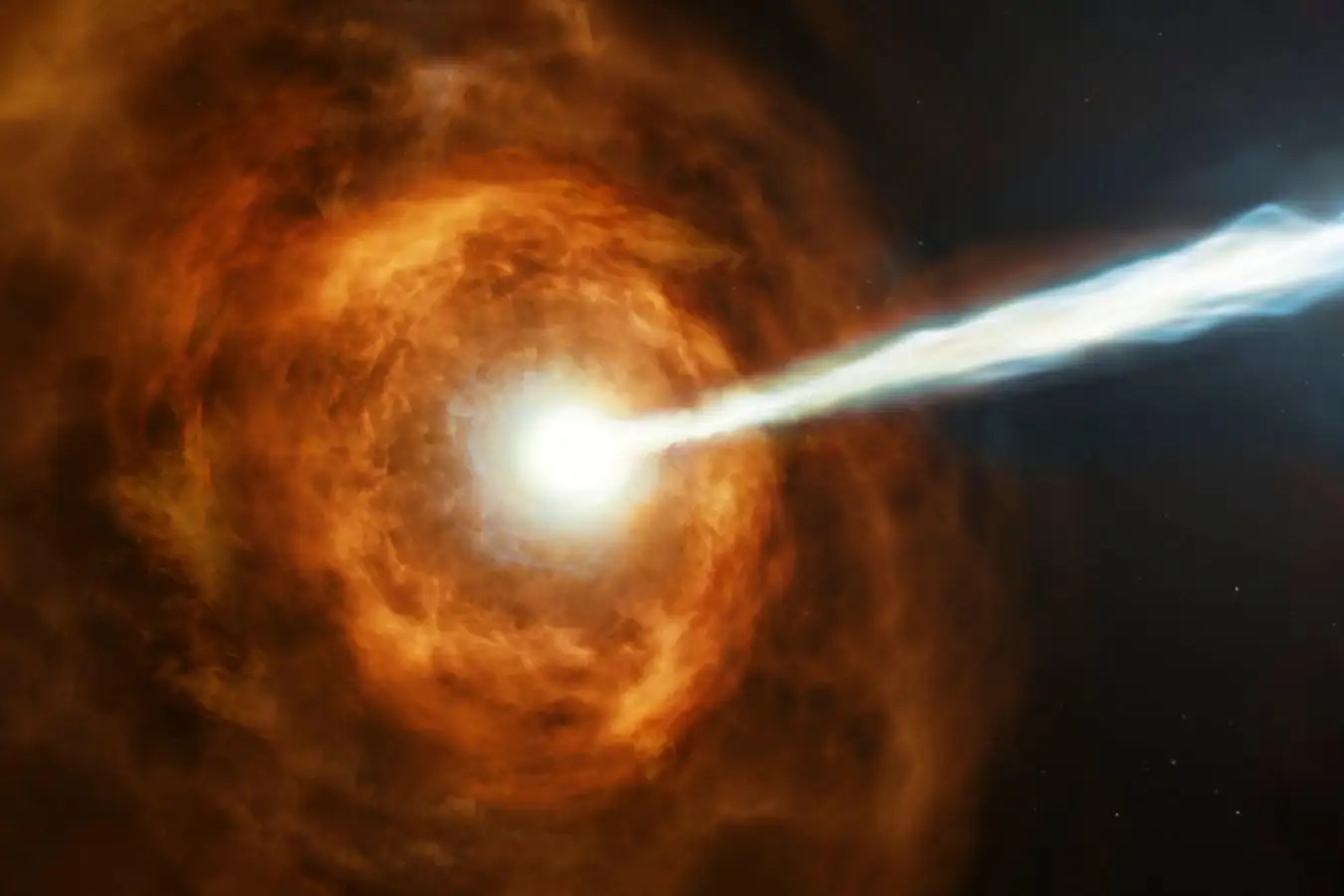
Astronomers have potentially observed a rare type of stellar explosion—a “dirty fireball”—for the first time. This discovery offers new insights into how massive stars die and could reshape our understanding of gamma-ray bursts, the most powerful explosions in the universe.
The Mystery of Massive Star Deaths
When massive stars exhaust their fuel, they collapse, often resulting in a supernova or the formation of a black hole. In some cases, this collapse triggers an intense, focused beam of radiation known as a gamma-ray burst (GRB). These bursts release energy equivalent to the sun’s entire lifespan in mere seconds. However, the exact mechanisms driving GRBs remain unclear.
Physicists theorized that if the jet of radiation from a collapsing star interacts with heavier matter—protons and neutrons—it would slow down, shifting the emitted energy from high-energy gamma rays to lower-energy X-rays. This “dirty fireball” scenario hadn’t been confirmed until now.
New Evidence from the Einstein Probe
Researchers led by Xiang-Yu Wang at Nanjing University in China have analyzed data from the new Einstein Probe space telescope. They detected an X-ray flash, designated EP241113a, originating from a galaxy roughly 9 billion light-years away. The flash contained energy comparable to a GRB but emitted in X-ray frequencies. The explosion’s initial burst lasted several hours before fading, mirroring the behavior of typical GRBs.
“It’s a very exciting prospect,” says Rhaana Starling at the University of Leicester. “Dirty fireballs have been theorized since the 90s, but there hasn’t really been any compelling evidence for them.”
Implications for Gamma-Ray Burst Studies
This observation suggests that dirty fireballs may be more common than previously thought. The event could involve a black hole or neutron star interacting with the jet in a unique way. Confirming this would provide a clearer picture of black hole formation throughout the universe.
Additionally, the discovery raises the possibility that many GRBs remain undetected due to observational biases. There could be a spectrum of such events, ranging from powerful gamma-ray bursts to weaker, X-ray-dominated explosions that have gone unnoticed.
Remaining Questions
While promising, the findings require further validation. Om Sharan Salafia at the Brera Astronomical Observatory emphasizes the need to confirm the explosion’s distance and nature. If confirmed, this event could be a puzzling but significant step forward in astrophysics.
In conclusion, the potential detection of a dirty fireball provides strong evidence for a long-standing theory about star deaths and could revolutionize how we understand the universe’s most energetic phenomena.


