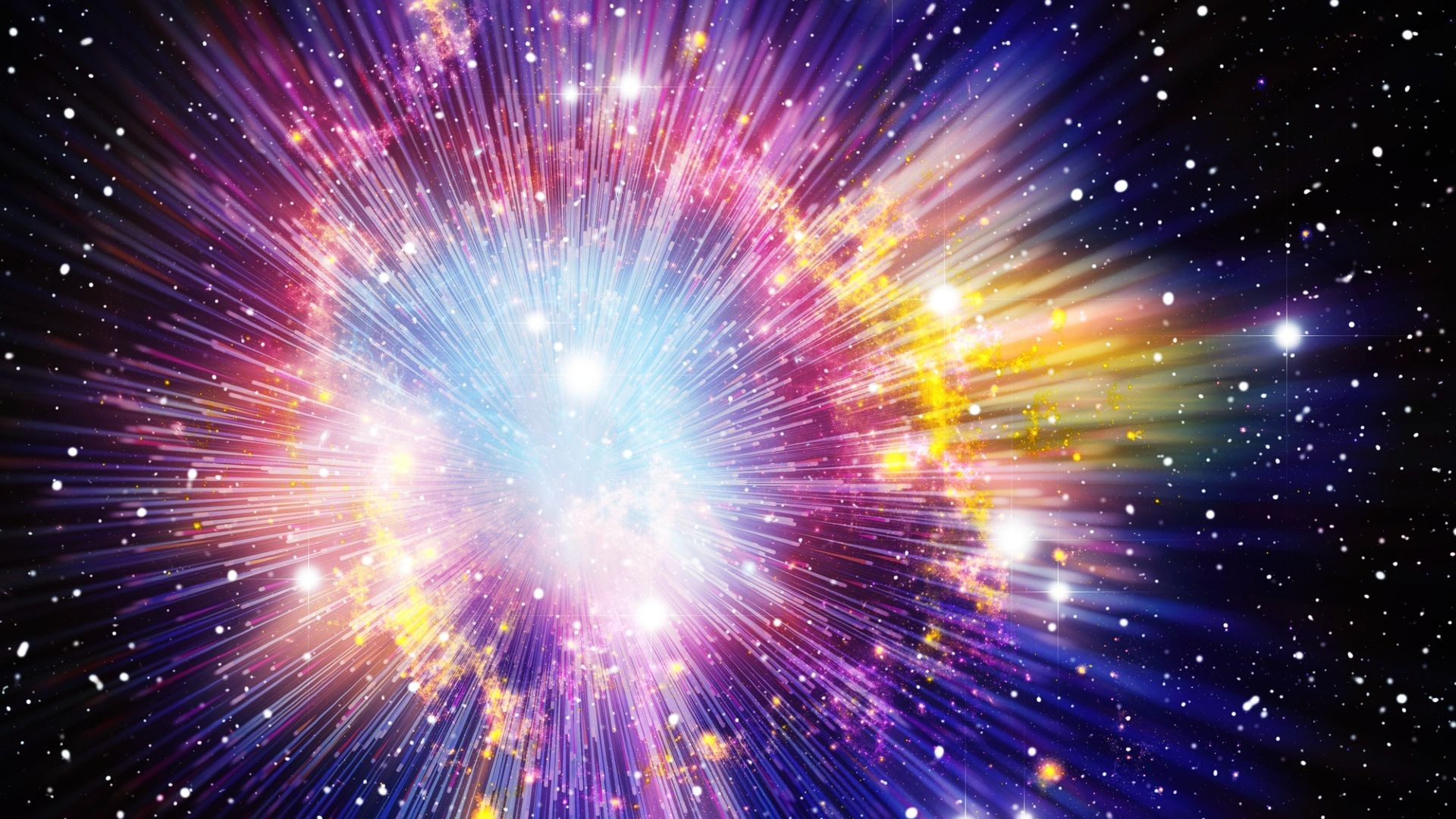
The standard model of the Big Bang relies on Einstein’s theory of relativity, which predicts an initial state of infinite density – a singularity where known physics breaks down. However, emerging research suggests the universe’s birth may have unfolded differently, potentially avoiding this catastrophic breakdown through an extension of Einstein’s gravity known as Quadratic Quantum Gravity (QQG).
The Limits of Einstein’s Theory
Einstein’s general relativity accurately describes gravity at large scales – from planetary motion to black holes. But it falters when applied to the extreme conditions of the early universe or the quantum realm. The singularity predicted by general relativity is a clear sign that the theory is incomplete; infinite density simply doesn’t make sense.
“The main problem is that Einstein’s general relativity predicts its own failure under extreme conditions, most famously at the Big Bang singularity,” explains physicist Niayesh Afshordi. This has driven decades of searching for a more robust framework for gravity under these conditions.
QQG: A Potential Solution
QQG builds upon Einstein’s theory by incorporating additional terms that become significant at extremely high energies. This allows the theory to remain consistent even at the Big Bang’s extreme conditions, potentially avoiding the singularity altogether.
A recent study published in Physical Review Letters suggests that the early universe, under QQG, may have passed through a high-energy phase without an abrupt, infinitely dense beginning. Instead, the universe could have emerged from a smoother, more stable state with finite density and temperature. This avoids a fundamental flaw in standard cosmology.
Inflation Without the Inflaton
QQG also offers a new perspective on cosmic inflation — the period of rapid expansion immediately after the Big Bang. Standard models require a hypothetical field, the “inflaton,” to drive this expansion. QQG, however, produces inflation naturally as a consequence of gravity itself.
“In other words, some of the key ingredients we normally add separately to cosmology may arise directly from the gravitational theory itself,” Afshordi adds. This eliminates the need for an unobserved field.
Asymptotic Freedom and Observational Tests
One key feature of QQG is its behavior at different energy scales. It simplifies at extremely high energies—a property called asymptotic freedom —before evolving into the gravity we observe today. This creates a continuous transition from an exotic early universe to the well-tested physics of later times.
The theory isn’t untestable. Subtle differences in primordial gravitational waves and the cosmic microwave background could reveal QQG’s imprint on the early universe. Future observations, particularly in gravitational wave astronomy, may be able to distinguish this model from standard inflationary scenarios.
“As observational sensitivity improves over the coming years and decades, future measurements of primordial gravitational waves could begin to distinguish this kind of model from more conventional inflationary scenarios.”
In conclusion, QQG presents a compelling alternative to the singularity-based Big Bang. It offers a mathematically consistent framework that may resolve long-standing inconsistencies in our understanding of cosmic origins. If confirmed, this could reshape our view of the universe’s beginning, replacing a catastrophic breakdown with a continuous, quantum description of gravity.