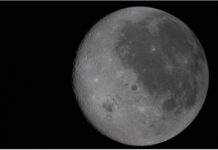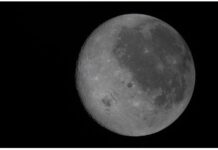
The Artemis II mission has reached a historic milestone, providing humanity with its first close-up, human-eye perspective of the Moon’s far side. During a lunar flyby on April 6, astronauts captured high-detail imagery of landscapes that have remained largely obscured from human sight for millennia.
Exploring the Hidden Hemisphere
Because the Moon is tidally locked—meaning it rotates on its axis at the same rate it orbits Earth—one side always faces us, while the other remains hidden. The Artemis II crew utilized this flyby to observe regions that have never been witnessed by human eyes in such detail.
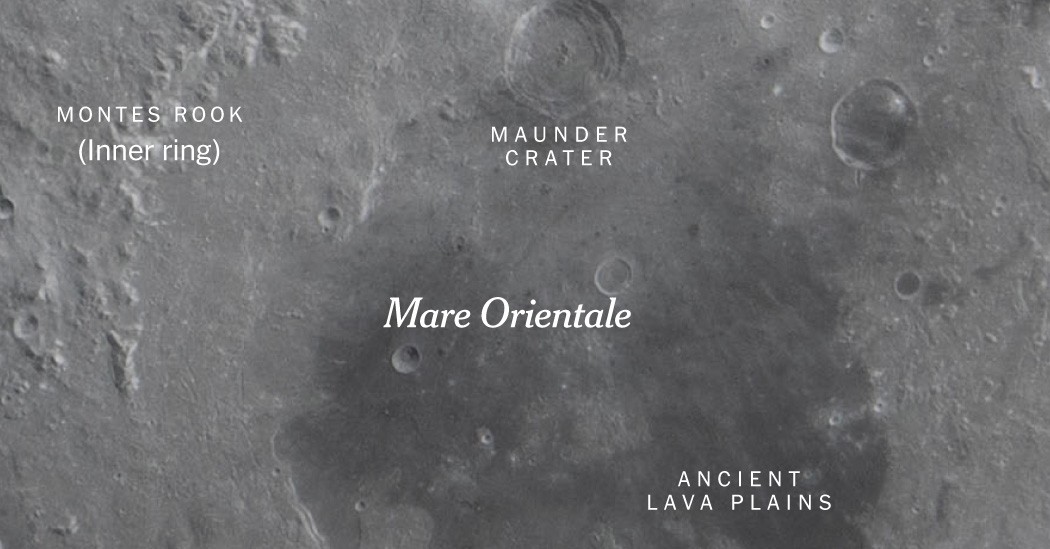
One of the most significant sightings was a complete view of Mare Orientale. This massive, ringed impact basin spans approximately 600 miles and straddles both the near and far sides of the Moon. While previous Apollo missions visited the Moon, they were strategically timed so that landings occurred while this crater was shrouded in darkness. The Artemis II astronauts, however, were able to observe the entire basin, noting a distinct shift in color—shades of brown concentrated near the center of its concentric rings.
Mapping Geological Wonders
The mission’s observations provided a detailed look at the Moon’s diverse and rugged topography:
- Crater Dynamics: The crew observed the Vavilov crater, located on the rim of the much older Hertzsprung crater. Through their camera lenses, they were able to distinguish subtle color variations and textures that were invisible to the naked eye, noting smooth plains within the inner rings contrasted against highly rugged rim terrain.
- The Solar System’s Largest Impact: Approximately 24 minutes into the flyby, the crew turned their attention to the South Pole-Aitken basin. Spanning roughly 1,600 miles, this is the largest known impact crater in our solar system. By observing the “terminator line”—the boundary between the sunlit and dark sides—scientists hope to extract vital clues regarding the Moon’s ancient geological evolution.
Celestial Phenomena and the “Earthrise”
The mission also provided a rare opportunity to observe astronomical events from a lunar vantage point. Following the flyby, the crew experienced a 53-minute solar eclipse. During this period, they were able to view the sun’s corona—which they described as looking like “baby hair”—as well as glimpses of Venus, Mars, and Saturn.
The journey concluded with a profound visual moment: Earthrise. As the Moon swung back into view, the Earth appeared to rise over the lunar horizon, echoing the iconic imagery captured by Apollo astronauts in 1968.
These observations do more than just provide beautiful imagery; they offer a raw, visual data set that will help scientists bridge the gap between satellite data and human geological observation.
Conclusion
By capturing these unique vistas, the Artemis II crew has provided a vital link in our understanding of lunar geology. These images serve as a foundation for future missions aimed at decoding the history of the Moon and our solar system.