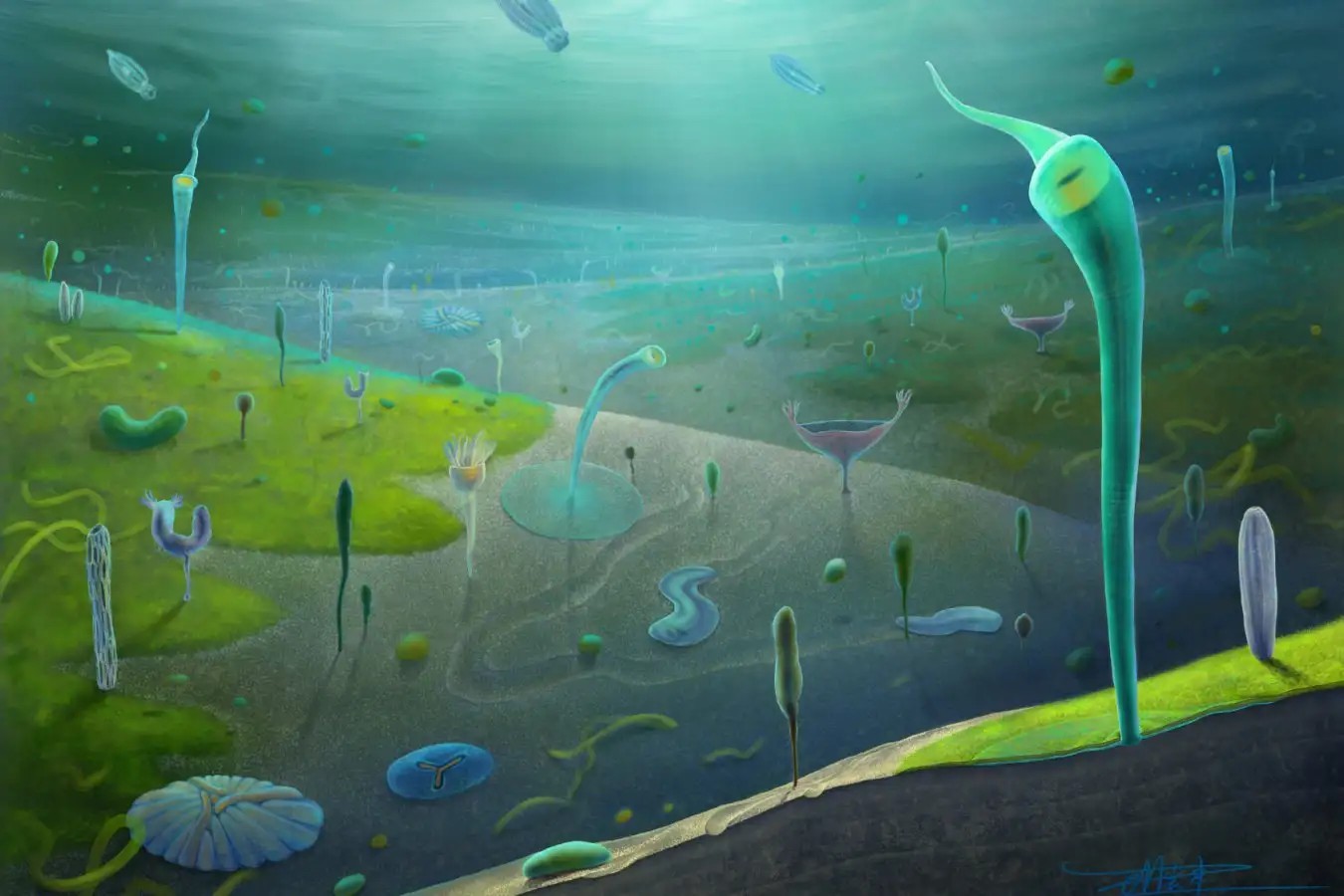
Recent discoveries in China are reshaping our understanding of when complex animal life first emerged, suggesting that the famed “Cambrian explosion” may not have been as sudden as previously thought. A remarkably preserved fossil site, the Jiangchuan biota in Yunnan province, contains over 700 specimens dating back 554 to 537 million years, predating the peak of the Cambrian explosion (541 to 513 million years ago).
The Ediacaran Period Reconsidered
For decades, the Ediacaran period—the time before the Cambrian—was viewed as an era of simple, largely soft-bodied organisms. The new fossils challenge this view, revealing surprisingly advanced animal communities. According to Gaorong Li of Yunnan University, the lead researcher, these fossils demonstrate that the foundations for the Cambrian explosion were already in place by the end of the Ediacaran, with transitional forms present alongside more complex creatures.
What Was Found?
The Jiangchuan biota includes a diverse array of bilaterians—animals with bilateral symmetry—some of which were previously unknown from the Ediacaran. These include two new species of deuterostomes, a major group that includes vertebrates, indicating early diversification within this lineage. Other discoveries include cambroernids, coiled organisms with filamentous tentacles, and creatures resembling Margaretia, a tube-like organism that Li describes as “an animal living inside a ventilation pipe.”
One particularly intriguing fossil resembles the sandworm from Dune, suggesting an animal that anchored itself to the seafloor and extended a tubular appendage to feed. Researchers also found evidence of worm-like creatures with the ability to move, indicating early adaptations for locomotion. These organisms possess key features of modern animals—mouths, guts, and pharynxes—but in unique combinations that don’t quite match any living species.
The Cambrian Explosion: Slow Burn or Sudden Burst?
The discovery raises questions about the nature of the Cambrian explosion itself. Ross Anderson of the University of Oxford suggests the event might have been a more gradual process than a sudden burst of evolution. While the fossils don’t invalidate the idea of an explosion, they narrow the timeframe for its onset, suggesting animal body plans likely diverged over a 30-million-year span at the Ediacaran-Cambrian boundary.
Why This Matters
The debate over the Cambrian explosion has persisted for centuries. The abrupt appearance of modern animal body plans in the Cambrian fossil record has been a long-standing puzzle. These new fossils provide the strongest evidence yet that ancestral forms were indeed present in the preceding Ediacaran period, filling in a critical gap in the evolutionary timeline.
“The preservation of the specimens is a bit coarse, so we’re missing some fine details, but there are some distinctly animal-looking forms among them,” says Joe Moysiuk of the Manitoba Museum.
Further research will be crucial to definitively classify these fossils, but if confirmed as animals, they could fundamentally alter our understanding of early animal evolution. The discovery underscores that evolution is rarely a clean break, and the foundations for even the most dramatic changes are often laid long before they become apparent.