Astronomers have identified the largest protoplanetary disk ever observed, orbiting the young star IRAS 23077+6707, located approximately 1,000 light-years from Earth. This discovery isn’t just about size; the disk is unusually turbulent and extends far beyond what’s typically seen in planet-forming systems.
What are Protoplanetary Disks?
Protoplanetary disks are the birthplaces of planets. These swirling structures of dust and gas surround young stars, providing the raw materials for planetary formation. Over time, gas falls into the star, while the remaining material clumps together to form planets. The sheer size and chaotic nature of the disk around IRAS 23077+6707 challenge existing models of planet formation.
Scale and Structure of the Disk
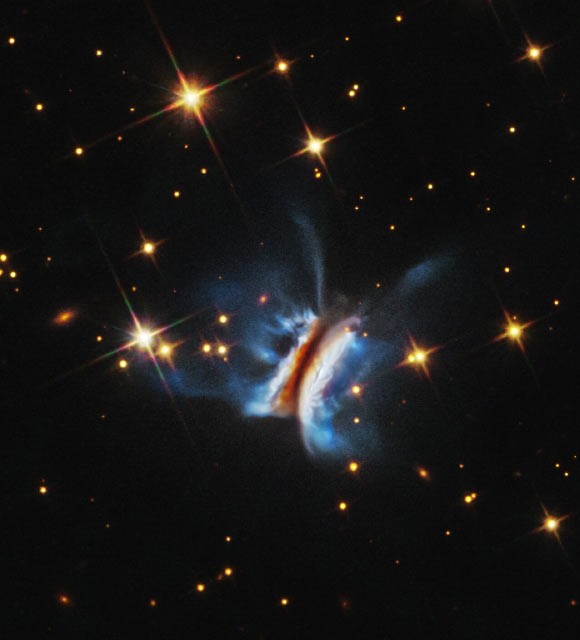
The disk spans an astonishing 644 billion kilometers (400 billion miles), roughly 40 times the diameter of our Solar System. Its vast size suggests the potential for forming multiple gas giants. The structure is also striking: the disk appears edge-on, resembling a hamburger with glowing top and bottom layers of dust and gas.
However, the disk isn’t symmetrical. One side features prominent, filament-like structures, while the other side has a sharp, clean edge. This asymmetry indicates that dynamic processes—such as recent infalls of material or interactions with its surroundings—are actively shaping the disk.
Why This Discovery Matters
This disk is unique because it provides an unprecedented level of detail for studying planet formation. The high-resolution images from the Hubble and James Webb Space Telescopes reveal a level of activity and chaos in planet nurseries that scientists hadn’t previously expected. The star at the center is either a massive, hot star or a binary system, further complicating the environment.
The disk’s mass is estimated to be 10 to 30 times that of Jupiter, providing ample material for forming multiple gas giants. This makes it an exceptional case for studying planetary system formation in extreme conditions.
“We were stunned to see how asymmetric this disk is,” said Dr. Joshua Bennett Lovell, an astronomer at the Harvard & Smithsonian’s Center for Astrophysics. “Hubble has given us a front-row seat to the chaotic processes that are shaping disks as they build new planets.”
The discovery raises critical questions about how planets form in such massive environments. While the underlying processes might be similar to those in our own Solar System, the scale and turbulence of IRAS 23077+6707 could lead to vastly different outcomes.
Ultimately, this discovery doesn’t provide answers but opens new avenues for research. The findings will be published in The Astrophysical Journal, and will undoubtedly spur further investigation into the complex dynamics of planet formation.
This system represents a rare opportunity to observe planetary birth in real-time, promising valuable insights into the diverse environments where planets arise.